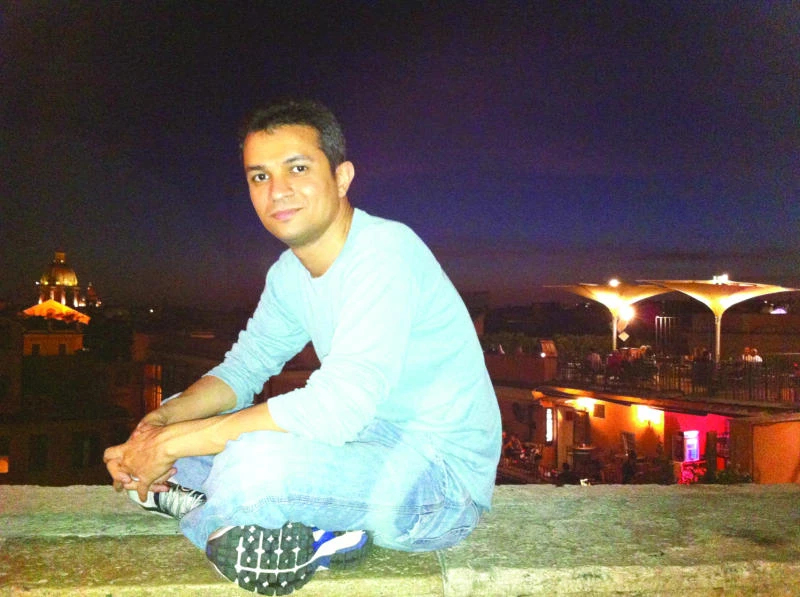
Mohammed Hasan Alwan is a 33-year-old writer from Riyadh whose latest book “The Beaver” was shortlisted for the International Prize in Arabic Fiction (IPAF) among 133 novel entries from 15 countries.
The Beaver is a story about a man who travels back in time through three generations of his troubled family: separated parents and brothers with nothing to connect them except the house they live in. The leading character heads to a distant city to try and restore his memory of fragmented stories with the help of a beaver that accompanies him on his fishing journeys in Portland, USA. The novel also contemplates the relationship with his lover who visits him over many years in different towns when she can get away from her husband.
The young novelist has written four novels and many short stories. He holds a day job as a director at an investment company in Riyadh. He previously contributed as an opinion writer at Al-Watan newspaper for five years before he decided to quit and develop his writing career further as a storyteller.
He was also chosen in 2010 by the Beirut39 project as one of the “Best Arab Authors under the age of 40”.
When did you decide to become a writer?
Mohammed Hasan Alw “I honestly don’t remember the moment when this decision was made. It emerged gradually from my genuine interest in writing since I was 14. I wrote some poems and managed to get some of them published in local magazines and newspapers. It wasn’t until I turned 21 that I decided to write my first novel Saqf Al-Kefaya (The Limit of Sustenance) and got it published two years later. My family supported my writing aspirations as a child, yet this support has slightly diminished, as my voice took a different path from the beliefs my family holds dear. However, my wife, who is also a writer, is very supportive and constructively critical of my writing.”
Was it easy to become an author while juggling a completely different day job?
“Becoming a writer was an easy and spontaneous decision, yet continuing to be one isn’t. At the beginning, writing emerged as an enjoyable exercise. Eventually, it became more demanding as I started to desire more of its rewards. If writing is not the sole profession of a writer, they’ll often allocate more time and effort to it within an increasingly busy schedule. When that happens, the decision to continue writing becomes difficult to make.”
What can you tell about the themes in your previous novels?
My first novel Saqf Alkefaya is a desperate love story that is set in Riyadh, where love is typically frowned upon. Sophia, my second novel, is about a relationship between two lovers from different religious backgrounds. It tackles the philosophies of love and death from both perspectives. My third novel, The Collar of Purity, describes the psychological damage of a sexually harassed child.”
Beirut39 chose you as one of the best Arab authors under 40. How do you feel about such an important recognition?
“I appreciate it. Young writers in the Arab world definitely have a more distinct voice than the previous generation. Therefore, they should be considered as a group with similar aspirations from different backgrounds.”
Your controversial short story Statistics tackled a very unusual theme: predicting the death of family members. Did you not feel any reservations about such a subject?
“It’s a story about a person who is obsessed with statistics to the extent that he starts to statistically analyze when his family members will die. He tries to calculate, based on the expected inheritance, whether he should start a career or not. I know it is shocking to imagine such a behavior. However, the behaviors that we reject the most somehow exist in the deepest corners of our subconscious.”
A couple of your short stories have been translated into English. How do you feel about these translations?
“Getting lost in translation is very common, and it is something I face on a daily basis as a reader of translated works. Last year, I participated in an Arabic-English translation program in the UK. It proved to be a very beneficial experience for my translator and me to learn how words are perceived, and see how translators learn to express authors’ ideas through words.”
Your new book The Beaver has been shortlisted for the IPAF. How do you feel about this nomination?
“I am very happy to be shortlisted. The long-list had many big names, which made the mission of the jury committee really complicated. It seems they opted for younger writers.
“I always think of literature as a universal undertaking that goes beyond nationalities and political geography. Saudi Arabia is indeed in the sociological stage to produce many novels that reflect the rapid changes that it is going through.”
Has The Beaver been translated into English already?
“I have received an offer for translation, but the negotiation is not finalized yet.”
What do you think needs to change about the publishing industry in Saudi Arabia?
“Writing in Saudi Arabia is still largely something we do on the side of a full-time profession. This is because the industry is not well established. I think we need more publishing houses with a long-term strategy to create incentives for writers to invest more time and effort into writing, and lure readers into buying and reading more books.”
Do you think censorship in writing is an overrated phenomenon?
“It certainly exists and is annoying. However, it has a different effect on each writer, depending on his or her selected topics, views, and styles. Therefore, we can’t rate it in a generalized way. Some will find it overrated and others won’t.”
What are the things you get most inspired by?
“The unnoticed daily human struggle intrigues me more than rare events and uncommon stories.”
How do you tackle writer’s block?
“I don’t tackle it. I just surrender until it fades away by itself. That explains the two to three-year gap between my novels.”
What do you think are the qualities an aspiring writer must possess?
“Many would answer this question with a list of qualities such as creativity, imagination, and style. I don’t think there is a specific and necessary list of qualities. What matters is that he or she should combine any of those qualities to produce something interesting to read.”
What difficulties do you face when starting a new book?
“The most difficult part is at the beginnings when I’m not familiar with my protagonists yet, and thus I don’t have a clear idea about how they should act. It is not until a few months pass that they start speaking to me and tell me exactly what they feel and want to do.”
What are some of the obstacles you face as a young writer in Saudi Arabia?
“Being thrown against my will into the midst of ideological battles by putting words into my mouth or misinterpreting my novels.”
Who are your favorite writers?
“Gabriel García Márquez, Amin Malouf, Naguib Mahfouz, and many others.”
Any words of inspiration for young writers who want to make it big in the writing world?
“Writing is not an exclusive club. Once you write something enjoyable for your selected audience, you are there.”
For more information on Mohammed Hasan Alwan, visit www.alalwan.com, or follow him on Twitter @m_alwan.