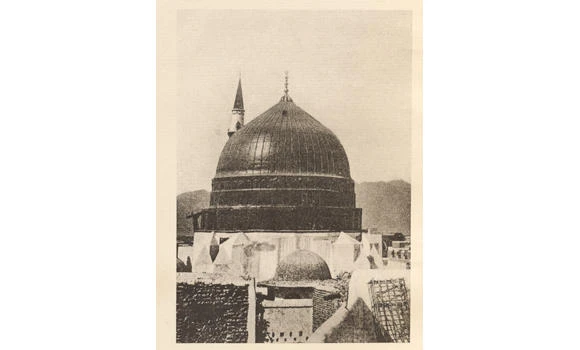
Over the years, William Facey has published some wonderful books which focus on the history and architecture of the Arabian Peninsula. The recent republication of ‘The Holy Cities of Arabia’ stems from his vested interest in Western travelogues to Makkah and Madinah.
Despite its good reviews, this travel book published in 1928 did not bring to its author the success he rightfully deserved. Its disappointing sales barely justified a reprint in a cheaper format. Hailed as “a piece of true literature” in the Nation, the Daily Mail, places “The Holy Cities of Arabia” alongside Doughty, Palgrave or Burton, the authors of some of the greatest narratives on Arabia. Even St. J. B. Philby who considered Rutter as a competitor wrote that “his description of the Haram and the Kaaba; the buildings, streets and eminences of Makkah, its daily life, its men, women, children…; its manners, customs, laws and ritual …is unreservedly admirable”.
The timing of Rutter’s pilgrimage is particularly interesting because it happened in 1925, the year Ibn Saud put an end to the Ottoman reign in the Hijaz. Eldon Rutter was evidently eager to meeting Ibn Saud. He managed to talk to him on several occasions. The first meeting took place in the office of the government in Makkah.
“As we entered the room, the Sultan, who was sitting on a large divan with his back to the window, rose and extended his hand. At the same moment the Syrian told him who I was ‘Sallah ed-Din El Inkilizizz’.
“Abdul Aziz motioned me to a seat beside him on the divan, and all resumed their seats. There were merely some four or five of his employees in the room. This was in the days before the fall of Jidda. After that event the word had only to go round that the Sultan was sitting in the Hamidiya, for half the leaders and place-hunters of Mekkan society to crowd into the government building in order to make their speeches…
“I subsequently visited Ibn Saud several times at his palace in the Abtah. On one of these occasions, he told me that his concerns were three; ‘Firstly, Allah; secondly Muhammad; thirdly the Arab Nation.’”
One cannot fail to appreciate the author’s admirable descriptions of Makkah and Madinah, but this feeling is often marred by a feeling of suspicion. Was his conversion to Islam sincere? Or was he a total fake? Indeed, some passages in the book remind us that he tried his utmost to hide the true nature of his beliefs.
Towards the end of his sojourn in Makkah, Eldon Rutter fell seriously ill. He was seized by a delirious fever. “I was obsessed, however, by the idea or delusion that in speech lay imminent danger…At one moment I felt myself to be in full possession of my faculties, and I schemed with myself and mentally said ‘I must be cunning, and must speak little’ for in my obsession I feared to say things which might incriminate me…”
It is at times difficult to believe that it is the same person who wrote a few lines below:
“Yet there was a key which would unlock the hearts of my companions and bring them to my side not with womanish pity but with the sympathy of man to man in a supreme common aim…I felt with peculiar certainty in that moment that, ultimately, in the world of men, a man must stand or fall alone. How long I lay pondering these matters I do not know, but I remember being clearly conscious at last that I could expect no succor from man.”
At this point, Rutter recited “Ayat el Kursi” or “The Throne Verse”. This created a moment during which his companions’ faces showed an “expression of eager delight” and several days later he recovered his health.
Indeed, one of the unresolved mysteries remain the elusiveness of its author. However, Sharon Sharpe’s thorough research has enabled to trace Rutter’s birth in 1894 in London, his early life, service in the First World War, and career as a young man in Malaya where he converted to Islam.
After the end of the First World War, Rutter lived in the Malay states. His sojourn among a settled Arab community from Hadhramaut in Southern Arabia helped him master the Arabic language. During his stay, he also became attracted to Islam and converted. He left Penang in 1924 to pursue his Islamic studies in Egypt where he completely immersed himself in the Arab society. When he left Egypt to make the pilgrimage to Makkah, he was so well prepared that he was easily able to pass himself off as a Syrian merchant.
In their excellent introduction, William Facey and Sharon Sharpe have included a fragment of an extraordinary letter Rutter had written to his wife while he was living in Egypt. The breathtaking beauty of the scene is described in a flurry of feelings, sounds and thoughts that transcend reason: “When I lived in Egypt I sat on the sand under the white Mokattam hills, with the gleaming moonlight pouring down like cascaded silver from crag to crag. In the moistureless upper air the stars seemed to come low and make glittering signs to the earth in the deep silence, a silence so rich and vast that it joined like a living thing in the communion of all things there…
In this ancient communion the supernatural became natural; and there I knew that, no matter in what way men might try to express their conviction of the knowledge, it was real, the knowledge that God is.
And why did that scene, among many others, impart or confirm to me in a manner so effortless, this understanding? I do not know why. But when I have tried to analyze the impressions which I experienced, I have found that they were always the same. And from these constant impressions I am led to deduce that the conviction that God exists.”
It is difficult to believe that Rutter was a total fake and blatantly insincere. The account of his journey to the holy cities of Arabia ends in a scathingly brief fashion. He shaves off his beard, puts on a suit and eats with a knife and fork. Does this physical transformation echo his religious feelings?
He disappears inexplicably after writing his last known letter to his daughter Philippa on Sept. 17, 1956. It is interesting to know that in 1951 he asked her to send him his Arabic Qur’an in Istanbul. The conspicuous lack of information concerning his whereabouts is not an end in itself. The road to the truth goes through endless speculations but the mystery remains unsolved to this day.
One can only praise William Facey’s ambitious desire to republish this least known classic of Arabian travel. Much of the praise written for the first edition in 1928 ring true today and that is largely due to the author’s brilliant writing. The ‘Holy Cities of Arabia’ brings to life a past era thanks to the author’s lively dialogues and vivid descriptions. It deserves to be rediscovered for it truly lies among the great books on Arabia.
— [email protected]
An account of a mysterious Englishman’s pilgrimage to Makkah