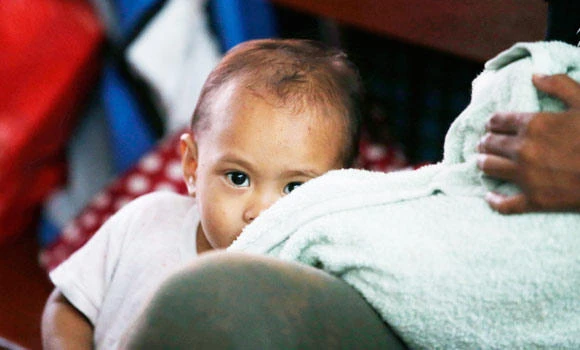
Hungry children as young as six are begging for food by the side of the road in the typhoon-lashed Philippines, victims of a disaster that could echo through their lives for years.
“We ran out of rice,” says nine-year-old Shamsher Hussein. “It was swept away by the water.”
Shamsher and other youngsters from remote villages around Salcedo have scruffy hand-made signs pleading with someone — anyone — to give them something to eat.
Children such as Shamsher and six-year-old John Mark Balbada can be found all over the area devastated by Typhoon Haiyan, whose 315 kilometer per hour winds wreaked devastation across a swathe of an already poor part of the country.
While the government says food aid is now getting through to all communities, there are still many children going hungry.
The United Nations estimates that five million people under the age of 18 were affected by one of the most powerful storms ever recorded on land. Around 1.7 million were made homeless.
At the extreme end of the scale, they face horrendous risks, says Sarah Norton-Staal, UNICEF Philippines child protection chief, particularly those from the hard-hit agricultural areas where many would have been employed to work in now-useless fields.
“When those livelihoods are destroyed, we have a situation of desperation,” she told reporters in Manila. “This area is already known as a high-risk area for child trafficking, and now you have a population that is desperate, vulnerable, displaced and has nothing.
“In crisis situations like this, children get separated from their parents, and when they get separated they become that much more vulnerable,” Norton-Staal said.
Similar large-scale natural disasters in the past have resulted in a 10 percent rise in the instances of child trafficking, she said.
“We need to make them aware of predators, to be aware of those criminal elements.”
Even in more urban areas, the storm has deprived youngsters of some of the basic needs of childhood — education and places to play. The UN estimates 90 percent of daycare facilities and schools were destroyed.
“Where do the children go?” asks Norton-Staal. “There’s nowhere to go.”
In Tacloban, a city badly damaged by the typhoon and the huge storm surge it brought, school chiefs are despairing about how they can get the system back on its feet.
Antonia Rosanes, the city’s education program supervisor, says all 50 elementary schools and 12 government-run high schools in Tacloban were damaged or destroyed.
Many of those still standing are being used as evacuation centers for the tens of thousands of people made homeless in Tacloban.
“I feel like crying with sadness,” she told AFP in her office on the second floor of a building littered with debris and filled with water.
Fifteen terminals that she used to teach basic computer skills to out-of-school youths have been destroyed, as have desks, chairs, books and school records. “I don’t know when we will ever get on our feet.”
Childhood a victim of Philippines typhoon