Every now and then, a picture catches the attention of viewers on a global scale, often stirring controversy or showing a glimpse of a certain horror or something purely magnificent. These are the pictures that stick to the mindset for a long time eventually becoming the photographer’s legacy. The world is a bit more closer knit now with the help of numerous social media platforms popping up every now and then. It’s important to notice great work when it floats by, more often than not, their work is recognized and circles these numerous social media platforms as well as catching the eye of many recognized global newspaper publishings. Dougie Wallace, an internationally recognized photographer best known for his social documentary projects also known as “Glasweegee,” a native of Glasgow, Scotland, is a witty, adventurous and inquisitive photographer out to discover the nature of human behavior.
It all started about 15 years ago with a camera, an interested individual itching to discover what makes the people around him tick and the power or imagination to capture an image best suited to his emerging style at the time. Dougie’s projects have been featured in the New York Times, The Sunday Times, Germany’s Stern Magazine and many more publications on a global scale. What makes this photographer’s work so interesting? The way he captures human stories as they walk by, their expressions, their emotions, their stance, the reactions toward surrounding environments and so on are just some of the features that make his work special. Not only were his projects featured in magazines and social media platforms, he has also published a number of books and exhibited works in the UK, Poland and Saudi Arabia as of recent.
His most recent work was just published this past February, “Road Wallah” is the name, it features the disappearance of one of Mumbai’s oldest taxis, the Padmini taxis. First introduced in the 1960’s, these iconic black and yellow cabs flock the streets of Mumbai and each one holds a story of its own. “I call these cabs Bollywood cabs on wheels,” exclaimed Dougie, “they’re vibrant with music, colors and scents and the people both riders and drivers are unique in their own way too. It’s insane in there!“
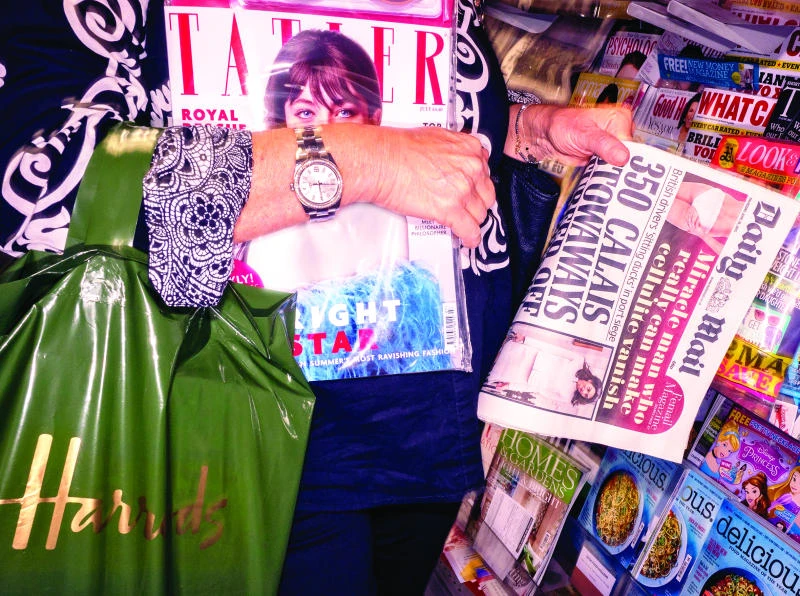
I first met Dougie as his work was being featured in Jeddah’s “The Empty Quarter Gallery” owned by Princess Reem Al-Faisal. Often named the street photographer, his successful series “Harrodsburg” aptly named for exploring the world of the one percent super rich flocking the residential and retail districts of Knightsbridge and Chelsea opened at the gallery on March 20 and will continue for one month. It was a pleasure to have been invited to the private opening, where I was able to steal a few minutes to chat with Dougie. Before arriving, I remembered reading a newspaper article a few months ago regarding some his published photos of this specific series. The article stirred some heavy controversy in the Gulf area claiming that the photographer depicted some of the photographs’ subjects as spoiled with an affluent upbringing moving on from one luxury store to the other while others flaunt loud expensive Ferraris, Rolls Royces and Aston Martins. So naturally I was a tad bit intimidated but inquisitive at the same time.
At a first glance, the photographs were candid, close up and very detailed. I was able to catch a glimpse of what the photographer really tried to translate, and it was the total opposite of what this so called “controversy” claimed. I had the fortune to catch Dougie just as the last of the visitors left and had a one on one conversation with this very interesting photographer.
AN: Your work has been featured worldwide, your method is quite different from some other photographers. What makes your style so different and unique?
DW: I pretty much walk around in search for something that catches my eye so unique that requires my attention. For my “Harrodsburg” project, I held my camera with two flashes; this way I got to capture the essence of what my subject is about, I would get really close to the subject, take a picture and leave. The super rich who roam the streets of Knightsbridge and Chelsea are unique in their own way, the way they dress, their accessories and even the shopping bags from the numerous high-end shops of the area tell of what makes them what they are. It’s a bit difficult to explain but it gives a hint of their character.
AN: You mentioned “Harrodsburg,” there was a bit of controversy regarding your documentary series. Why do you think there were such negative views to it?
DW: I truly don’t understand it myself, I see beauty and aristocracy in the females of a photo and I see the men ride their expensive cars indulging in its beauty. Maybe the method is a bit over the top, yes they’re detailed, yes they’re uncomfortably intimate but it’s a style that I see suitable for the end result I want in my photographs.
AN: What feeds your motivation?
DW: Pushing boundaries as a way to explore human behavior.
AN: Speaking of exploration, it took you a long time to create and organize “Road Wallah” and clearly you enjoyed shooting in India for this. The pictures are vivid, colorful and loud with your known style for documenting details of the intended target. How’d it all come to be?
DW: The taxis of Mumbai and the interiors are all that it took for me to be hooked. They’re legendary! The black and yellow taxis are moving mini Bollywood discos and a law that took place recently in Mumbai ordered the removal of these iconic taxis from the streets as to decrease pollution. I had a blast taking such close up pictures of the passengers and interiors; with such crowded streets, a taxi stalling as well as the semi vertical front glass made it easier to catch frontal shots of the drivers.
AN: The pictures show more than just drivers and their dashboards.
DW: Oh no, they show more than that. You get to see a family’s tortured reactions as they’re crammed inside the taxis, old women airing themselves with paper fans because of the thick air inside these hot and humid cars, insanely psychedelic patterns of the upholstery of the cars, tassels on the steering wheels and so much more. They’re loud and vibrant on the inside blending perfectly with the busy junctions and traffic lights. The Premiere Padmini spoke their own stories, some of the drivers spend almost all their time in them, sometimes even sleeping in them. These taxis are their pride and joy and it took me 4 years to capture it.
AN: Was it worth the risk? The way you throw yourself into a project?
DW: Of course! I get a thrill seeing the results of my photographs. They’re intimate, they’re surprising and frozen in time.
The artist that is Dougi Wallace is quirky, funny with a thick Scottish accent that I found fascinating. Even while speaking, he kept his eyes open to the way the visitors reacted to his photographs. You can view his work and keep up with the latest of productions at the photographer’s website www.dougiewallace.com as well as on his social media profiles on Instagram, Twitter and Facebook. Don’t miss out on his exhibit at “The Empty Quarter” Gallery in Jeddah telling the story of “Harrodsburg,” it’s all in the details.
— [email protected]
Dougie Wallace — the witty photographer