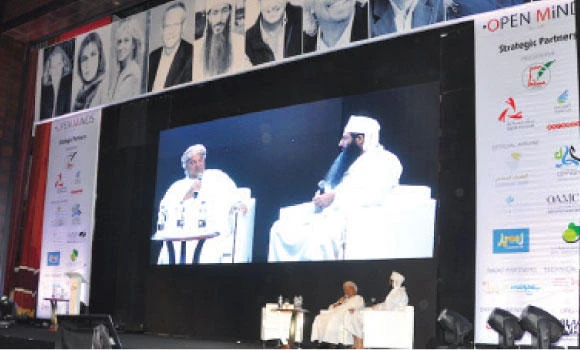
For two days last week, Oman was buzzing with activity when some of the most famous global icons shared their success stories with eager young entrepreneurs in the capital Muscat.
Organized by Black and White magazine, the “Open Minds” forum included award-winning British author Jeffrey Archer, British music sensation Sami Yusuf, Oman’s top businessman Sheikh Mohammed Al-Barwani, Australian speed painter Brad Blaze, the human beat box from Australia Tom Thum, the first amputee to climb Mount Everest Tom Whittaker, Omani scholar and success coach Sheikh Khalfan Al-Esry, and Tony Wheeler, the man behind the incredible success of “The Lonely Planet” series.
Sheikh Khalfan, a mechanical engineering graduate from Napier University in Scotland, and a recognized speaker, coach and facilitator on personal leadership and human development for more than 20 years, outlined the critical factors that can help people become successful.
Sheikh Khalfan said those seeking to go out on their own should ask themselves a few simple questions: If I were to leave my job today, will I be able to survive without my end-of-service benefits? Can I earn money from the skills I have acquired? If I’m afraid of failure, will I be able to get the same job back after one year?
If the answer is “yes” to all the questions, then people should take the plunge. “Those who have achieved their dreams didn’t do it sitting in a comfort zone. They challenged the status quo,” he said. His advice was for young people to follow the “Four Ds,” which are desire, decision, discipline and determination. “Some people are driven by pleasure; others by fear. People who have big dreams turn fear into pleasure,” he said.
Al-Barwani, who is among the richest Arabs with a net worth of $1.2 billion, said that he believes in following his instincts. “Gut feeling is far more important than all the spreadsheets in the world,” he said. “When your gut feeling tells you that something is wrong, believe that. Don’t let someone try to convince you otherwise.”
Al-Barwani narrated how his friends discouraged him when he gave up his lucrative 10-year job as a petroleum engineer at Petroleum Development Oman (PDO). He acknowledged that as a student he was scared of failure. “I had many sleepless nights, but it was hard work that helped me get over my fears,” he said.
Whittaker, the mountaineer with an artificial leg, outlined how an iron will can help people become successful. “Failure is not an option for me,” he said. He urged invitees never to give up on their dreams. He now wants to become the first amputee to conquer the highest peak on each of the seven continents with his next destination being Antarctica.
“When I climbed the mountain in 1998, the chances of perishing were one in six,” he said. It was “persistence and passion” that helped him achieve his goal. Whittaker spoke about his “personality disorder,” which is “if someone says I can’t do something, I do it.”
He said challenges are part of life. “The great thing about disappointment is that you learn from it and find a new way to make your dream happen.” He warned that “people who have abandoned their dreams will stand in the way of you achieving yours.”
Wheeler, the travel writer, literally took every unexplored road to success. Since his first big adventure in 1972, when he and his wife traveled overland from the UK to Southeast Asia and then down to Australia, Lonely Planet’s founder has had a thirst for travel.
Although he and his wife sold Lonely Planet in 2011, Wheeler has continued writing for the company. In addition, in 2013 he wrote a book called “Bad Lands” which took him to conflict-ridden countries, including Palestine, Zimbabwe and Pakistan.
Wheeler and his wife are doing their part to improve the lives of others. Lonely Planet is the only guidebook publisher to have books about every African country, and this was part of the inspiration for their charity organization, Planet Wheeler, which provides funds for health and education in many developing countries.
Since Jeffery Archer wrote his first book, “Not a Penny More, Not a Penny Less,” 40 years ago, he has gone on to sell more than 270 million books in 97 countries. It wasn’t an easy start. Now 74, Archer admitted that he was also a big dreamer. As a child he wanted to be the captain of the English cricket team and the prime minister of Britain. He knew he wanted to be successful and have a lot of money.
“At a young age I already wanted to be an entrepreneur, but I had to discover what was realistic to achieve,” he explained. Archer said it is important for writers to practice their skills. He writes every single day, and when he is working on a book, it is for eight hours a day.
“I’ve never needed a penny since ‘Kane and Abel,’ my third book. I didn’t need to work again. But I’m a very ambitious man and I wanted to get better and better. I will be writing in my grave,” he said.
“I’ve been inspired by the enthusiasm around the world. That’s what drives me. The storytelling is sheer, God-given luck,” he added. “I am not a writer, I’m a storyteller,” Archer said. “Scott Fitzgerald, Charles Dickens, Jane Austen ... are my favorites. Not because they are great writers, which they are, but because they are great storytellers,” he said.
His advice to writers is to “keep writing, every single day.”
Sami Yusuf, the 34-year-old British singer, described how he became one of the most popular voices of spiritual music, selling more than 30 million albums, by staying true to himself.
“As a child of immigrants, one does go through humiliation, challenges, bullying and negativity in general. There are almost 1,000 reasons for one to hide away and wither away and give up, but I didn’t do that,” Yusuf said. Instead, he found a way to bring about positive change in the world around him without losing his own identity.
Speed painter Brad Blaze brought his unique art to the stage. With the theme music from “The Simpsons” playing, Blaze put a black canvas on the easel and started painting. At first it looked like Bart Simpson, but soon, with a series of rapid strokes, Blaze morphed the image into a portrait of Albert Einstein.
“I’ve been drawing ever since I was a child,” he explained. As a child at school Blaze would study comic books to learn drawing techniques when he was supposed to be reading, and years later, while working in finance and insurance, he would spend his daily commute on the train drawing. He realized he missed art and decided to dedicate his time to painting.
“They say it takes 10,000 hours to master a skill. I would say I have spent more than 10,000,” he said. Now he makes his living painting speedy portraits in less than four minutes. He has painted politicians, sports stars including Tiger Woods, and actors.
Tom Thum didn’t only turn up to speak, but gave the audience a wonderful performance of the skills that has seen him described as the human beat box. He whistled, crackled, trumpeted, drummed, clucked, popped, clicked, blew horns, and made hundreds of other sounds all with his voice and a microphone. “As you can probably tell by that raucous display of noise, I am a beat boxer,” he said.
The Australian musician has made a career out of entertaining people with his unusual ability. It was hard to imagine how he made so many distinct sounds all at the same time, but Thum said his brain is different.
He admitted he was a very hyperactive child, but creative and expressive, and he would spend a lot of time drawing. “I would always add the sounds of what I was drawing. I would create these crazy soundscapes just using my mind and my voice,” he explained.
As Thum got older, he learned about the technical side of music, using technology to loop and layer sounds, so he could record his sounds together. “I started to become really interested in how the human voice could be used not just as a party quirk ... but as a composition instrument,” he said.
Now people are paying to hear him and he can make a living from it. He has been all over the world entertaining people, and wherever he goes, he takes sound souvenirs from his travels instead of physical ones.
Veteran journalist and editor Bikram Vohra and well-known quizmaster Giri Balasubramaniam moderated the events with panache and elan.
The Open Minds forum was a massive hit. It has put Oman on a new pedestal in the region and across the globe. “The message that has gone out from here is that we in Oman are ready for the next level in our intellectual growth,” said Sheikh Khalfan. “This forum has opened the minds of our youngsters.”
—
Email: [email protected]
Global Icons inspire youth