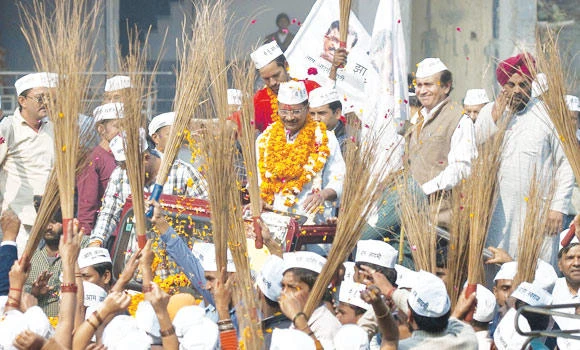
Arriving in a small and scruffy blue car, India’s newest political star springs from the front seat, shirt untucked, and walks toward his supporters with the air of a low-key civil servant.
Which is just what Arvind Kejriwal was — until 2001, when he left his job as a tax official, disgusted by his colleagues, to embark on a career as an anti-corruption campaigner that would lead to national fame.
The bookish father-of-two turns up with no trailing security — a status symbol in the capital — and begins shaking hands at his first campaign stop in a dusty village on the far edge of the capital.
On Dec. 4, the city of 16 million will elect a new state assembly, with Kejriwal’s Aam Aadmi (Common Man) Party threatening a political earthquake only a year after it was formed.
For the next five hours, he stands in an open-topped jeep as it winds from the rural hinterland, through streets of open workshops, slums of sick and unschooled children, and culminates near Delhi University.
Along the way, he’s garlanded with marigolds and gives brief fiery speeches at scheduled stops.
“If all the youngsters get together, they can change the face of the country!” he says to cheers from a group of students, who are told that 50 percent of the Aam Aadmi Party’s (AAP) candidates are under 30.
On the move, supporters dance to music calling politicians “blood-sucking devils” and “thieves.” Many distribute the symbols of the party — the broom and the Gandhi cap.
The broom symbolizes a clean sweep of India’s rotten politics; the white Gandhi cap connects Kejriwal to the father of the nation and an era “when we had a politics of honesty and a politics of public service,” he told AFP.
As the winter sunshine starts to fade, he dismounts from the jeep and squeezes back into the same blue car to talk about his “revolution.”
After leaving government service he campaigned to bring in India’s Right to Information Act in 2005, which earned him “Asia’s Nobel,” the Ramon Magsaysay Award.
A few years later, he teamed up with a former army driver called Anna Hazare who launched repeated hunger strikes in 2010 demanding a new anti-corruption law.
Together they channelled anger about everyday corruption as well as graft scandals that have embroiled the national government.
Though their demands went unheeded and relations between the duo ultimately soured, their campaign panicked the government and propelled Kejriwal onto the national stage.
“We were forced into politics because there was an anti-corruption movement in the country and the government promised a strong anti-corruption law, but it went back on its word,” he explains.
Support for his party fluctuates wildly, according to pollsters, from an impressive six to eight seats in the 70-member New Delhi assembly to an extraordinary 30 or more.
Analysis of Google searches shows him to be the fifth most-searched politician nation-wide.
As passers-by take photos of him, he says the inroads are down to two things.
“One, corruption became so much that it became intolerable for the people,” he said. “Secondly, every time someone would defeat someone in elections rather than vote in someone’s favor. This time they have an honest option.”
Using tactics popularised by US President Barack Obama, the party has raised 200 million rupees ($3.2 million) through small donations — with supporters’ names listed on the website.
The government has since launched an investigation into whether it broke funding laws which ban donations from foreigners.
The 44-year-old has made many enemies in the ruling Congress party, dominated by the Gandhi political dynasty and run in Delhi by Chief Minister Sheila Dikshit.
Congress supremo Sonia Gandhi’s son-in-law Robert Vadra handed Kejriwal his most memorable nickname in an outburst earlier this year, in which he branded AAP “mango people in a banana republic.”
“Aam Aadmi” can also mean “mango people” in Hindi.
Dikshit, 75, India’s longest serving chief minister, has often appeared to struggle to respond to the often highly personal attacks.
“He is not even on our radar,” she told Open magazine dismissively this month. “We must first know what he stands for.”
India’s ‘Mango man’ takes broom to root out corruption