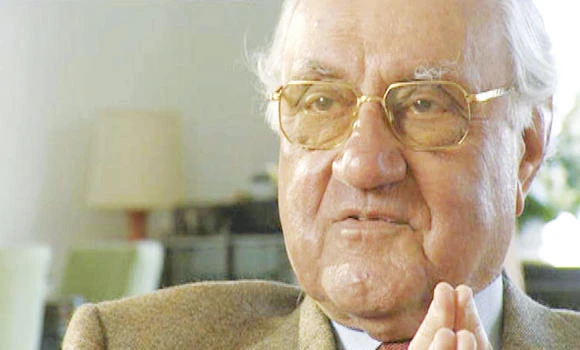
Iraq is still very much in the news, and it remains a continuing point of interest for many. Since the foundation of the Iraqi state in the 1920s, there have been different ideas put forward about its future. The recent publication of Dr. Adnan Pachachi’s memoirs sheds some light on the complex history of this ancient land and, in doing so, suggests some possibilities of its future.
Despite his decision to leave Iraq when, in July 1968, the Ba’athist government came to power, Dr. Adnan Pachachi never ceased to love his native country. Before going into exile, Dr. Pachachi had served his country as Ambassador and Permanent Representative to the United Nations from 1959 to 1965, as well assuming the role of Foreign Minister from 1965 to 1967. Upon the invitation of Sheikh Zayed, he took up residence in Abu Dhabi. He was appointed Minister of State in the first government of the Emirate of Abu Dhabi, and took up office on the first of July, 1971. Three years later, he was granted UAE citizenship and went on to play a key role in the remarkable transformation of this fishing village into a modern state.
"My presence there afforded me a tremendous privilege, opportunity and challenge to help establish a new modern Arab state in a region long neglected by the Arabs and isolated from the rest of the world”, said Dr. Pachachi in his new memoir.
Following, Saddam Hussein’s disastrous invasion of Kuwait, Dr. Pachachi decided to devote his time to helping the problems that were facing Iraq. And in 2003, after an absence of thirty-four years, he finally returned to Baghdad because he felt he had “something to offer”. He became a member of the Governing Council, and ascended to its President in January 2004. He was also a member of the Interim National Council in 2004-2005, and a member of the Iraqi Parliament from 2006 to 2010.
However, the high hopes and expectations that followed America’s presence in Iraq were soon replaced by feelings of frustration, anger and resentment. This was largely due to the absence of any plan to assist the country politically and economically combined with the American’s mismanagement of the country which resulted in an increased corruption and a growing divide along sectarian lines.
“The most tangible result of the US involvement in Iraq has been the consolidation of Iran’s influence and power in the country. The US had the means to prevent this but lacked the will and determination. I, like most Iraqis, am still at a loss to understand why the United Nations squandered the historic opportunity to make a success of democracy in Iraq", he notes.
Dr. Pachachi strongly believes that Iraq is destined to play an important role in the Middle East by preserving the Arab character of the Gulf, and confronting the growing Israeli menace. He also believes in a unity of Iraq and Syria: “I am not speaking about solidarity or co-operation, but about a federal union which might then be joined by Jordan and other Arab states in the region…This is why I consider the establishment of a federal union between Iraq and Syria to be a matter of supreme national importance and urgency.”
Indeed there is a consensus that in countries torn apart by ethno-sectarian violence, there is a need for credible federal institutions resting on assured powers. Only institutionalized local power can create proxies for the sectarian and tribal domains into which these societies have retreated.
The author concludes that Iraq is facing a dual challenge. One emanates from Iran, and a second that is caused by the Shiite and Sunni religious political parties who are vying to establish a form of theocratic power. “The only way for Iraq to resist this dual challenge is by creating a strong and determined opposition combining the younger generation with all the liberal, secular democratic, non-sectarian elements and educated elite of the country”.
Dr. Pachachi's greatest love lies in his deep ties to Iraq. He was able to continue in his position as Permanent Representative for Iraq under several regimes because he felt that he was never serving any particular government but his country.
In an article published in the Financial Times on March 3, 2003 he spoke about his optimism regarding the future of Iraq:
“Although some regimes have oppressed sections of their population, the people of Iraq have always lived in peace and harmony. What differentiates them is not ethnic origins, or their religious or sectarian affiliations, but their political beliefs and aspirations. Among the Shi’ites, Sunnis and Kurds one will find socialists, capitalists, communists, nationalists, religious fundamentalists and secularists. With the spread of modern education and intermarriage, Iraqis have learnt the virtue of tolerance without which no democratic system can survive.”
During his lifetime, Dr. Pachachi remained true to democratic and pluralist values. Will Iraq be governed according to his vision of a secular democracy? The future remains uncertain. What is clear is that the political history of the Iraqi state is continuously in the making. New spaces are opening up with new possibilities to assert themselves in the shaping of Iraq’s history. But that does not mean that all traces of past regimes will disappear. They will continue to exist and those who are involved in the creation of a new political order must take into account the strong legacies at work if they do not want to succumb to their logic.
Writing in the Independent on 16 June 2003, Patrick Cockburn noted that he expected Dr. Pachachi to play a big role in a transitional Iraqi administration for years to come: “Mr Pachachi, at 80 years old, may be the only prominent opponent of Saddam Hussein with whom all sides are prepared to work.”
—
Email: [email protected]
Living to some purpose memoirs of a secularist Iraqi