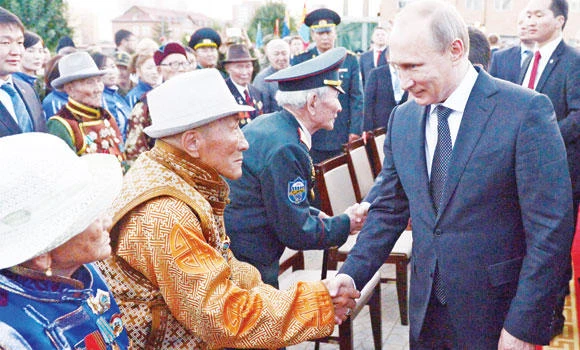
Mongolia was a Soviet satellite for decades but now fears economic domination by China, with this week’s visit by Russia’s Vladimir Putin, hard on the heels of Xi Jinping, highlighting its delicate balancing act, analysts say.
Although dwarfed by its massive neighbors, landlocked Mongolia is still one of the world’s 20 largest — though least densely populated — countries, its three million people spread across more than 2,000 kilometers of mountains, rolling steppe and rocky desert.
In the face of strategic and geographic reality, it has sought to reach out to other powers, including the United States and Japan, in what is known as a “third neighbor” strategy.
Mongolia enjoyed world-beating growth in recent years — peaking at 17.5 percent in 2011 — on the back of a resources boom, primarily coal, copper and iron ore.
But resource nationalism has since become the defining issue in Mongolian politics, with rules on foreign investment tightened after corporate deals threatened to see one of the country’s biggest coalmines fall into Chinese hands.
Foreign direct investment has since plunged, down 70 percent in the first half of this year, while growth slowed to 5.3 percent in the same period, and it also faces rising inflation and a falling currency.
Ulan Bator is looking to counter the decline by exploiting more of its estimated $1.3-trillion of mineral resources, and both presidential visitors oversaw the signings of multiple agreements in business and other areas.
But at the same time it is painfully aware of the risks of being dominated by any one partner.
“Mongolian foreign policy is based on precisely that balance between Russia and China,” said Julian Dierkes, a Mongolia expert at the University of British Columbia.
To the south, China is responsible for more than half of all Mongolia’s foreign business, but with the world’s most populous country and second-largest economy on their doorstep, many Mongolians are highly suspicious of increased Chinese investment, and anti-Chinese sentiment is longstanding.
“This traces back in history ever since China has become an urban settled civilization, whereas Mongolia has its nomadic civilization,” explained Munkhdul Badral, an entrepreneur and founder of news service Cover Mongolia.
“These are differences in our cultures, and where the very beginning of tensions began.”
They “never stopped,” he said, even at the height of Mongol power, when Genghis Khan’s descendants ruled the largest contiguous land empire in history, stretching from eastern Europe to the South China Sea.
“There’s always been fighting and wars,” said Badral. “At one point we conquered China — and at one point, China conquered Mongolia.
“But nowadays, it comes down to economic reasons why Mongolians are so suspicious of China.”
Mongolia was in Moscow’s orbit and under Communist rule from 1924 to 1990, when the Soviet Union to the north was its major trading partner.
It remains heavily reliant on Russian fuel and electricity supplies, and political ties with Moscow remain strong, as do post-Soviet nostalgia and pro-Russian sentiment in some quarters.
Many Mongolians speak Russian and many of its artistic stars were educated in Russian schools.
“Mongolia sees itself as culturally aligned with the West, and eager to distinguish itself from Asian countries,” said Franck Bille, a social anthropologist at Cambridge University.
Putin’s visit was his third since he first became Russian president in 2000, and in 2003 Moscow eradicated some 98 percent of Mongolia’s Soviet era debt.
Mongolia balances between dragon and bear