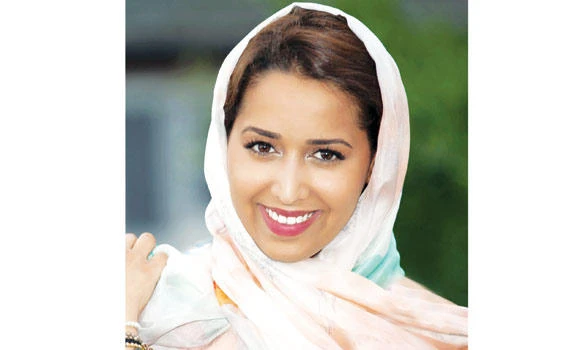
Saudi national Shahad Alshahyl, 27, was selected by the King Khaled Foundation for a scholarship at Acumen, a non-profit global venture fund that uses entrepreneurial approaches to solve the problems of poverty. She is representing Saudi Arabia at the fellowship program, which aims to help build financially sustainable organizations that deliver affordable goods and services that improve the lives of the poor.
In an interview with Sayidaty magazine, Shahad talks about what it means to be the first Arab to join the global fellowship program in social entrepreneurship and the difficulties encountered in the process.
Tell us about yourself?
Before I talk about my accomplishments, it is worth mentioning that my story is not a story of self-enhancement, but it is the product of the experiences of many people who influenced my character and supported me. I learned a lot from them and my mother is the first of my supporters. My journey began with my mother’s encouragement and my understanding of the concept of personal responsibility toward the individual and society. I then studied finance and accounting and through this I got to know about social entrepreneurship. I enhanced my understanding by studying MBA in Entrepreneurship at the Johns Hopkins University in the US. It is considered to be the first program of its kind in the use of entrepreneurship to develop social work in an innovative and sustainable way. During this period I did a lot of humanitarian consulting projects in Rwanda, Turkey and Armenia, which strengthened my experience. And after graduation I was selected by the global foundation “Acumen,” which seeks to find innovative solutions to fight poverty and social development. I spent a year in India to determine the expansion strategy of a company that is seeking to deliver education to children in isolated areas of India.
Tell us more about the concept of social entrepreneurship?
The Arabic and global press speaks about the concept of social entrepreneurship. It is very important to understand the meaning of this term, and only then people will be able to participate in it. The concept of “social entrepreneurship” has emerged to combine the advantages of the private sector and the social sector, where we have learned from the private sector financial sustainability, the possibility of expansion and the importance of development to meet the needs of the market and customers, while we have learned from the social sector the importance of togetherness and solutions to community problems. Social entrepreneurship seeks to find sustainable solutions for social and humanitarian problems, to benefit the greatest number of people for many years. The concept itself is not new; the Prophet Muhammad (peace be upon him) said: “When a man dies, his deeds come to an end except for three things: Sadaqah Jariyah (ceaseless charity), knowledge which is beneficial, and a virtuous descendant who prays for him (for the deceased).” We find that the Prophet (pbuh) was the first one to speak on the subject of sustainability.
Tell us about the fellowship program at ‘Acumen’.
Of the most important goals advocated by ‘Acumen’ is developing methods of combating global poverty through the use of sustainable solutions to enhance the dignity of the people in need. They invest in companies playing this role in different sectors, including: health, water, education, agriculture, energy, and furthermore, they invest in companies that are characterized by a new and distinctive way of thinking in how to evolve with these facilities. These programs are organized once every year. Ten people per year are chosen among more than a 1,000 people. The selected candidates are subjected to training for two months in New York. They are also trained at the hands of world-class trainers in areas such as finance and leadership, as well as in innovative approaches such as Human Centered Design and Impact Measurement. After the two-month training, they will be sent to one of the companies that Acumen invests in, such as in India or Pakistan, or East and West Africa. My mission included ensuring that education reaches children in the isolated areas of India, creating an innovative business model to deliver high quality education at a low cost in line with the capacity of parents and enhancing the independence of the community by training and employing its women. Thanks to the efforts of our team, we managed to expand the company from 60 branches (schools) to 115 branches. We raised the efficiency of teachers, in order to train more of them with less effort. The method of selection of fellows in Acumen depends on several criteria such as work experience, education degree, degree of faith and a strong incentive of the applicants.
What do you think of the achievements of Saudi women during the era of Custodian of the Two Holy Mosques King Abdullah?
The era of Custodian of the Two Holy Mosques King Abdullah is an era that cares for education, learning, rights and balanced development for both long and short terms. And I’m a girl of this era. I have been affected by it a lot, and it has helped me to reach where I am today. The reformist movement led by the Custodian of the Two Holy Mosques enhances the feelings of many Saudi women. Abu Miteb (King Abdullah) is a father figure for us and we strive not to disappoint him. We are happy to see reforms in our country such as the appointment of Saudi women to the Shoura Council and the opening of the King Abdullah University of Science ad Technology, as well as the scholarship program that I am part of. These are evidences that the Saudi leadership is seriously taking up issues of equal opportunities for both men and women and the emphasis now is on women’s full participation in community development.
Your success journey includes many countries such as Rwanda, India, Armenia and Turkey. What about your country, Saudi Arabia?
My success is a real expansion of the concept of social work to humanitarian work. We want to give a helping hand to people anywhere, irrespective of geographical and racial boundaries. We carry a message of humanity, and this is the policy of my country, which has a lead in global initiatives. My trip to these countries added to my experience and profession, and gave me a wealth of experience in the application of the concept of social entrepreneurship and reaping fruitful results. Now, I put my experience at the service of my country, and I support and co-operate with anyone who needs my experience.
Who are your most important supporters?
It is my duty to admit that my achievements are not only personal, but they are the product of the actions and achievements of people surrounding me, who helped me and motivated me to become what I am now. Apart from the people who I learned from in terms of study and work, I would like to highlight my family’s support, especially my mother and brother. My field is a non-traditional one and entering it was a big risk, especially because I graduated from a prestigious university and had several job offers. What made me take a different path is my strong faith in the importance of my role and the reason for my existence in this world.
What are the main difficulties that you are facing right now?
Although everyone agrees that poverty is a serious and important problem and that it is necessary to be solved, especially in Saudi Arabia, there are still some other difficulties that we face now, the most important being the collision of new solutions and innovative ones, and the idea of sustainability with traditional solutions on social work. I hope to give a creative and innovative solution to ease bureaucratic procedures that may limit development work.
What is your ambition?
My ambition is to strengthen the principle of social solidarity, where we become aware of the extent of our personal responsibility toward individuals and the world around us. Each one of us has a role, and the real development starts within us through the accumulation of all the work we do, and I’m working on connecting it to the new generation in the Arab world. I encourage their initiatives in order to change our economic and social realities.
—
Email: [email protected]
My experiences are for my country