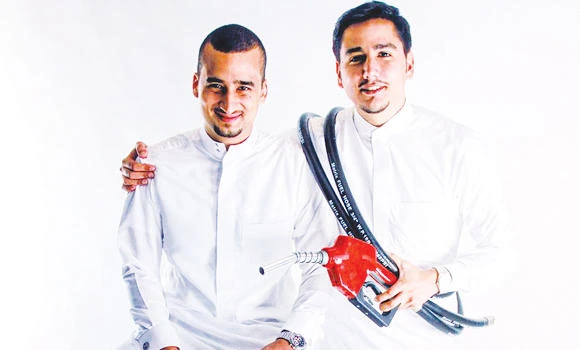
It all started when two young Saudi entrepreneurs Mohammed Awlia and Omar Naseef decided to put their creative minds together, leading to the making of a lifestyle brand taking inspiration from the Kingdom’s natural resources. The duo, who are based in Jeddah and operate in London, was inspired by the Saudi lifestyle, which is largely famous for black gold, or in other words, petroleum. The two entrepreneurs say petroleum represents both wealth and luxury and that is what they wanted their brand to reflect.
Oil Barrel does not intend to be a local brand; instead it aims at being an international brand from the start. The brand was launched in London as the place offers a bundle of resources, a strong network and buyers as well an international landscape popular for being a hub for fashion.
Naseef is a graduate from SOAS, University of London, majoring in International Management and minoring in economics with a focus on the MENA region. He is a member of the Arab, British Chamber of Commerce, has worked in both private and public sectors and covered an internship in China. Naseef has been working at Oil Barrel as the CEO and is responsible for the distribution, designs and logistics.
Awlia graduated from King’s College London, majoring in International Politics with a focus on political economy. He is handling the budgeting, finance and marketing.
Both young men majored in fields far from the fashion design world yet were able to pull off a line of clothing suited for a stylish target group.
Oil Barrel started in London, where Awlia was covering Political Economy and much of Naseef’s studies had to do with oil and gas.
“That’s when we decided to start a fashion line that combines both themes for it is edgy and innovative. We knew that this brand could cause some controversy but at the same time it has a unique selling point that represents us as Saudis and is an interesting theme for a fashion brand,” said Naseef.
The team was inspired to launch the brand as its uniqueness was that it represents their identity as Saudis and the fact that the oil industry is a very attractive industry, according to Naseef. “Oil is part of our identities as Saudis; it is part of our modern identity because in the past deserts, camels and palm trees reflected our identity. The oil industry replaced that since the 70s,” he said.
The duo hired a consultant who educated them on the A to Z of starting a fashion brand. “We already had the idea, the artistic skills and the creativity but we needed someone to execute the plan for us. We wanted to create the whole network of designers, suppliers, labels, printers, garments and so on,” said Awlia. “We had to outsource everything. It was a very long and hard process initially but now that we have set it up, all production will be in-house. It took us a long time for us to make the brand a reality. Eighty percent of ideas in business are just ideas but when you execute them, they become real action business,” he added.
Undoubtedly, oil is he most important industry in Saudi Arabia, but how can one link it to fashion? “The name is very tough, Oil Barrel, but there are similar names in the fashion industry, such as Diesel. We are using this as an outlet to touch others with stories of our lives. The oil industry itself is very controversial; you have corruption and political aspects with money coming in. There are also many environmental disasters and we are trying to play on that very thin line of positivity and negativity,” said Awlia. “The positives include the money that is coming in and how we are spending it on development, scholarships and so on. This gave us a good platform to create art. A lot of art involved oil spills. We realized that we are not only talking about Saudi Arabia, but also about the GCC, Russia and South America where we share a common identity related to petroleum,” he added.
The market for Oil Barrel is diverse. The brand sold a huge number of their fashion items to Londoners. “We then noticed the demand from the Saudi market and that’s when we decided to expand. Social media is a great platform for us and we tapped into it to make huge sales; it helped with getting the brand the acknowledgment it needed,” said Awlia.
Oil Barrel was selected by Forbes magazine among the top 100 leading entrepreneurs in Saudi Arabia. “This was a great motivation; it meant we could do something different and new in the market and that’s when we decided to tap into the furniture market using completely recycled oil drums,” said Naseef. “We thought we were trapped into making just T-shirts; it was frustrating because we wanted to identify ourselves as a lifestyle brand, which includes furniture and art pieces, and use our products to make events and feature them in art exhibitions,” he added.
The oil drums are recycled, polished and cleaned up, then reused as furniture items. “We started with looking for suppliers, there are a huge number of oil drum suppliers who sell them to people who want to refill them with oil or cement. We visited the suppliers, told them that we wanted a small quantity as they are used to selling thousands of drums at a time. We requested them to polish the drums,” said Naseef.
“We used the existing art we had for the T-shirt line as a mood board for the furniture collection. With constant trials, we finally found the perfect designs that suit the brand and our style,” he added.
Oil Barrel’s furniture line includes chairs and tables. “Oil drums are made of steel and we can design anything using this element, we just have to think out-of-the-box and come up with ideas that are artistic and beautiful to look at,” said Awlia. “There are almost a 100 million oil barrels that are being produced per day. This gives us the freedom to be creative and each supplier can provide us with up to 10,000 pieces,” he added.
According to Naseef, their goal is to see their furniture line in public places. “We want our collection to complement neighborhood gardens in Jeddah because our pieces can handle the strong sunlight and heat, they even look more beautiful when they are rustic,” he said. “We also want to see our pieces in Aramco cultural center, art galleries, office spaces, cafes with industrial themes and so on,” he added.
—
Email: [email protected]
Oil Barrel: Lifestyle brand that tells a story