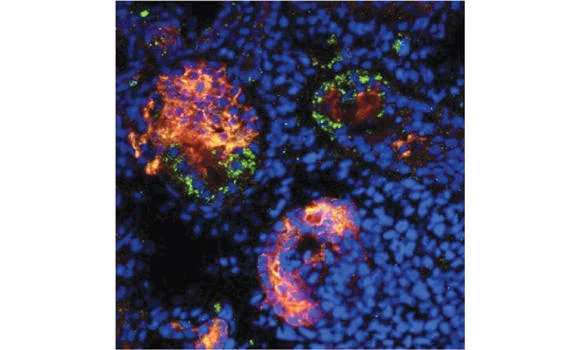
TOKYO: Researchers in Japan said yesterday they have succeeded in growing human kidney tissue from stem cells for the first time, in a potential first step toward helping millions who depend on dialysis. Kidneys have a complex structure that is not easily repaired, but the latest findings put scientists on the road to fixing a diseased or distressed organ, they said.
More than 300,000 people in Japan alone rely on dialysis because their kidneys do not function properly. Researchers said the latest breakthrough may one day mean that kidney tissue generated from a patient’s own body could markedly improve how a damaged organ works.
Kenji Osafune of Kyoto University said his team had managed to take stem cells — the “blank slates” capable of being programmed to become any kind of cell in the body — and nudge them specifically in the direction of kidney tissue.
“It was a very significant step,” he told AFP.
Osafune said they had succeeded in generating intermediate mesoderm tissue from the stem cells, a middle point between the blank slate and the finished kidney tissue.
“There are about 200 types of cells in the human body, but this tissue grows into only three types of cells,” namely adrenal cells, reproductive gland cells and kidney cells, he said, adding that as much as 90 percent of cultures in their research developed into viable mesoderm tissue.
This embryonic intermediary can be grown either in test tubes or in a living host into specific kidney cells.
Osafune stressed there are still many hurdles to overcome before applying his work to actual medical treatment. “It is not known yet if simply transplanting regenerated cells would really cure kidney ailment,” he said.
He and his team created part of a urinary tubule, a small tube in the kidney that plays a role in the production of urine.
While the research is not aimed at growing an entire working kidney, he said the method his team had developed would help scientists learn more about intermediate mesoderm development and may provide a source of cells for regenerative therapy.
“I would say that we have arrived at the preliminary step on the road to the clinical level,” he said.
Stem cell work has been controversial until relatively recently because embryos were the only source, and their harvesting led to the destruction of what some people consider a human life.
This research has used induced Pluripotent Stem (iPS) cells, a bio-technology where a fully-developed adult cell is effectively re-engineered to return it to its infant state.
Scientists grow kidney tissue from stem cells