
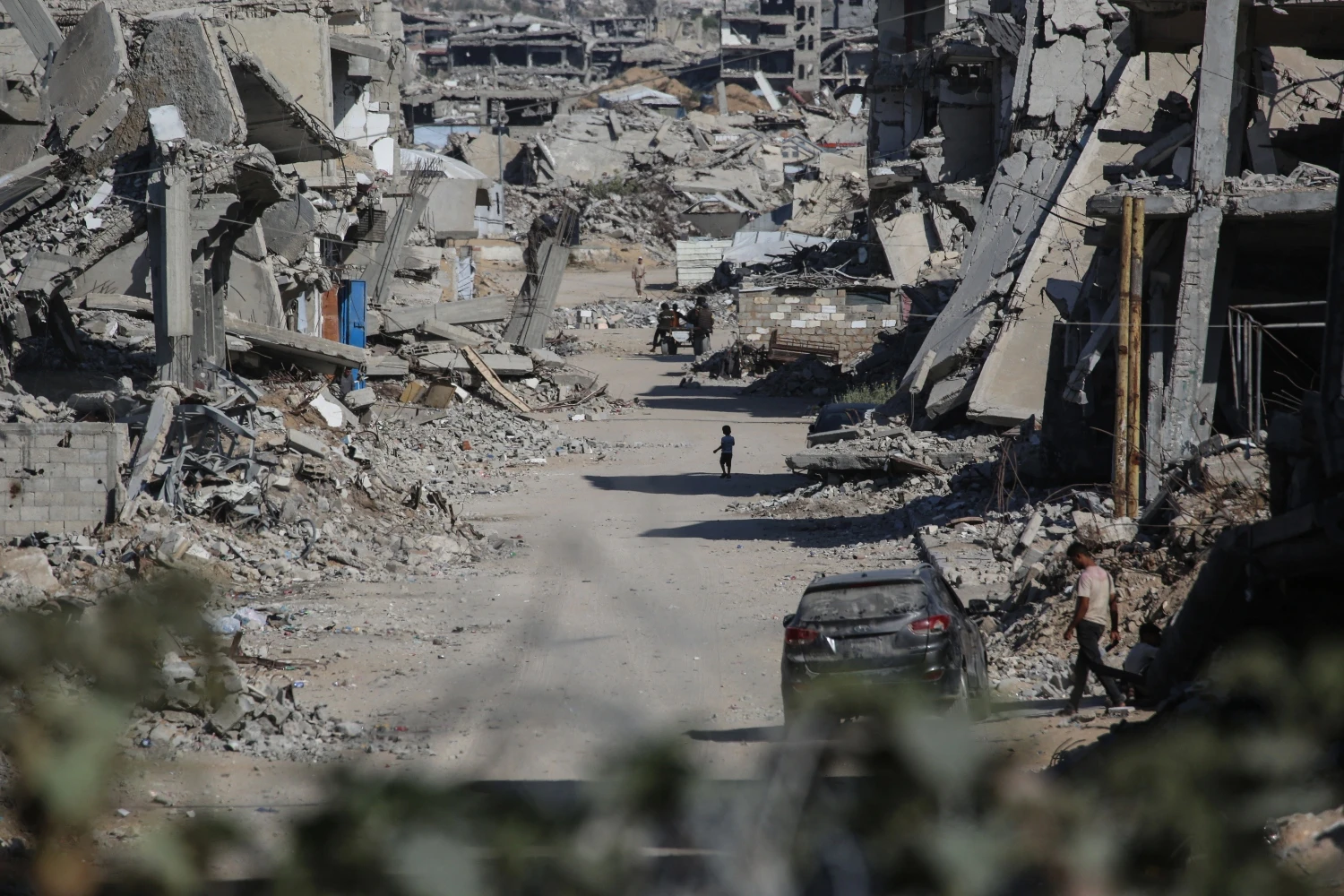

For decades, those of us who watched this conflict up close — as journalists, businesspeople or simply as Arabs who felt the injustice in our bones — have said the same thing to different audiences, with varying degrees of patience: the settlements are illegal. Not “controversial,” not “an obstacle to peace,” but illegal, as per the Fourth Geneva Convention and the 2024 advisory opinion of the International Court of Justice — and now the official view of the British government.
This week, London — joined by Paris and Ottawa, which each announced their own parallel bans — said it would ban the import of goods from settlements in the West Bank, sanction individuals and companies that build, finance and profit from them and, for the first time, declare the occupation itself, not merely the settlements atop it, unlawful. The British foreign secretary used language rarely heard from a G7 country, accusing settler groups of ethnic cleansing against Palestinian communities. Twelve states in total, several of them long-standing partners of Israel, signed a joint statement warning that continued settlement expansion was foreclosing the possibility of a Palestinian state.
For a generation, Arab voices called for exactly this kind of accountability and were told it was unrealistic — that Western capitals would never move past statements of concern into measures with teeth. This week they did. That deserves credit before I move to what should come next.
We are meant to live together, to love our neighbor and to treat one another as we ourselves wish to be treated
Rida-Hassan Said
I write this also as someone who once carried a press pass rather than a business card. Years ago, as a producer for CNN, I spent time in Jerusalem, Gaza and the West Bank, watching this conflict up close rather than through a screen. What stayed with me was not any single atrocity, though there were many, but the slow, grinding way the cycle of violence corroded relations between Muslims, Jews and Christians in the very land all three faiths hold sacred and where for centuries they coexisted. It is a myth — a convenient, lazy myth — that we are destined to hate one another. Every one of our holy books teaches the opposite: that we are meant to live together, to love our neighbor and to treat one another as we ourselves wish to be treated.
Have we not, after the horrific massacres of Oct. 7, 2023, and the subsequent endless horrors inflicted on the Palestinians in Gaza, finally seen enough misery to prove that this path leads nowhere but to more of the same?
But sanctions correct the law. They do not make peace. That distinction is one I have been turning over while reading a book that arrived at exactly the right moment.
The book is “The Future is Peace,” written jointly by Aziz Abu Sarah, a Palestinian, and Maoz Inon, an Israeli. Each lost family to this conflict — one his brother, killed by Israeli forces; the other his parents, killed in the attacks of Oct. 7. By every reasonable measure of grief and grievance, these two men have every right to hate each other and every excuse to spend their lives justifying that hatred. Instead, they have chosen to travel their shared, wounded land together and to write about what they found: not a resolution of who is more wronged but a recognition that both peoples’ suffering is real, that both peoples’ claims to this land are rooted in history, faith and memory, and that neither side can be reasoned, sanctioned or defeated out of existence.
I do not know how many more sanctions announcements it will take before something durable changes on the ground
Rida-Hassan Said
I raise their book not as decoration for an argument about trade policy but because it names what a sanctions regime, however welcome, cannot supply. Law can strip the settlements of their claim to legitimacy and make it costlier for governments and companies to underwrite an illegal occupation. What it cannot do, on its own, is heal the sense — shared across the wider Arab and Muslim world, not only among Palestinians — that our history and our dignity have for decades been treated as negotiable in a way others’ were not.
That feeling of injustice does not begin or end at the Green Line; it runs through how this whole region has watched itself be discussed, divided and decided over, generation after generation. Treating the settlements as illegal and acting as though we mean it is one of the few concrete signals that this pattern does not hold indefinitely — for Palestinians most immediately but for the region’s trust in a rules-based order more broadly.
None of that is served by triumphalism or by treating this as a victory over Israelis rather than a correction of policy. Abu Sarah and Inon’s case for peace is explicitly not a case against the other side’s history or faith. It holds that Jewish, Muslim and Christian claims to this land — its cities, its holy sites, its stories — are each real and each deserving of respect, without requiring the erasure of the others. That is a harder position than simple partisanship and a more honest one. It is also, I believe, the only foundation on which a durable two-state solution — one that respects the security of Israelis, the sovereignty of Palestinians and the sanctity of this land to three faiths — can actually be built.
I do not know how many more sanctions announcements it will take before something durable changes on the ground. But the sequence matters: first, the world stops pretending the settlements are a gray area; then, slowly, the people living amid the consequences of that gray area are given the space to do what Abu Sarah and Inon have already done — insist that their neighbor’s grief is as real as their own and that peace is not naive but the only serious option left.
That, to me, is a future worth working toward. Not one side vindicated and the other diminished but a region finally able to address its oldest injustice honestly enough that all its peoples — Jewish, Muslim and Christian alike — can begin to trust one another with their histories again.
Rida-Hassan Said studied Middle Eastern history at Oxford, worked as a CNN producer-journalist and co-founded Dayim, a Gulf-based investment platform. He is an advocate for peace and dialogue. X: @ridasaid


