
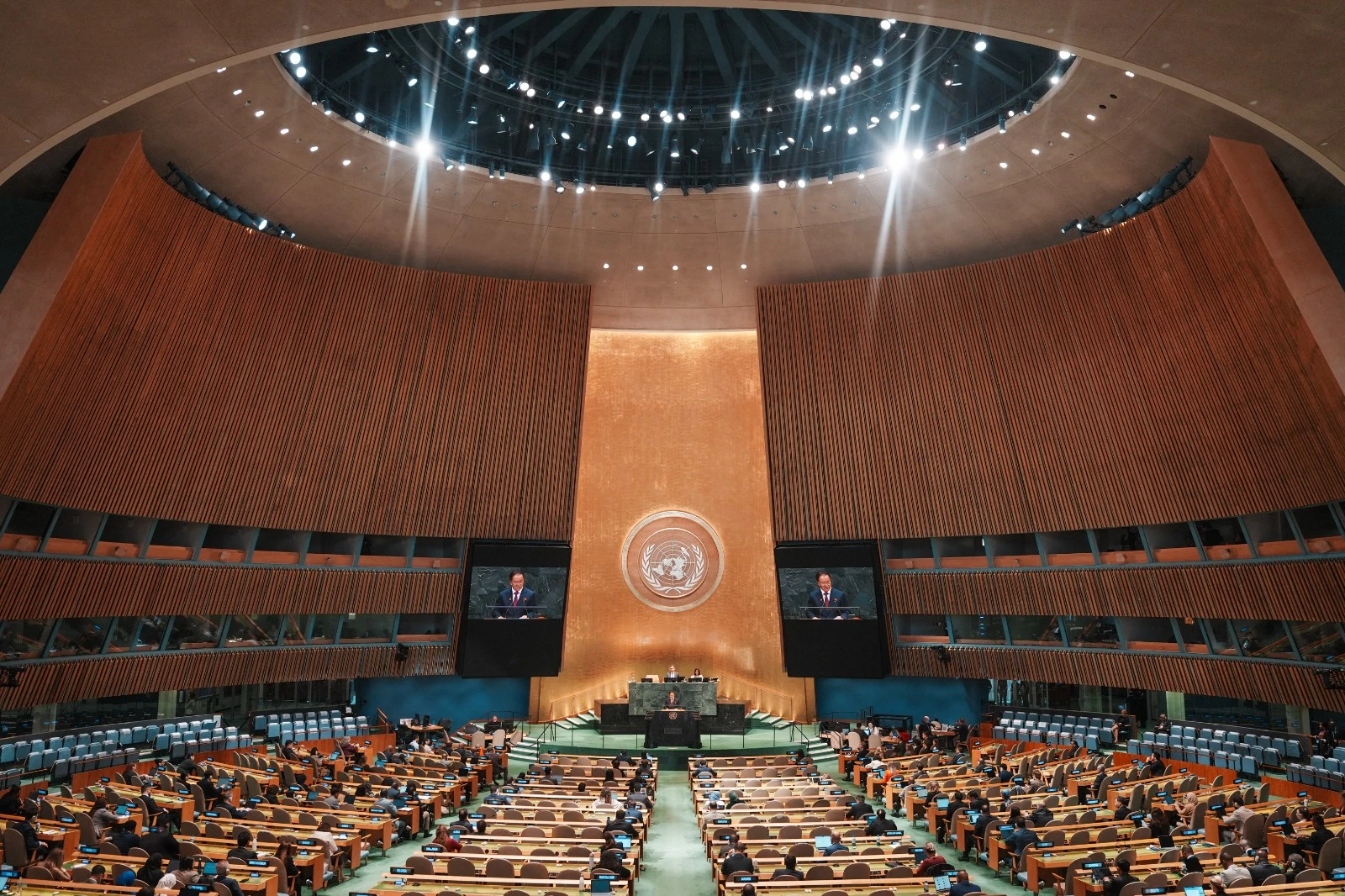

Every September, Africa returns to New York with a familiar diplomatic portfolio: representation, debt relief, climate finance, reparations, development, security, and reform of the UN Security Council. Presidents speak, delegates applaud, resolutions pass, and communiques circulate. By the following General Assembly, many of the same demands have acquired newer language while retaining the same destination: nowhere.
The disturbing pattern becomes easier to see when measured against the institutional rules. Africa commands 54 of the 193 General Assembly votes, roughly 28 percent of the chamber. Security Council reform requires a two-thirds General Assembly majority followed by ratification through the UN Charter amendment process and concurrence from all five permanent members: China, France, Russia, the UK, and US. African governments, therefore, occupy a bloc large enough to make reform mathematically impossible without them, while remaining excluded from the permanent structure whose rules they are being asked to change.
It goes beyond mere representation. In March last year, the General Assembly adopted a resolution calling for reparative justice for African nations and people of African descent by 123 votes to 52, with three opposed. The resolution called for structured dialogue and concrete measures, yet contained no financial restructuring, binding reparations mechanism or capital transfer. Anyone watching from outside the diplomatic bubble could be forgiven for asking what, precisely, changed after the vote.
Moreover, throughout 2025, the Security Council adopted 44 resolutions, including 24 under Chapter VII of the charter, a provision used for coercive measures when the council determines a threat to global peace and security exists. Eighteen of those 24 Chapter VII resolutions concerned Africa. Consequently, Africa represented about 75 percent of the council's Chapter VII output while holding zero permanent seats. The institution, therefore, exercises an unusually high degree of coercive authority over African crises without granting African states a permanent hand in the body making those decisions.
Africa's Security Council campaign has reached a peculiar stage: The demand is now older than the officials repeatedly restating it. The Ezulwini Consensus, adopted in 2005, called for two permanent African seats with full veto rights and five non-permanent seats. Twenty years later, only the diplomatic language around reform has changed while leaving the map of permanent membership untouched.
Permanent membership determines who remains in the room; veto power determines which decisions can survive the room.
Hafed Al-Ghwell
A durable institutional obstacle stands in the way because the five existing permanent members possess a built-in veto over the rules governing their own privileges. Any amendment to the UN Charter requires approval by two-thirds of the General Assembly and ratification by all five permanent members. China and Russia have strategic concerns about expanding the council toward additional states perceived as close to the West, while successive White House administrations have always been wary regarding the perceived consequences of adding governments whose foreign policy preferences may diverge sharply from Washington's.
The dispute over the veto reveals why the distinction between occupancy and power matters. A permanent African seat without veto authority would confer status, visibility, and continuity, while leaving the central instrument of Security Council power elsewhere. For governments confronted with coercive resolutions concerning their continent, the difference is considerable. Permanent membership determines who remains in the room; veto power determines which decisions can survive the room.
Meanwhile, African security institutions have been doing the operational work. The African Union Peace and Security Council held 16 meetings in the final quarter of 2025, covering crises from Sudan and Somalia to Mozambique. The 19th annual joint consultative meeting between the Peace and Security Council and the UN Security Council in October 2025 reproduced the familiar cycle of dialogue and communiques.
Thankfully, a Security Council resolution authorized funding for three-quarters of AU peace operations for the first time, which carries significant implications. Every functioning African security capability increases the continent's bargaining power by reducing the distance between African decisions and African implementation.
The AU Peace Fund, revitalized in 2025, provides part of that architecture. Regional security coalitions provide another layer. A stronger continental financing system could gradually transform African security from an agenda largely processed by external powers into a system increasingly designed, financed and executed from within the continent.
To that end, the global financial system offers perhaps the clearest evidence of why diplomatic recognition has limited value when institutional power remains elsewhere. African countries are estimated to pay roughly $75 billion each year in additional borrowing costs associated with risk perceptions and mispricing. Now debt service costs can easily consume as much as 25 percent of government revenues, leaving governments servicing yesterday's liabilities with resources needed for infrastructure, health, and industrial investment.
Africa's response is beginning to move from protest toward institution-building. The African Credit Rating Agency, established under African ownership in 2025 and headquartered in Mauritius, is designed initially to rate local currency debt and strengthen domestic capital markets. Local currency financing matters because every dollar of external debt can become more expensive when an African currency depreciates. A stronger domestic bond market therefore addresses two pressures simultaneously: the price assigned to African risk and the foreign exchange exposure attached to external borrowing.
Minerals present a more tangible route to changing the dynamic. Africa holds more than 30 percent of global reserves of key energy-transition minerals yet generates less than 1 percent of the value created in clean-energy technology manufacturing. Export quotas, domestic processing requirements, and regional battery and electric vehicle hubs could shift part of that value into African economies. Indonesia offers a concrete precedent: processed nickel export value rose from $3.1 billion in 2013 to $19.2 billion in 2023 following its raw nickel export restrictions.
In addition, there is compelling evidence of an internal commercial shift already accumulating. Intra-African trade rose 5.47 percent in 2025 to $213.8 billion, while the 2025 Intra-African Trade Fair generated $48.3 billion in trade and investment deals. The African Continental Free Trade Area is moving from pilot transactions toward regularized preferential trade, including negotiations over automotive and textile rules of origin.
Africa's next chapter depends heavily on what happens within African institutions: continental trade, domestic processing, regional security financing, sovereign credit assessment, local capital markets, and African control over data and digital infrastructure. The General Assembly can continue providing a global stage for grievances. Durable bargaining power will emerge from the factories, refineries, capital markets, and security institutions capable of converting continental scale into material power.
The applause in New York may continue for another generation and perhaps more. However, the work that changes Africa's bargaining position is already waiting in Addis Ababa, at AfCFTA negotiating tables, in emergent industrial corridors, and inside the financial and digital institutions that Africa is building for itself.
Hafed Al-Ghwell is senior fellow and program director at the Stimson Center in Washington and senior fellow at the Center for Conflict and Humanitarian Studies.
X: @HafedAlGhwell


