
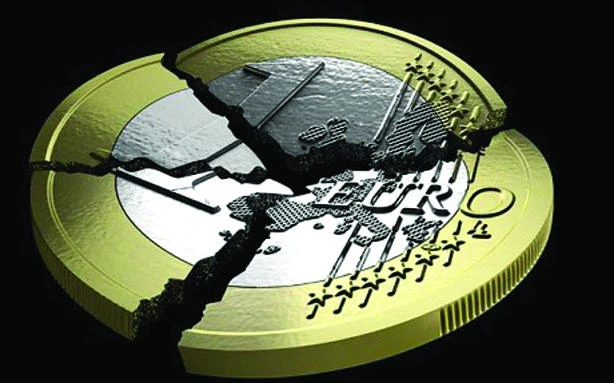

The euro crisis, it is said, is over. Calm has returned to financial markets, amid ironclad assurances by the EU authorities — particularly the European Central Bank — that the monetary union will be preserved. But Southern Europe’s economies remain depressed, and the euro zone as a whole is suffering from stagnant growth, deflationary pressure, and, in the crisis countries, persistently high unemployment.
Not surprisingly, given the EU authorities’ obvious inability to end the malaise, many member states are losing patience with austerity. Indeed, some countries are facing a political upheaval.
When the turmoil comes, it is likely to be triggered — as with the euro crisis — by Greece, which is holding a presidential election that seems unlikely to produce a winner. If the Greek parliament does not elect a new president by a two-thirds majority in next week’s third and final round, it will be dissolved and a snap election will be called. The risk is that Syriza, a far-left socialist party, will come to power.
To win, Syriza must either mislead its voters about its options, or insist that it will renegotiate the repayment conditions imposed on Greece by the so-called Troika (the European Commission, the ECB, and the IMF), all while pursuing unilateral action should renegotiation fail. But any renegotiation following a Syriza victory would undoubtedly unleash a political avalanche in the southern EU that would sweep away austerity and fully reignite the euro zone crisis.
Of course, Greece itself is too small for its problems to present any real danger to the euro zone. But the election result in Athens could fuel panic in financial markets, causing a crisis that would threaten to spill over into Italy, the euro zone’s third-largest economy, and, with some delay, France, the second largest.
A miracle could occur: A new president could be elected in Athens next week, or Syriza might not win the next parliamentary election. Unfortunately, either outcome would merely delay a politics-induced crisis in the EU. After all, in Italy, too, the signs point to a coming storm — one bearing down not only on austerity, but also increasingly on the euro itself. And after the storm hits Italy, France could be next.
The crisis in the euro zone and the refusal to attempt any real European approach to reviving growth has contributed — not exclusively, but significantly — to the rebirth of nationalism within the EU.
On one level, this seems bizarre. After all, none of the problems that Europe is or will be facing can be solved more easily alone and at the national level than within the EU and through the framework of a supranational political community. Indeed, nationalist xenophobia is particularly absurd in view of demographic realities: An aging Europe urgently needs more immigrants, not less.
It is no exaggeration to say that the EU is currently both internally and externally threatened by reactionary nationalism, which is why the next euro crisis will come in the form of a political crisis. So why are the authorities still not willing to change their policies, which quite obviously have made a bad situation worse? Observing the EU from the outside is like watching a train collision in slow motion — and one that was announced at the station.
—
©Project Syndicate


