
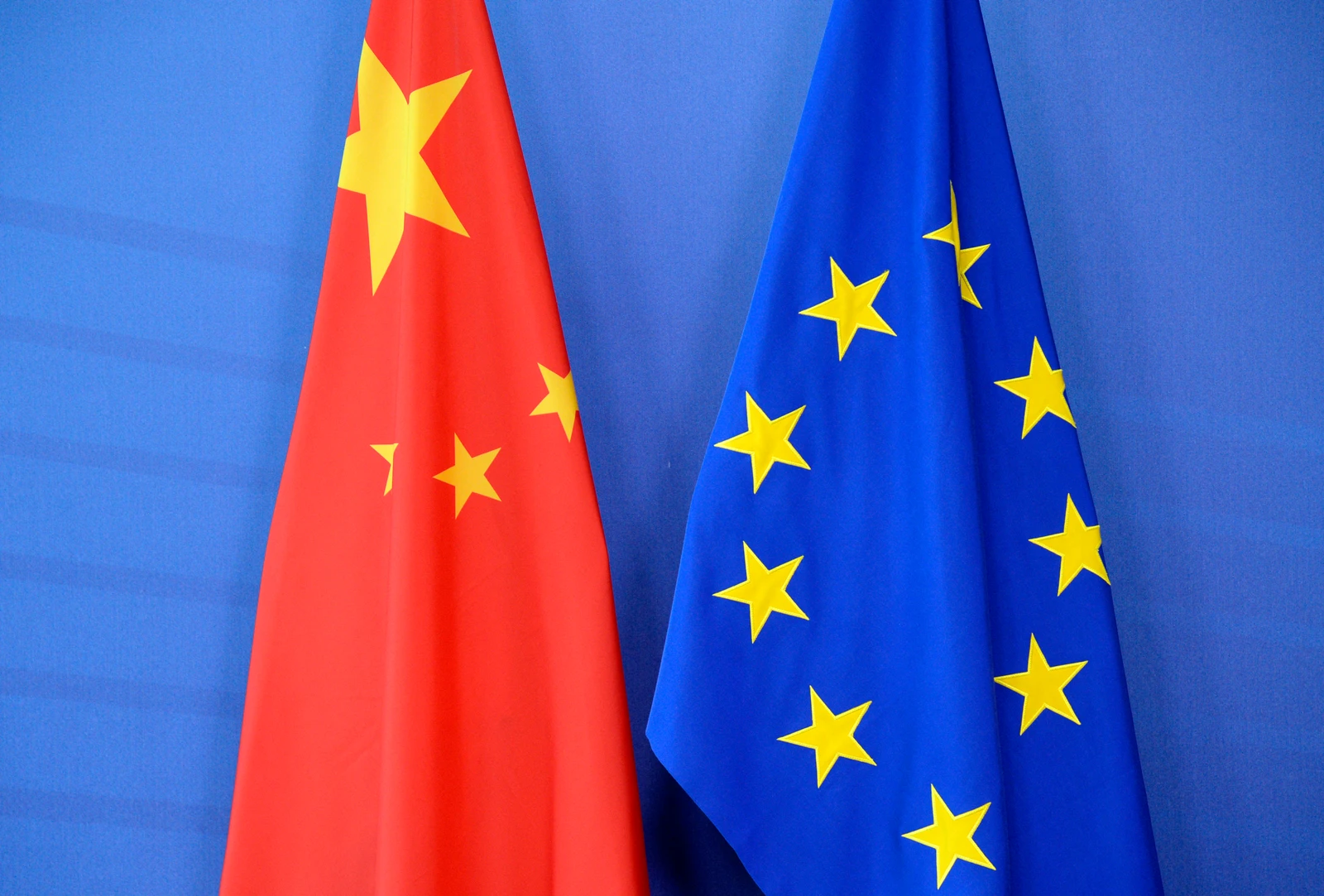

EU concerns about the bloc’s relationship, especially its trade deficit, with China are not new. However, a potential pivot point is approaching that may be the most important for bilateral relations since the 2008-09 global financial crisis or even Beijing’s 2001 accession to the World Trade Organization.
In a diverse region of 27 member states, marshalling consensus across the EU is rarely easy. However, senior politicians in national capitals and Brussels are increasingly aware that its economy may face an existential challenge without stronger action. This is what European Commission President Ursula von der Leyen warns risks becoming a “new China shock.”
In 2025, China’s trade surplus with the EU hit €360.6 billion ($411 billion), larger than with the US. Strikingly, that total is almost exactly €1 billion a day, an increase of 15 percent from 2024. It is increasingly clear that the managed competition of recent years is not enough and that a tougher trade policy is necessary.
This appears to be the view of a growing number of senior European politicians, including French President Emmanuel Macron and German Chancellor Friedrich Merz. This is important not only because France and Germany are the EU’s largest economies but also because both have previously been among the strongest advocates of open European trade with China.
Macron has made Chinese trade and growing global imbalances a key plank of this year’s G7. Moreover, a recent report by the French Commission for Planning argues that current EU trade defense tools are not fit for purpose to tackle Beijing’s long-term industrial strategy. It also asserted that the distance between Chinese and European production costs is frequently “too wide to be closed quickly through innovation or productivity gains alone.”
Macron, Merz and a growing number of other leaders, therefore, appear increasingly adamant that the EU must do more to mitigate the risks, with Chinese firms dominating European supply in key sectors such as chemicals, critical minerals and industrial robots. Other European politicians even voice concerns about the need to preserve Europe’s democratic model, via a strong industrial base, to help remain a key geopolitical actor.
It is increasingly clear that managed competition is not enough and that a tougher trade policy is necessary.
Andrew Hammond
At the time of writing, the EU is approaching the end of a lengthy consultation period with China ahead of a deadline for action this month. European Commissioner for Trade and Economic Security Maros Sefcovic and Chinese Commerce Minister Wang Wentao identified four workstreams, including export controls and trade and investment balancing, and agreed to establish a joint trade monitoring mechanism “with a view to improving transparency, enhancing mutual trust and managing trade frictions.”
This consultation period has seen much diplomatic activity. However, the fundamental challenges are unlikely to be tackled meaningfully in the relatively tight timeframe, not least as the Chinese economic growth model remains reliant on exports rather than domestic demand.
This core point is shown in the words of each power. Wang has called for the EU to promote “a rational and objective perception of China ... and the adoption of positive and correct policies toward China.” Meanwhile, Sefcovic said that “China’s exports to the EU keep rising, while our market share in China keeps shrinking … The status quo is not an option.”
The view that little fundamental is likely to be agreed this month is shared by Bernd Lange, the straight-talking chair of the European Parliament’s International Trade Committee. He has said that this timeframe is “not realistic at all” if Brussels wants to secure meaningful, binding concessions from China.
What is much more plausible this autumn is a broad framework deal on major issues. This might then be followed by the negotiation of a deeper, bespoke agreement with a clear legal text to underpin it in a bid to try to tackle these issues as harmoniously as possible and avoid deep-seated confrontation and a potential trade war.
Yet, even if such a process were to be followed, the EU still needs a powerful hand of cards to force meaningful, sustainable concessions from China. The answer cannot be more face-saving, nonsubstantive measures.
This is why the EU is considering ramping up its toolbox of trade tools beyond the new Industrial Accelerator Act, which would prioritize EU-made goods in public procurement — plus the Anti-Coercion Instrument, which has not yet been used, and is widely perceived as too unwieldy.
The EU recently introduced a reduction in the duty-free quota for imported steel, and a €3 customs charge on small parcels. In 2025, almost 6 billion such parcels entered the EU, with the huge majority coming from China.
Other measures under consideration in Brussels include a mechanism to diversify supply chains and reduce vulnerable dependencies, plus another to build greater EU solidarity in the event of Chinese retaliation.
Taken together, it is increasingly clear that EU-China trade ties are heading toward a potential pivot point. While that moment is unlikely to be realized in full this month, the bloc’s appetite for face-saving, non-substantive measures may finally be coming to an end.
Andrew Hammond is an associate at LSE IDEAS at the London School of Economics.


