

Developments in the Strait of Hormuz reverberated 6,500 km away when, in late April, Indonesian Finance Minister Purbaya Yudhi Sadewa, noting that Iran was planning to charge ships passing through Hormuz, said: “We sit along a key global trade and energy route, yet ships passing through the Malacca Strait are not charged.” He mused that the income from tolls at Malacca could be split three ways between the littoral states of Indonesia, Malaysia and Singapore.
In response, Singaporean Foreign Minister Vivian Balakrishnan, reflecting his country’s commitment to free navigation, categorically rejected the idea of tolls. Malaysia did not reject tolls outright; its foreign minister only said that a decision needed to be taken consensually by the countries concerned. However, despite these disclaimers, the idea that some form of disruption could take place at Malacca has now been implanted in the global consciousness.
The Malacca Strait stretches nearly 900 km from the Indonesian island of Sumatra in the west, past southern Thailand and Malaysia, and ends at Singapore. It links the Andaman Sea with the South China Sea and is the shortest maritime link from Europe and the Middle East to Southeast Asia and the Western Pacific. The width of the strait varies from a narrow 2.8 km off Singapore to 250 km at its widest. Its depth just south of the Andaman basin is about 200 meters but this reduces to 25 meters at its southern end.
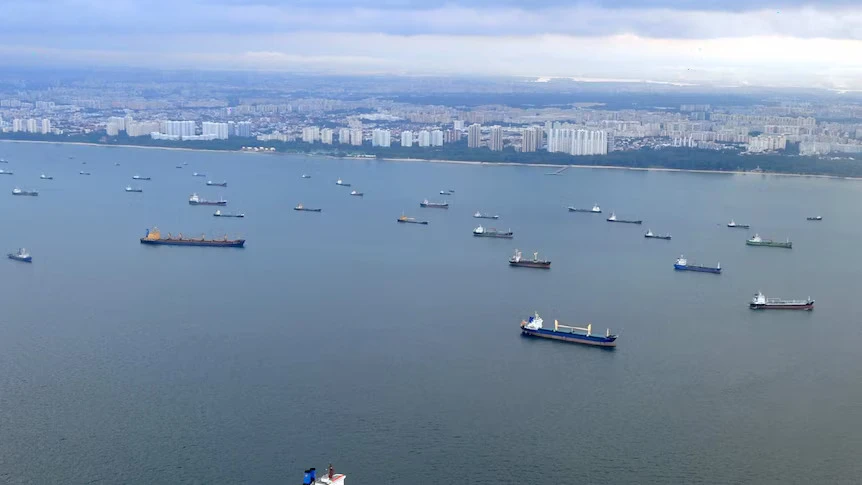
More than 100,000 vessels pass through the strait annually, carrying about 25 percent to 30 percent of global cargo, valued at $3.5 trillion. This cargo includes 35 percent of oil transported by sea — about 23 million barrels per day — and 20 percent of liquefied natural gas. Between 75 percent and 80 percent of the global trade of China, Japan and South Korea passes through the Malacca Strait, making the waterway the world’s busiest chokepoint. It has been described as “the irreplaceable heart of global maritime trade.” Besides oil and gas, the strait carries agricultural products, chemicals, consumer goods, manufactured products, machinery, textiles, electronics and, in recent times, rare earth minerals, lithium and cobalt.
There are three alternative routes — the Sunda, Lombok and Makassar straits — but these are longer and more expensive. The route from Saudi Arabia to Japan through Malacca takes half the time compared with the three alternative routes.
More than 100,000 vessels pass through the strait annually, carrying up to 30 percent of global cargo by value.
Talmiz Ahmad
Maritime movement through this narrow and busy channel faces several challenges. The waterway is shallow and congested. It requires regular dredging and wreck removal. Given that a commercial vessel traverses its narrowest outlet every five minutes, storms and accidents can block traffic for long periods and cause environmental damage through oil spillage.
The strait has, over several years, had to contend with the scourge of piracy — there were more than 100 incidents in 2008. After a lull due to joint action by the littoral states, the problem reemerged in 2024 with 62 incidents, followed by 108 incidents in 2025.
Indonesia, Malaysia and Singapore exercise sovereignty over their territorial waters for a distance of up to 12 nautical miles. In 1971, the three countries established a tripartite arrangement for the management of shipping through the strait, including the handling of accidents, environmental challenges and the safety and security of the waterway.
Given its status as the principal east-west maritime link, Malacca has been a battleground for competing forces for several centuries. In 2003, former Chinese President Hu Jintao spoke of China’s “Malacca dilemma.” He was referring to his country’s acute dependence on a single narrow channel for 80 percent of its crude oil imports and two-thirds of its global trade by volume. He was highlighting China’s vulnerability to a blockade of the strait by the US in the event of a conflict over Taiwan or the South China Sea.
Since then, China has undertaken several initiatives to dilute the effects of this “dilemma.” These have included a major expansion of its naval capabilities; the robust pursuit of land and sea connectivity projects under the Belt and Road Initiative, including alternative land-based supply routes of Gulf oil through Pakistan and Myanmar; and the deepening of economic and political ties with Association of Southeast Asian Nations and Middle East states, alongside the establishment of dual-use ports across the Indian Ocean under its “string of pearls” network. Still, Malacca remains the crucial link for China’s economic well-being.
The experience of the Strait of Hormuz has affirmed that maritime chokepoints and the attendant connectivity linkages — infrastructure, energy facilities, pipelines, data centers, undersea cables and sea lanes — are valuable strategic assets that can be leveraged for longer-term advantage, including through monetization such as tolls at chokepoints. Wars in the Middle East have heightened concerns that Malacca, as Paola Morselli has noted in The Diplomat, could be “where commercial interests, national security concerns and geopolitical competition intersect.”
The musings of the Indonesian finance minister relating to obtaining financial returns from the Malacca Strait have emerged from these considerations. Thailand has seized the opportunity to pursue other connectivity projects, such as a land bridge from the Andaman Sea to the Gulf of Thailand that would link seaports on both sides of the country and bypass the Malacca Strait, thus reducing travel time and shipping costs.
As the rules-based international order goes through its death throes and major states seek to pursue strategic benefit through confrontation and conflict, the likelihood of Malacca being monetized and, if necessary, weaponized, appears to be growing.
Talmiz Ahmad is an Indian former diplomat.


