
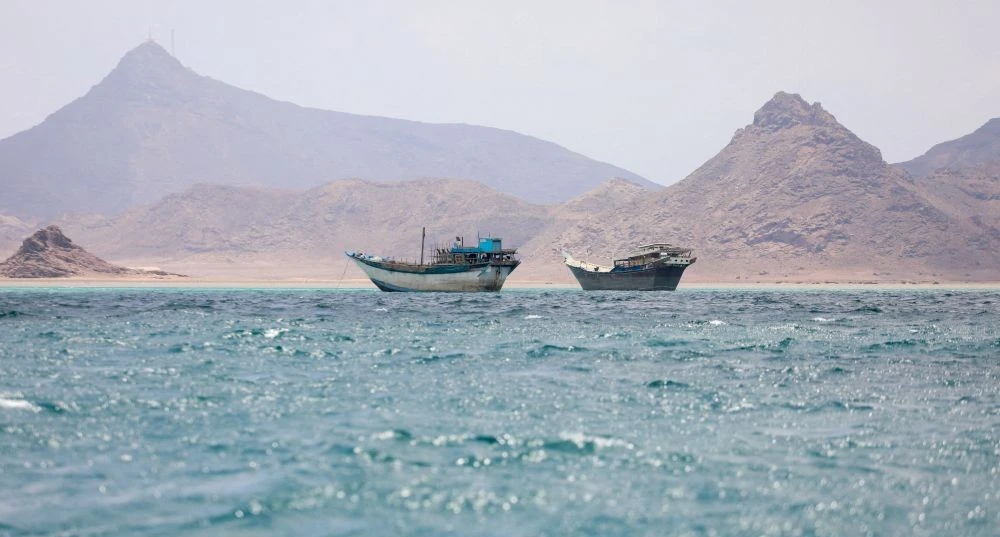

It is easy to fall for the illusion that the Houthi threat to shipping in the Red Sea has receded. For months, images of burning vessels and missile attacks did not dominate news bulletins as they did at the height of the crisis. Yet recent developments have demonstrated that this lull did not mark the end of the threat. Rather, it was a transitional period in which the danger itself became an instrument of deterrence, negotiation and economic pressure.
On Monday, the Houthis went a step further, announcing what they described as a “naval blockade” and warning shipping companies against loading or unloading cargo at any Red Sea port. They threatened that vessels failing to comply could be targeted wherever they came within the reach of Houthi military capabilities. The threat was therefore no longer confined to ships alleged to be linked to Israel or bound for Israeli ports.
The Houthis’ success should not be measured by the number of ships they manage to hit but by their ability to alter the movement of global trade without firing a single missile.
The danger lies not only in the higher cost of shipping but also in the timing. With a significant share of energy traffic through the Strait of Hormuz disrupted by the US-Iran war, growing reliance has been placed on pipelines carrying oil to the Red Sea. This route has become the principal alternative for exporting millions of barrels a day without passing through the Gulf.
At this point, the Houthi threat ceases to be a narrowly Yemeni or maritime problem and becomes part of the global energy equation. If the Strait of Hormuz is the natural outlet for Gulf oil, Yanbu and the Bab Al-Mandab Strait constitute the emergency route when that outlet is disrupted. Threatening both routes simultaneously means that the crisis no longer concerns a single maritime passage but the entire infrastructure through which Gulf energy reaches the world.
Days before the blockade was announced, it was reported that Tehran had asked the Houthis to prepare to disrupt the oil route through Bab Al-Mandab if the US targeted Iran’s electricity network. A source close to the group said missiles and drones had been positioned near the strait, awaiting the order to act. Neither Iran nor the Houthis officially confirmed the report but, if accurate, it reveals the extent of their coordination and the possibility that Bab Al-Mandab could be used as an extension of Iranian pressure in the Strait of Hormuz.
The group is seeking to consolidate its authority inside Yemen and secure a measure of practical regional recognition.
Dr. Abdellatif El-Menawy
Even so, it would be simplistic to regard the Houthis as little more than a button for Tehran to press. The group has its own domestic project and strategic calculations. It is seeking to consolidate its authority inside Yemen and secure a measure of practical regional recognition. Its relationship with Iran provides weapons, expertise and political cover, but this does not prevent the Houthis from using that support to pursue their own Yemeni objectives.
It is this overlap between local and regional agendas that makes the threat more complex. The Houthis do not have to choose between serving Iran’s strategy and advancing their own interests — the same escalation can achieve both.
The Houthis do not possess the conventional capabilities required to impose a full naval blockade. They do not control the strait in the way a state controls its territorial waters, nor do they have a fleet capable of inspecting vessels and physically preventing their passage. But they do not need one. Antiship missiles, drones, explosive boats and naval mines, combined with a proven record of striking vessels, are enough for markets to treat their threats as credible.
Indeed, uncertainty itself may be more effective than a conventional blockade. Shipping companies do not wait for an attack before rerouting their vessels and insurers do not need to see the wreckage of a tanker before raising their premiums. The mere possibility of an attack becomes a cost in its own right.
For Egypt, these developments create a complicated paradox. Tankers leaving Yanbu for Asian markets have been forced to turn north through the Suez Canal, sail into the Mediterranean and then travel around Africa to reach their destinations — a route that adds weeks to the journey. The canal may temporarily become an emergency outlet for some Saudi oil, with the Suez-Mediterranean pipeline assisting supertankers unable to transit the canal while fully loaded.
Yet if the expanding threat in the Red Sea turns into actual attacks, the ultimate consequence will be to keep large sections of international trade away from the Suez route, inflicting further losses on the Egyptian economy.
The US faces a different dilemma. President Donald Trump has threatened to “take care of” the Houthis if they obstruct shipping, but opening a new front near Yemen would require Washington to divide its ships, aircraft, air defense systems and munitions between the Gulf and the Red Sea.
Previous US campaigns inflicted real damage on the Houthis’ military and economic infrastructure but failed to eliminate their ability to launch missiles and drones. Years of airstrikes have also demonstrated the group’s capacity to conceal its assets, redeploy its forces and rebuild parts of its arsenal.
Inside Yemen, the war has not ended but it has evolved from large-scale battles into a struggle over legitimacy, resources, ports and political recognition. The longer a settlement remains out of reach, the greater the Houthis’ ability to transfer the conflict from Yemen’s interior to the surrounding maritime corridors.
What is happening now confirms that Bab Al-Mandab and Hormuz can no longer be treated as separate files. They have become part of a single equation that might be described as the “geography of pressure.” Iran applies pressure in Hormuz, while the Houthis threaten the Yanbu route and Bab Al-Mandab. The objective is not necessarily to close both waterways completely but to raise the cost of the war for the US and its allies and strengthen their negotiating position in any future settlement.
What is happening now confirms that Bab Al-Mandab and Hormuz can no longer be treated as separate files.
Dr. Abdellatif El-Menawy
The Houthi threat has not disappeared; it has changed in character. It has evolved from attacking individual vessels to threatening energy networks and ports, and from a potential Iranian card into an instrument of pressure already affecting tanker routes and insurance premiums.
Protecting ships with additional destroyers or launching further strikes against missile sites is therefore no longer sufficient. Several parallel tracks are needed: securing freedom of navigation, preventing the US-Iran conflict from spreading to Bab Al-Mandab, preserving Saudi-Houthi channels of communication, and reviving a credible political process in Yemen. A maritime corridor cannot remain indefinitely insulated from the war unfolding along its shores.
The Houthis may not be able to close the Red Sea but they have proven that they can make it more expensive, more volatile and more deeply entangled in an open-ended regional conflict. That is a power whose dangers should not be underestimated.
- Dr. Abdellatif El-Menawy has covered conflicts worldwide. He is the author of “The Copts: An Investigation into the Rift between Muslims and Copts in Egypt.” X: @ALMenawy


