
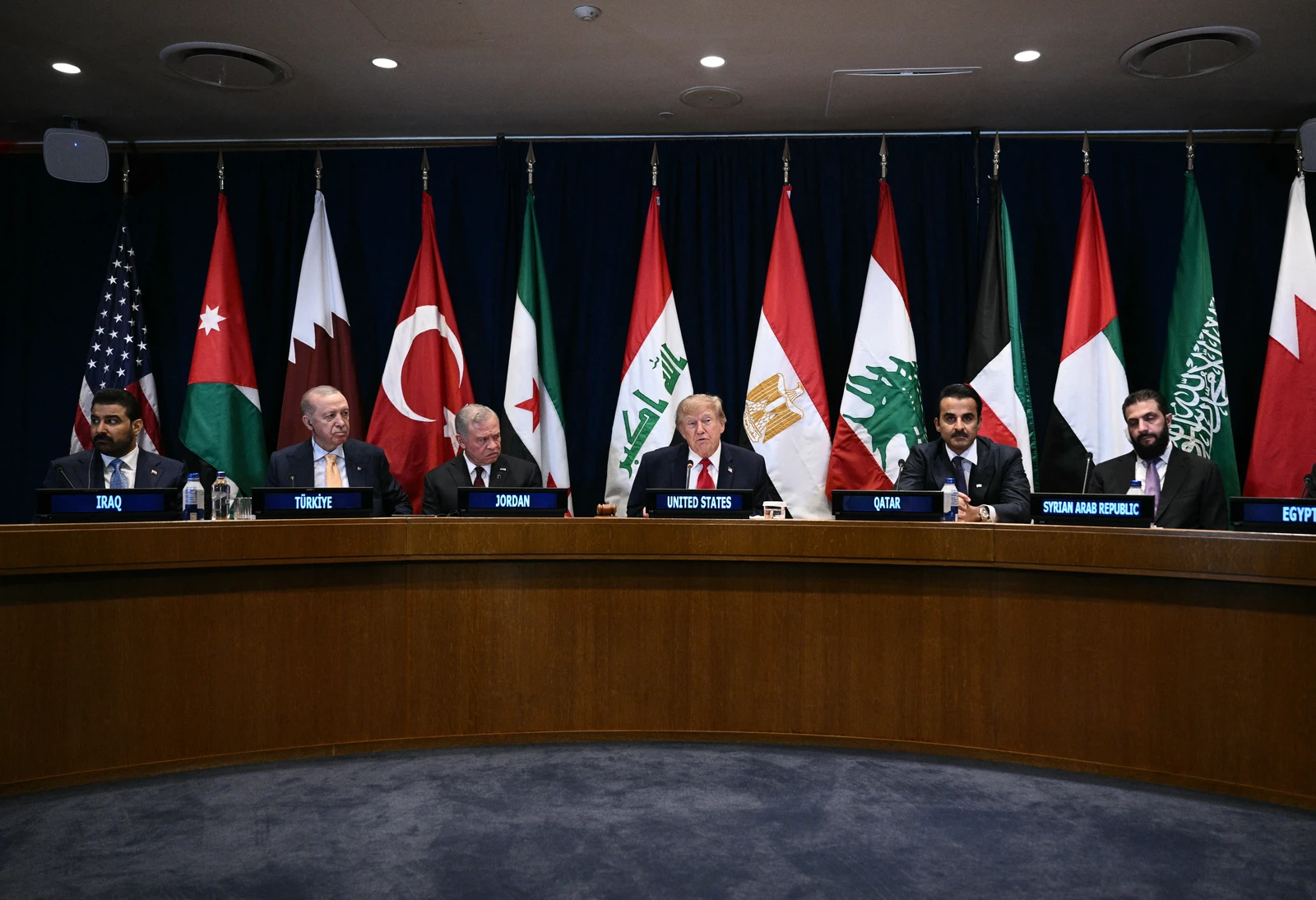

Last week brought an unusually dense stretch of American diplomacy on the Middle East. On the sidelines of the UN General Assembly in New York, President Donald Trump met representatives of 12 countries: the six GCC member states, alongside Egypt, Iraq, Jordan, Lebanon, Syria and Turkiye. The following day, Trump welcomed Chinese President Xi Jinping at Joint Base Andrews for a three-day state visit. Both took place with the Strait of Hormuz still closed to normal traffic, after a June memorandum of understanding between Washington and Tehran collapsed in August amid disputes over navigation through the strait.
The New York meeting ended without any new joint commitments or a timetable for ending the conflict with Iran. On its own, the meeting appears largely symbolic. But set against the events of the fortnight around it, the picture changes. The security commitments the Gulf has been asking for are being assembled piece by piece, through arms approvals and naval escorts, and the real question is whether Washington’s postwar plan will lock them into a form that outlasts the current administration.
The substance of the meeting itself was concentrated on shipping lanes and diplomacy. According to Riyadh’s readout, the delegates discussed the regional escalation and the security of navigation through the Strait of Hormuz and the Bab Al-Mandab Strait, as well as efforts to contain the conflict and strengthen diplomatic channels.
Trump told the room that his envoys, Steve Witkoff and Jared Kushner, had held productive talks with Iranian intermediaries and that a deal was getting closer. He also said the US had escorted more than a billion barrels of oil out of the Gulf and he endorsed alternative export routes and the India-Middle East-Europe Economic Corridor as ways of reducing the region’s exposure to vulnerable waterways. The same day, G7 foreign ministers, including the US, condemned Houthi strikes on Saudi Arabia and called on Iran to stop arming the group.
Vision 2030 and the wider diversification agenda depend on investors pricing the Gulf as a stable place to commit capital
Zaid M. Belbagi
On Sept. 17, the State Department approved the potential sale of 48 F-35 fighters to Saudi Arabia, valued at $24.3 billion. If completed, the Kingdom would become the first country in the region apart from Israel to fly the aircraft. Earlier in the month, Washington had approved a $5 billion sale of more than 10,000 bombs to Riyadh.
Then, on Sept. 23, Secretary of State Marco Rubio addressed the Houthi attacks directly. “We will live up to our commitments in that agreement,” he said, referring to the Strategic Defense Agreement signed during Crown Prince Mohammed bin Salman’s visit to Washington in November 2025, when Saudi Arabia was also designated a major non-NATO ally. These are material signals that the partnership is deepening under wartime pressure.
Washington heard its Gulf partners before receiving Beijing. Xi’s visit was his first state visit to the US in more than a decade and its only concrete deliverable was a two-month extension of the US-China trade truce to Jan. 10. On Iran, the two leaders talked past each other. Trump asked Xi to halt any assistance to Tehran, while Xi urged a return to the June memorandum and a nuclear deal.
The economic stakes explain why Gulf capitals want these arrangements formalized. The World Bank now expects Gulf economies to grow just 1.3 percent this year, down from 4.5 percent in 2025. About 80 energy facilities across the region have been targeted, with repair costs estimated at $58 billion, and QatarEnergy says restoring the Ras Laffan industrial hub alone could take up to five years.
The summit confirmed the US’ Gulf partners sit at the center of both its war planning and its search for a settlement
Zaid M. Belbagi
The region has absorbed this with considerable resilience. The UAE has kept crude moving by pipeline to Fujairah, bypassing the Strait of Hormuz, and Saudi Arabia has restarted its East-West oil pipeline after attacks in early September, a move Rubio described as critical to global trade. Yet Vision 2030 and the wider diversification agenda depend on investors pricing the Gulf as a stable place to commit capital. That same logic applies in Washington. With the midterms weeks away and Trump’s approval at a record low, the administration faces intense pressure to bring down petrol prices. Gulf security has become an American domestic interest.
The shared interests are clear but they do not, on their own, translate into binding commitments. The partnership is real but whether it becomes durable will depend on Washington’s institutions. The Strategic Defense Agreement was concluded by the executive and has not gone to the Senate as a treaty. The F-35 package still faces a 30-day congressional review and deliveries would be several years away even if it clears. Riyadh’s request for direct US action against the Houthis has so far not been met. Most importantly, the administration’s day-after plan for the war is expected to be finalized only after the midterms.
The New York summit confirmed that Washington’s Gulf partners now sit at the center of both its war planning and its search for a settlement. Those partners have already made clear that any settlement must return the Strait of Hormuz to its pre-Feb. 28 state and guarantee that no country can again hold either it or Bab Al-Mandab hostage. Meeting that condition would require a standing maritime security arrangement covering both straits, with Gulf navies inside the command structure, alongside congressional endorsement of the defense agreements already signed so that they outlast any single administration. The months following the midterms will show whether Washington is prepared to write that commitment into law.
Zaid M. Belbagi is a political commentator and an adviser to private clients between London and the Gulf Cooperation Council. X: @Moulay_Zaid


