
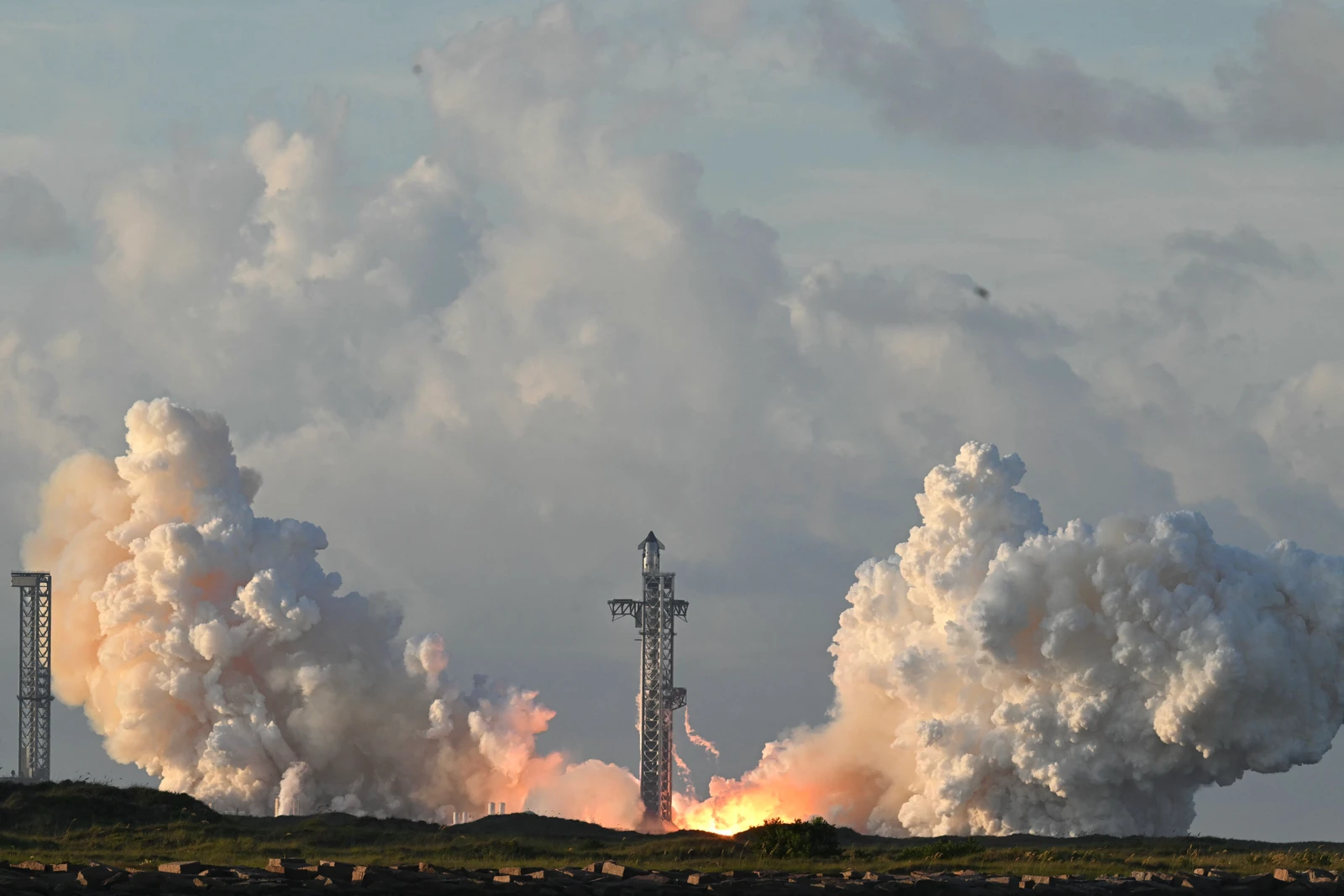

SpaceX’s Starship Flight 14 launched last week, marking a new era for the space industry. It reached orbit and successfully deployed 26 Starlink satellites. It has rightly been described as a genuine change in what is economically and physically possible in space.
This was not just another rocket launch, as Starship’s fully reusable design can lift 100 tonnes to 150 tonnes to low Earth orbit. This means it has more than twice the capacity of Blue Origin’s New Glenn and NASA’s Space Launch System and about four to six times those of the European Space Agency’s Ariane 6 and China’s Long March 5. Despite engine issues on both the booster and upper stage, the mission represents the next generation of launch and space infrastructure.
The significance goes beyond a single successful flight. SpaceX and Elon Musk are once again transforming the economics and scale of access to space. This is why SpaceX is beginning to phase out new commercial Falcon 9 and Falcon Heavy bookings beyond 2028. All efforts in engineering, manufacturing and production are now focused on Starship.
As well as having a smaller payload capacity, Falcon 9 cannot achieve the same flight frequency that is being targeted for Starship. The announced goal is to shift from several flights a month to several per day. This would create a completely different model for moving mass into orbit. Full reusability and high flight frequency would reduce the cost per kilogram of deliveries to space, potentially making missions and infrastructure that are currently too expensive commercially viable. This is the dawn of the real space economy. It clears the way for orbital data centers, in-space manufacturing, logistics and new communications systems, to name just a few possibilities.
Cheaper and higher-frequency access to orbit has the potential to create entirely new categories of space business
Khaled Abou Zahr
Cheaper and higher-frequency access to orbit has the potential to create entirely new categories of space business. You might want to compare this with how cheaper computing and connectivity opened markets that did not previously exist. Better technology allowed the development of cloud computing, software as a service, artificial intelligence, smartphones and entire digital platforms. Cheap and widespread connectivity allowed the development of social media, streaming, e-commerce, ride-hailing (which also needed GPS and space) and the app economy. While external customers cannot yet book Starship launches, the hopes for the future are great once reliability, recovery and rapid reuse are demonstrated.
This is part of the greater plan, which includes the building of a Starbase spaceport in Louisiana. This will provide the ground infrastructure for this next epoch. SpaceX has announced plans for a massive facility, with construction due to start in 2027 and an initial Starship launch possibly as soon as 2029. In order to achieve a high frequency of launches, the base will have multiple launch and landing pads, propellant production, power generation, vehicle processing, shipping infrastructure, housing and an airport. At full scale, the volume of launches will exceed, in a single day, what all today’s existing facilities combined can accommodate in a full year. Starbase is basically the steppingstone to an industrial-scale space transport system.
SpaceX has created a fully vertically integrated model. And in this shift, the rocket becomes a means to an end and not the core of the business, as it might have been until now. SpaceX has developed the capacity to launch its own satellites and operate the Starlink constellation. The strategic pieces fit together and Starlink provides an immediate internal customer capable of absorbing the enormous capacity that is planned. SpaceX will continuously increase its launch frequency to meet its own demand before opening the system to external customers. We are witnessing a new infrastructure empowered by higher flight rates and lower costs.
At full scale, the volume of launches will exceed, in a single day, what all today’s existing facilities combined can accommodate in a year
Khaled Abou Zahr
Not everyone is a believer in this new era. Critics state that there will never be the demand to meet the capacity that is being built and that the motto, “if you build it, they will come” does not work here. For them, this shift confirms the vertically integrated model of SpaceX toward serving satellite network and orbital compute business. Critics also point to the changing revenue mix and the successive strategic shifts from reusable launches to Starlink, Mars and now orbital computing as evidence of a company continually expanding into the next high-growth layer of the space economy.
Others argue that the original promise of lower prices created by the Falcon rocket failed to unlock the expected surge in demand for orbital launches. Today, external commercial customers still represent only a small share of the SpaceX business, with the majority of launches being used for its own Starlink satellites rather than serving third parties.
There is no doubt that this transformation will push the wider launch industry into the unknown, unless sovereignty considerations require nations to maintain their own launch capabilities. This will undoubtedly put pressure on existing launch economics and, on the other hand, unlock new orbital infrastructure and space-based services. A first point will be the role of transfer vehicles for the last mile, while Starship becomes the cargo ship. The bigger opportunity will therefore extend far beyond SpaceX and will go beyond Earth’s orbit.
The moon will become the next major destination and economic frontier and Starship is the vehicle to unlock this new phase. It will enable a cheaper and more practical way to transport cargo, equipment, habitats, power systems, rovers and other infrastructure to the lunar surface. This will make the moon habitable and allow the next phase of space development.
The challenges are clear. But when, not if, that transition takes place, this infrastructure will enable new services. These in turn will create entirely new markets and companies. In the not-too-distant future, Starship Flight 14 will be remembered as an event as important as the first moon landing.
Khaled Abou Zahr is the founder of SpaceQuest Ventures, a space-focused investment platform. He is the CEO of EurabiaMedia and editor of Al-Watan Al-Arabi.


