
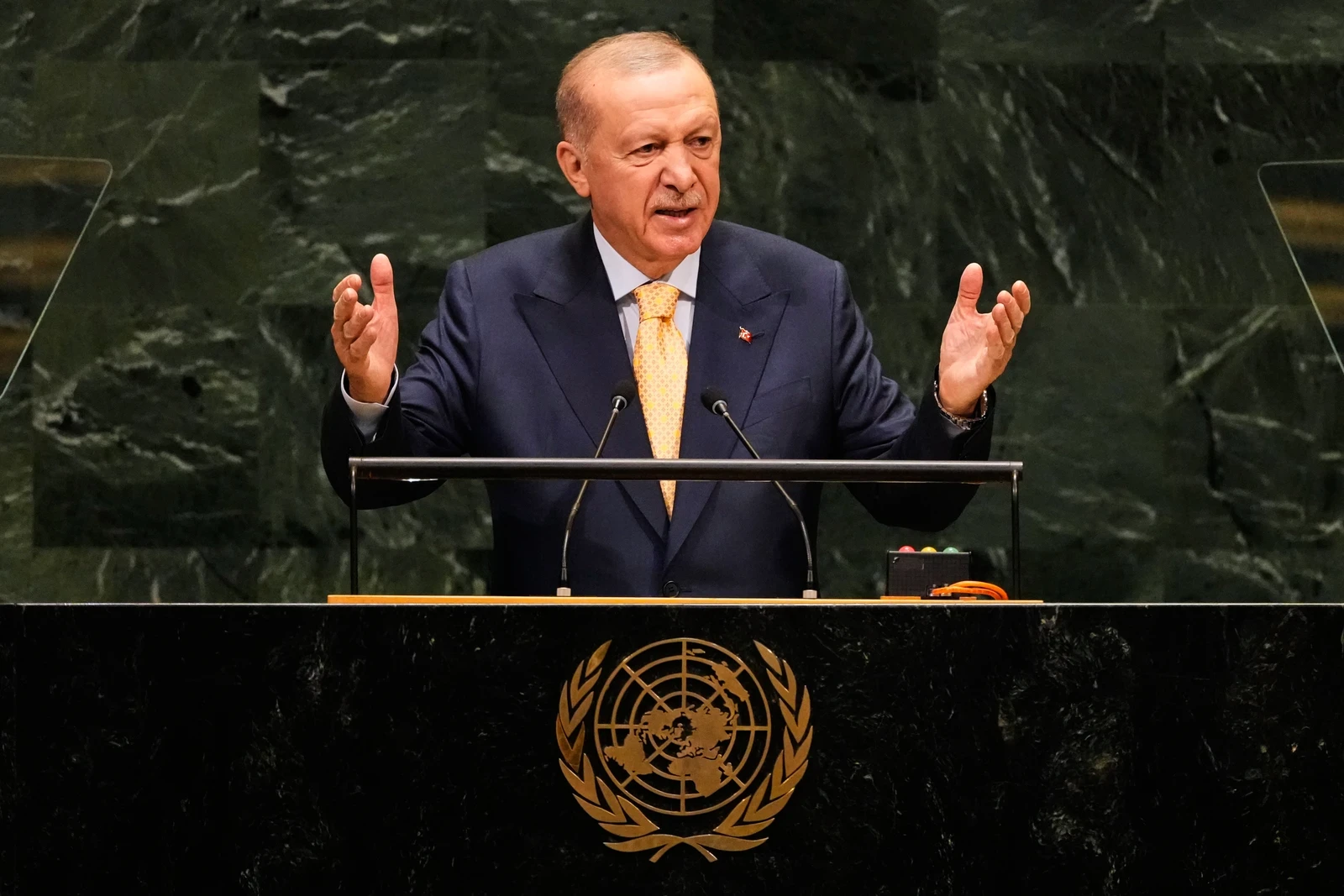

Heads of state and government gathered in New York last week for the 81st UN General Assembly, a platform that allows world leaders to set out their positions and priorities on major regional and global issues. However, this year’s gathering was different. It showed how Gulf Cooperation Council states and Turkiye, along with other regional states, are increasingly trying to shape the agenda at the UN on the issues that matter to them and the stability of the Middle East. Their agenda was common and clear: the US-Iran war; increasing Houthi attacks; disruption of the maritime shipping across critical chokepoints; growing Israeli aggression in the region; and the situation in Gaza, which remains unresolved.
In light of all these issues, a significant meeting took place between US President Donald Trump and the top representatives from the GCC states. The meeting was an expanded format that also included Turkish President Recep Tayyip Erdogan, Jordan’s King Abdullah, Syrian President Ahmad Al-Sharaa, and the prime ministers of Iraq and Lebanon. It focused on the security consequences of the Iran war, energy supplies, freedom of maritime navigation, and possible arrangements for the postwar period.
We have yet to hear much about what was discussed in the meeting, but the post-meeting atmosphere appeared positive. Trump said there was a “lot of momentum” around the talks with Iran, while Erdogan said that the meeting was held in an effort to overcome the difficulties in the Gulf and that the results of these efforts would be seen in the near future.
This was an important meeting not only because it showed the urgency Washington places on engaging with regional leaders, but also how regional states are increasingly able to coordinate their positions and present a more unified stance to the US. Such cohesion gives the regional states greater collective leverage and puts additional pressure on Trump to take their concerns and priorities into account.
In the past few years, we have seen meetings where regional states gathered in different formats to coordinate their positions. For instance, on the sidelines of last year’s UN General Assembly, GCC states held a meeting with Trump in which they also included Turkiye, Jordan, Egypt, and Pakistan. At that time, the main issue was Gaza, as the war on Iran had not yet begun.
This year’s UN gathering is a clear indication of a more coordinated regional posture on the international stage.
Dr. Sinem Cengiz
These meetings are significant because when GCC states coordinate with Turkiye, and other regional partners, they are able to present their concerns not simply as separate priorities but as part of a broader regional view.
Although not all GCC states share identical interests when it comes to some issues, when their concerns do converge, particularly on Iran war and maritime security, it gives them a role of “agenda-setters” in both international platforms as well as in their meetings with the global actors.
For GCC states and other regional states, the Iran war, Houthi attacks, disruption of maritime shipping, and the Gaza crisis are all closely connected to the security and the economic interests of the region, although the GCC states are among the ones that have been most severely affected by these crises. It is, therefore, important for them to internationalize these crises through the UN, or in their high-level meetings with the US directly. Trump had said before the meeting that he wanted to meet the GCC and regional leaders as he faced a “big decision” on the war and wanted to speak with them directly.
Despite the failures and limitations of the UN, the organization and its meetings still matter to middle powers and regional states as platforms for international diplomacy. Turkiye and the regional states, therefore, are trying to instrumentalize these platforms for their concerns on issues that the world tends to forget.
In this regard, the speeches of Erdogan, King Abdullah, and Qatari Emir Sheikh Tamim bin Hamad Al-Thani at the UN were also notable for drawing attention to stronger international action on Gaza. Erdogan used the UN podium to call on countries that have not yet recognized a Palestinian state to reconsider their position and urged the international community to increase pressure to enable the reconstruction of Gaza and advance the diplomatic process.
King Abdullah and Sheikh Tamim similarly placed the Palestinian issue and the humanitarian situation in Gaza at the center of their speeches. Also, a day before the meeting with Trump, the foreign ministers of Saudi Arabia, Turkiye, Qatar, Jordan, Egypt, the UAE, Indonesia, and Pakistan issued a joint statement expressing concern over the humanitarian situation in Gaza.
The coordinated regional position was also visible inside the General Assembly. As Israeli Prime Minister Benjamin Netanyahu took the stage, almost all the regional states, along with others outside the region, walked out — an important indication of the Israeli leader’s international isolation. The UN General Assembly became a significant platform for the regional states to prove this once again.
The UN remains weak in its ability to resolve the regional crises. The structure of the UN Security Council is also often criticized by Turkiye and the GCC states, particularly because its five permanent members hold veto power over critical decisions. Yet, for Turkiye, GCC countries, and other regional states, it remains an important diplomatic platform where they can shape the agenda and coordinate their positions. This year’s UN gathering is a clear indication of a more coordinated regional posture on the international stage.
Dr. Sinem Cengiz is a Turkish political analyst who specializes in Turkiye’s relations with the Middle East.
X: @SinemCngz


