
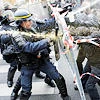

Short answer: No. The Paris event triggered war journalism; no peace journalism was observed.
Peace journalism was conceived in the 1960s as a reaction to foreign news negativism and focus on actors and elite people/countries. Not as advocacy of peace, but as journalism about peace, like war journalism is not advocacy of war, but indispensable journalism about war, reporting what happens and who is winning. It can be done well or not, and often becomes propaganda for one side, in national more than local and global media (with Anglo-American accent, however).
Thus, peace journalism was never a substitute for war journalism. The idea was to have both, complementing each other. The media suffer from bad, unprofessional journalism, reporting only one side of what goes on, only the negative, the violence, and only what elite actors in elite countries do. Plus some “leaders” in some other countries.
Take an epidemic as a metaphor. It has to be reported; etiology, lethality, where it started, how it spreads, the prognosis. However, if that is all, we feel that something is missing. We may call it health journalism and may see the reporting of the epidemic as biased disease journalism only. Journalists would, of course, also ask such questions as “what is the root cause,” “what kind of virus, micro-organism,” “how can we protect ourselves,” “how can we stop it?”
And to the government: “what are you doing or going to do about it?”
Answers may range from control of traffic, quarantine, inoculation to avoid contagion, and more long term strengthening of the immunity through better nutrition and exercise. We would all feel terribly short shifted by a journalism omitting that second part for the scourge of an epidemic, let alone for a pandemic. Yet, that is exactly what is missing for the scourge of war. The concept of “root causes” has arrived, that is already something; but not what they are, and what to do about it. The word “solution” has arrived, but not its content. We are on the way; but need much more.
Two root causes of war are trauma, wounds left by past violence leading to revenge; and conflict, incompatible goals pursued by the parties, leading to frustration due to blocked goals and to aggression. The words for the remedies are well known: Conciliation for traumas and solution for conflicts. But not how to do it.
Moreover, instead of exploring the goals of all parties in a conflict — ruling out nobody with some “anti” as in anti-communism, anti-terrorism, anti-jihadism, anti-Americanism, instead of exploring what kind of changes in reality could make their goals if they are legitimate and compatible, we may get a flat compromise satisfying nobody. Neither acceptable nor sustainable.
We must add some root causes of positive peace such as equity — cooperation for mutual and equal benefit — and empathy for harmony, being in each other’s shoes, to conciliation and solution for removing the root causes of war. A session of the US National Communication Association meeting in Las Vegas Nov. 19-22 was on Peace Journalism; a good move. The four papers were on the use of radio for peace journalism, on feature journalism on daily life and its issues, and two papers on Ukraine. The papers document how “peace journalism” comes across in the US.
Radio, more in public space than Internet communication, is a medium for two-way communication, dialogues, the mediation building blocs, with others listening in. As in Abie Nathan’s Voice of Peace for the Middle East; but no concrete solutions were mentioned. Nor for Radio Brod (“boat radio”) off the Yugoslav coast in the 1990s, or for Radio Okapi in Congo. And yet, their very existence was positive.
Feature journalism, focused on the individual, family and community, explores how issues are “confronted, ignored, resisted, enhanced.” And above all, solved; but no examples were given.
Nevertheless, we are on the way from nothing to something. Which “root causes” to be removed and to be built is a major peace journalism issue for dialogue.
n Transcend Media Service


