
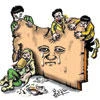

Has Libya totally unraveled as a nation, rendered a hodgepodge of city-states, run by dozens of militant groups answerable to no one? Looks like it. If so, why has the country’s plight sat on the international community’s back burner for the last four years?
According to Libya’s National Oil Company, eleven of the country’s oil fields are now inoperative because of “theft, looting, sabotage and destruction by unidentified armed groups” whose inter-factional confrontations have closed oil ports and disrupted production. Oil, keep in mind, is the lifeblood of he Libyan economy and virtually the only source of government revenue, indispensable, as it were, to the vitality of social life. Last Wednesday, the company said “if security deteriorates, the corporation will be forced to close oil fields and ports” and warned that such a step “will result in a total deficit in state revenues and directly impact people’s lives, including with power shortages.”
Libya has no army, no central government, no Parliament, no provincial governors, no civil society, no police. What Libya has are a lot of armed militias — at last count, roughly 60 of them, who have been running amuck, wreaking havoc in the land and visiting on their perceived enemies the same type of torture and mayhem carried out by the old regime.
What are the chances of Libya ever recovering from its descent into this hellish inferno any time real soon? In fact, according to Jon Lee Anderson, a noted American author, who traveled for two weeks in Libya recently and wrote a grim piece about his findings there, the chances are remote. To attest to that, he quotes Benjamin Rhodes, the deputy national security adviser and a close friend of President Obama, as telling him that getting political leaders and militia leaders to agree on anything is dicey.
Most revolutions are easy to start but difficult to bring to a meritorious conclusion. After all, revolutionaries set out to do no less than to effect a radical restructuring of their country’s polity — its economy, social life, political institutions, constitutional laws, and the rest of it. Where they succeed, say as in the case of the French Revolution, which began in 1789, and the American Revolution, which began in 1765, they do so because they had been anchored in antecedents.
In France, for example, the storming of the Bastille was inspired by the intellectual effusions of the so- called “encyclopedistes” or “philosophes,” that had set the parameters of the social contract between the ruler and the ruled. Checks and balances, the rights of man and constitutional guarantees that supported tolerance, plurality and open-mindedness. .
In like manner, the American Revolution was anchored in the Enlightenment’s liberal theories about governance, political philosophy and scientific empiricism — all of which predictably culminated in the transformation of America from a distant backwater as a British colony to the American Republic we know today. In both cases, the revolutionary movements had intellectual origins. In both cases, revolutionaries were guided by ideas, by a “book of instructions,” if you wish, on how to restructure a new state. And thus in both cases, the French and the American vanguard in the revolutionary struggle ended up profoundly altering the course of modern human history, not just the political destiny of their own people.
Sometimes, even where a revolution is anchored in well-defined ideas, that revolution is likely to fail where the ideas are subverted. In Russia’s 1917 Bolshevik revolution, as a case in point, the communists claimed the right to lead because they allegedly understood the Marxist dialectic, or the immutable “laws of history,” and therefore the destiny of men and women — and not just that of Russian men and women. And in Iran’s 1979 revolution, the leaders there claimed a special ability to interpret the will of God. To that extent, revolutionary governments were set up with extensive powers, whose end result was not a golden age of prosperity but, in the former, collapse and in the latter disillusionment.
The Libyan people, sadly, had been denied throughout their modern history, whether under colonial rule by Italy or indigenous rule under Col. Muammar Qaddafi, any freedom to engage in ideas and build an intellectual heritage of their own that they could draw on.
Libyans came from such a vacuum, and lived such vacuous lives under the dispensation of the old regime, that an infantile tome like The Green Book, penned by the Supreme Leader, was considered such a treasure trove of astute ideas. Libyans began their lives in a vacuum, and they remain in a vacuum today, lashing out at each other, at their nation and their fate. They deserve better.


