

WHO was Yitzhak Rabin, whose assassination 20 years ago this month by a messianic Jewish extremist was commemorated by tens of thousands of Israelis in a central square in Tel Aviv on Oct. 31?
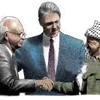
To a great many people in the Euro-American world, he was the “moderate” Israeli premier and courageous “peacemaker” who signed the Oslo agreement on the White House Lawn in September 1993 and shook hands (not so warmly, to be sure) with his nemesis Yasser Arafat, an event that was to herald a new era of peace, peace at last, between Israelis and Palestinians.
A cursory probe into Rabin’s background, however, would reveal that the man was a war criminal. To the outside world he may have been a statesman, but to Palestinians, who were familiar with that background, he was a statesman who never shed his uniform as a soldier, his ambitions as an expansionist and his penchant for cruelty as an occupier. Nor was he above ethnic cleansing, an act usually identified in international law as a war crime.
Consider the case of Lydda and Ramleh, the twin cities in Palestine lying outside the area designated for a Jewish state in the UN Partition Plan of 1947. In July 1948, Jewish troops, commanded by none other than Yitzhak Rabin, were given orders to expel the entire population of the two towns and to do it quickly “without attention to age.” Roughly 100,000 Palestinian men, women and children were driven out, and to hasten the process, Jewish soldiers went about throwing grenades into homes. Many of the residents, who ran out in panic, were shot at indiscriminately.
Many Jews who between 1948 and 1951 came to live in what came to be known as Israel settled in the refugees’ empty — and fully furnished — homes as a matter of government policy, aimed at preventing former residents from reclaiming them. In Israeli mythology, the residents went quietly “of their own accord,” but that mythology soon went by the wayside after Israel’s New Historians, people like Benny Morris and Ilan Pappe, showed via their research that what had happened in Lydda and Ramleh was, very simply, ethnic cleansing.
Perhaps the most gut-wrenching account of what befell these refugees following their expulsion from their homes is to be found in Larry Collins and Dominique Lappier’s iconic book, O Jerusalem (1972). “Under a boiling sun, clutching what few possessions they had had time to gather, an occasional Israeli bullet whistling overhead to keep them moving,” the authors write, “the miserable column of human beings stumbled over the rock and thorn-strewn hillside toward Ramallah. An unknown number of the aged and the young died during the trek.”
That was all thanks to Yitzhak Rabin, the “peacemaker.” As he was about to publish his memoir in 1979, where Rabin intended to break the taboo and that, no, the Palestinians of Lydda and Ramleh did not leave their home and homeland “of their own accord” but were driven out at gunpoint, a Cabinet committee that checks ministerial memoirs for security reasons, ordered that the mea culpa passage be deleted. Rabin appeared before the committee and was told, according to his ghostwriter, Dov Goldstein, “Yes, the story is open and true, but it can’t come from the mouth of one of our heroes, from someone who was involved in it personally, who was prime minister of Israel, because it will ruin our claim that we acted humanely.”
Reportedly, Rabin went along, and instructed his English translator, who was already in possession of the manuscript, to do the same. The translator instead passed the story on to the New York Times.
Then Rabin went from ethnic cleanser to bone breaker. As prime minister, soon after the outbreak of the first Intifada in late 1987, he was no less brutal as he gave orders to his occupation soldiers: “Break their bones.” And who would forget, among other brutalities, that memorable scene — a scene that many TV stations refused to show because of its grotesqueness — when a CBS cameraman caught four Israeli soldiers on film pounding away with their rifle butts and rocks at the heads, arms and legs of two young Palestinian stone throwers captured on a hillside near Nablus?
And the “peacemaker” who signed the Declaration of Principles on the White House Lawn, and effusively shook hands all around — clearly in bad faith — was soon back in the Israeli entity frenziedly building roads to connect colonies in the West Bank to each other and to Israel, a campaign whose goal was clear: Established colonies are facts on the ground, not occupied land to be returned to its rightful owners — Oslo agreement or no Oslo agreement. The road building was so frenzied that, according to Walid Khalidi, the Palestinian American scholar, American diplomats in Jerusalem were sending urgent cables to the State Department to express their alarm.
If someone like Yitzhak Rabin is celebrated as an Israeli peacemaker, then God save us from someone defined as an Israeli warmonger.


