
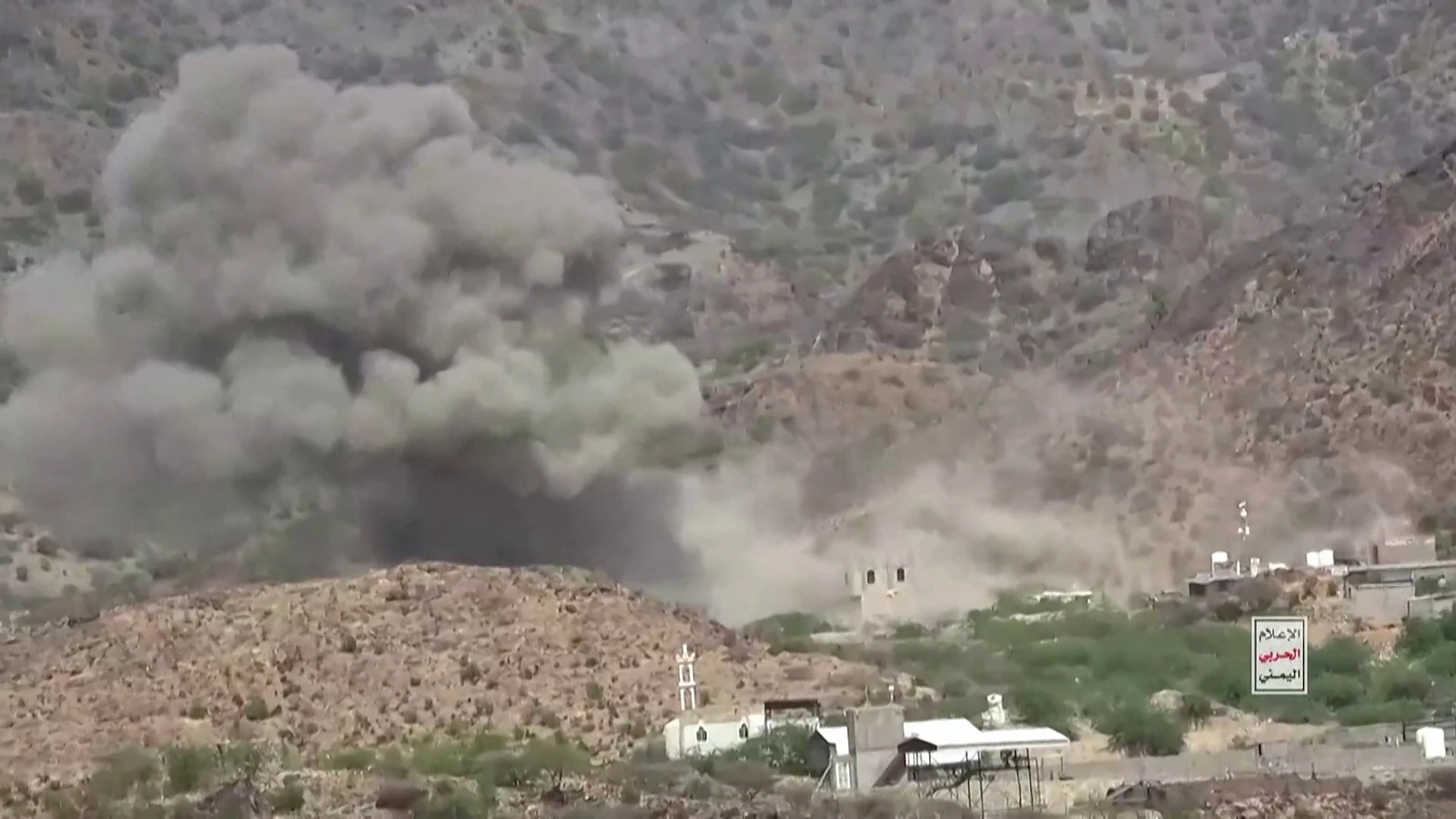

The Yemeni Houthi militia on Monday targeted several Saudi cities — Khamis Mushait, Abha and Taif — with ballistic missiles and drones, according to a statement issued by the Coalition to Restore Legitimacy in Yemen. The following day, the coalition announced that the attacks had injured 13 civilians and damaged seven homes and two vehicles.
This round of hostilities came less than a week after attacks that targeted Abha, Khamis Mushait, Jazan and Najran, injuring 73 civilians, including women and children, according to the coalition. Al Arabiya aired footage of the wounded being treated in Saudi hospitals, along with photos showing damage to homes and residential neighborhoods.
These figures are significant, as they indicate a return to a pattern that years of de-escalation and negotiations were supposed to have made less likely: the use of missiles and drones to impose political and security dynamics beyond Yemen’s borders. The calculations behind it are regional. The Houthis belong to the Islamic Revolutionary Guard Corps’ so-called Axis of Resistance and their aim is not only a tighter grip inside Yemen but leverage over the tankers and ships that pass through the Bab Al-Mandab Strait, thus widening the Strait of Hormuz crisis and raising its cost for countries in the region and their allies.
On Tuesday, a notable development occurred as the sirens sounded in Makkah, the holiest city for Muslims worldwide. Although the Grand Mosque remained safe and life went on as normal, this incident was considered serious. According to a Saudi source I spoke with, “the recent Houthi escalation has proved how dangerous it is for the militia to retain ballistic missiles and long-range drones. Capabilities it was allowed to acquire under the pretext of the conflict in Yemen are now being used to threaten Saudi cities and reach as far as Makkah and Madinah, necessitating a firmer international stance toward the source of their weapons and funding.”
Although the Grand Mosque remained safe and life went on as normal, this incident was considered serious
Hassan Al-Mustafa
The source noted that the targeting of Makkah “exposes the Houthi project for what it is: it invokes the holy sites when they serve its rhetoric, ignores their sanctity when they obstruct its interests and its backers’ agenda, and puts their security at risk.”
Given the gravity of the Houthis’ action against the security of the Kingdom and the Middle East, the Saudi Cabinet, chaired by Crown Prince Mohammed bin Salman, took a more resolute stance in condemning the attacks in its Monday session. The Cabinet stressed that “the security of Saudi Arabia and the integrity of its territory and its resources are firm principles that cannot be compromised, and that it has the legitimate right to defend itself and protect its sovereignty, citizens, residents and vital interests in accordance with the Charter of the United Nations and the provisions of international law.”
These clear stances coincide with the Houthis’ expanding presence along Yemen’s western coast and the vicinity of the Bab Al-Mandab Strait — a geographical reality that makes it impossible to separate the internal war from international trade.
The US Energy Information Administration estimates that 9.3 million barrels per day of oil and petroleum products passed through the Bab Al-Mandab Strait in 2023. Following an escalation in attacks on shipping, that volume fell to 4.1 million barrels per day in 2024, reaching 4.2 million barrels per day in the first half of 2025. Liquefied natural gas flows through the strait also fell to nearly zero during the same period.
This brings the issue of deterrence back to the forefront as a means of bringing the current events to an end
Hassan Al-Mustafa
These figures clearly illustrate the nature of the threat, which endangers not only the energy-exporting Arab Gulf states but also the global economy as a whole.
The Houthis do not need to close the Bab Al-Mandab Strait to raise the economic cost for everyone. The mere existence of an offensive capability to target or approach ships is enough to force shipping companies to reroute their vessels and extend voyage time.
The foregoing clearly indicates that the Houthi danger cannot be merely viewed as a threat to Saudi security. The Kingdom is the most vulnerable party due to its geography but the Bab Al-Mandab Strait is a corridor for energy and goods coming from the Gulf and Asia and heading to Europe and the Mediterranean.
Another more complex dimension is the nature of the Yemeni state itself. The issue is not the existence of an opposition political group or a local movement with social representation. The dilemma arises when an armed group possesses effective authority, ballistic missiles, drones and naval forces, while keeping these capabilities outside legitimate state institutions.
This brings the issue of deterrence back to the forefront as a means of bringing the current events to an end. Deterrence does not mean launching a new war with no limits or objectives. Saudi Arabia understands the implications of this option and recent years have demonstrated the limitations of air power in a conflict that is socially, geographically and tribally complex. However, it is also difficult to build a stable settlement if the use of missiles and drones remains a low-cost means of raising the bar on demands and engaging in financial and political blackmail.
Therefore, Riyadh is likely to act within a calculated vision, aiming to protect its cities and infrastructure and launch deterrent airstrikes against Houthi military capabilities, while simultaneously strengthening the capabilities of the Yemeni government, whose forces are already fighting the militia on the ground.
At the same time, diplomacy will remain a key component. The Saudi Cabinet’s statement reiterated the approach of dialogue and cooperation with the international community. This is significant, as what is needed is not an equation built on retaliation. Rather, a comprehensive plan is required that pairs force with diplomacy and ties any political agreement to clear rules on arms, ports, border security and freedom of navigation.
It seems unlikely that the Bab Al-Mandab Strait will be completely closed in the short term. It is more likely to remain open but with a high level of risk, while maritime and missile threats continue to be used as a means of applying pressure. If attacks extend to targeting a major energy facility or if civilian casualties within Saudi Arabia rise, the intensity of the Saudi military response will increase and become very decisive, demonstrating no tolerance toward the Houthis.
• Hassan Al-Mustafa is a Saudi writer and researcher specializing in Islamist movements, the evolution of religious discourse, and Gulf-Iran relations.
X: @Halmustafa


