
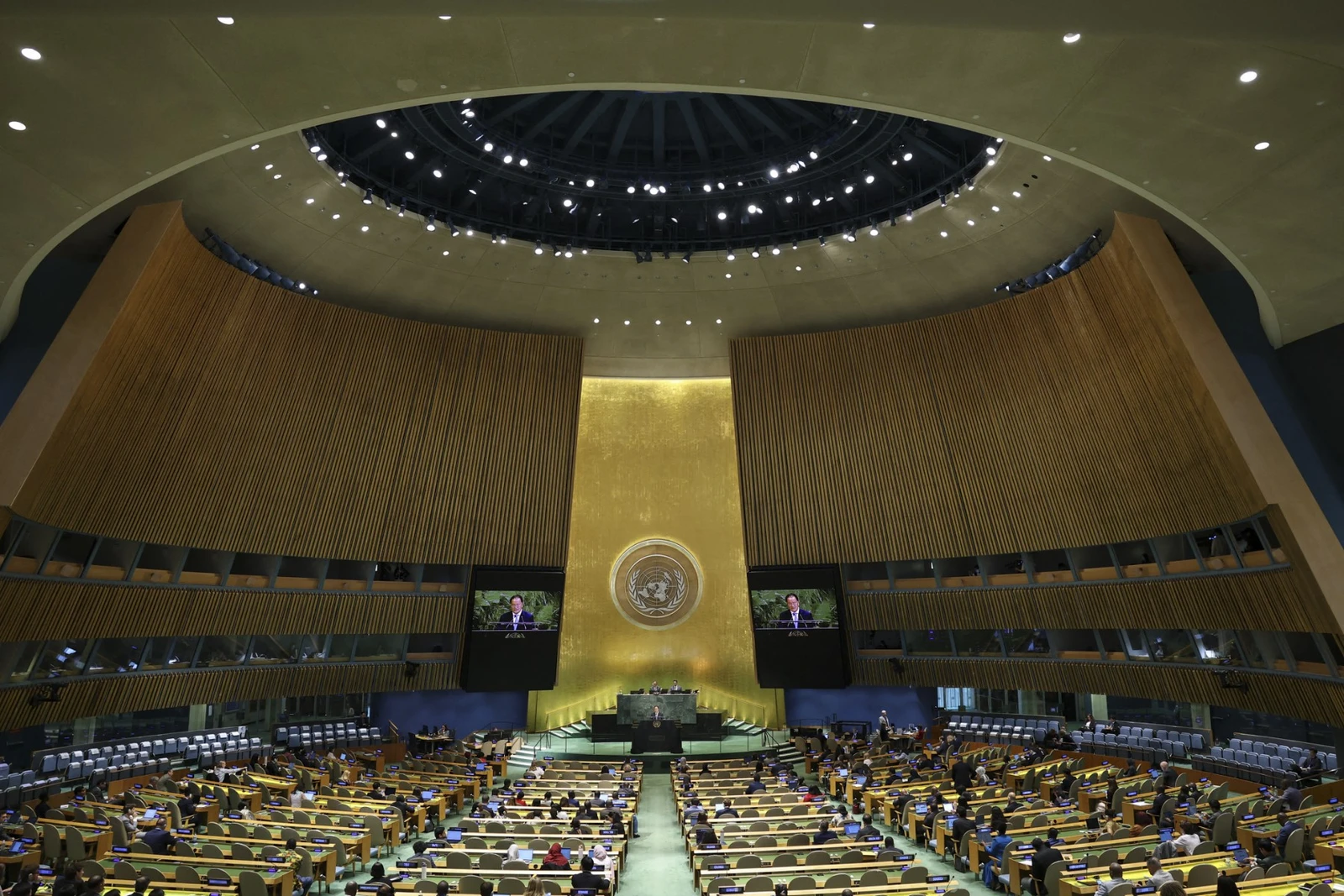

A new language on Palestine was the most noticeable change at this year’s UN General Assembly high-level meetings and in statements by Israel’s closest allies.
Last Thursday, Saudi Arabia co-chaired a meeting, along with Canada, France and the UK, on the implementation of the two-state solution. It was held on the first anniversary of the adoption of the UN resolution endorsing the New York Declaration. That landmark resolution was adopted overwhelmingly, with only 10 countries in opposition, including Israel, the US and a handful of Pacific islands. That resolution capped the efforts of many countries around the world, led by Saudi Arabia, France and Norway.
At this year’s UNGA, the language became sharply critical of Israel, including by some of its closest allies. In part, this shift is due to the diplomatic activity of the past three years to promote the two-state solution, but mostly it appears to be in reaction to Israel’s recent actions. There is clear revulsion at the continuing genocide in Gaza and ethnic cleansing in the West Bank, which appear to be designed, approved and carried out as official policy.
There is clear disappointment that President Donald Trump’s 20-point Gaza peace plan, which was endorsed by UN Security Council Resolution 2803, is going nowhere because of Israel’s obstruction of its implementation. Israeli ministers reject the plan and instead speak openly about expelling Palestinians from the Strip. To achieve that goal, Israel blocks aid, bars UNRWA from providing basic services and prevents Gazans from returning to their homes.
There was fear that time is running out before Israeli actions trigger another crisis of catastrophic proportions
Dr. Abdel Aziz Aluwaisheg
There was fear among many at the UN that time is running out before these Israeli actions in Gaza and the West Bank trigger another crisis of catastrophic proportions. King Abdullah of Jordan spoke to this in a moving speech delivered on Sept. 22. He said that what was happening in the West Bank was not simply an escalation but a fundamental shift in the course of the Israeli occupation.
“What was once a creeping process has exploded into something far more aggressive. Settler violence is rampant. Palestinians are being beaten, shot and terrorized. Homes torched. Property destroyed. Families driven from their land. And Israel is tightening its grip on more of the West Bank, seizing land, expanding settlements and pushing Palestinians out,” he said.
King Abdullah explained: “What is unfolding across the West Bank is not a series of isolated acts. It is elements of a single policy to compel an entire population to leave their land.” He added: “And there is a name for that: forced displacement. And that is a war crime.”
Israel intends to make Jordan the destination for those forced out of their land in the West Bank. It is home to millions of Palestinians who were driven out of their homes in previous waves since 1948, including 2.4 million who are registered with the UN as refugees.
The Trump administration again banned Palestinian President Mahmoud Abbas from attending the session in person, perhaps hoping that his absence would dampen the support movement at the UN. But the opposite happened. The contrast in delegates’ reception could not be greater between their warm applause for Abbas, who spoke via video, and the mass protest of 70-plus nations whose delegations left the General Assembly Hall when Israeli Prime Minister Benjamin Netanyahu stood at the podium, leaving him speaking to a nearly empty room.
In a speech clearly directed at his constituents in Israel, Netanyahu said that Israel did not commit genocide in Gaza but prevented one from happening. He so desperately needs to win the upcoming election that he took a risk in flying to New York, dodging the arrest warrants outstanding against him.
The shift in positions of some close allies of Israel has been remarkable. The UK’s reversal, in particular, has been extraordinary
Dr. Abdel Aziz Aluwaisheg
Delegates spoke of a lack of balance in barring Abbas from attending, in clear violation of the US-UN headquarters agreement, while allowing Netanyahu to attend even as he was sought by the International Criminal Court for war crimes and crimes against humanity. They cited Israeli policies that were in clear violation of UN principles and conventions, including genocide in Gaza and ethnic cleansing in the West Bank.
The meeting on the two-state solution held on Sept. 24 was attended by heads of state and government and other senior officials from more than 100 countries and organizations. The statement by its co-chairs stressed three points. First, the two-state solution is the only path to achieving Palestinian political rights, including the right to establish an independent state in Gaza and the West Bank, including East Jerusalem, along the 1967 lines.
Second, the rejection of Israel’s actions meant to block this solution, including settler violence and settlement expansion in the West Bank, violations of the legal and historical status quo in Jerusalem, and blocking the return of Gazans to their homes.
Third, the statement called for unhindered delivery of aid and expressed support for UNRWA to carry out its duties in helping Palestinian refugees.
The shift in the positions of some close allies of Israel has been remarkable. The UK’s reversal, in particular, has been extraordinary. Foreign Secretary Ed Miliband said in a speech this week that, while the UK fought antisemitism at home and supported Israel’s right to exist and defend itself, it equally opposed its policies toward the Palestinians. “We call out ethnic cleansing by the settler terrorists in the West Bank. We call out the evidence of war crimes in Gaza. We call out Israel’s illegal occupation of Palestine,” he said.
The reference to ethnic cleansing, war crimes and “illegal occupation of Palestine” is unusual in recent UK statements. But Miliband was clearly meaning to apologize for previous fence-setting on these issues, as he added: “I want to say to the millions of people in this country and indeed elsewhere, who have been moved and outraged by the plight of the Palestinian people. We hear you. You were right.”
Miliband had previously announced a number of trade sanctions against settlement exports to the UK.
A week earlier, a ban by the Netherlands, another close ally of Israel, on imports and the sale of products from settlements in the West Bank, including Jerusalem, and the Golan Heights entered into force. In April, at the initiative of the Netherlands, the EU reached an agreement regarding a third package of sanctions against a number of extremist settlers and organizations that support them. Work is underway on a fourth package of sanctions.
Officials in Germany, Israel’s staunchest ally in Europe, have also criticized some Israeli excesses, including rebukes voiced by its Chancellor Friedrich Merz.
These developments have led The Times of Israel newspaper to conclude: “The Netherlands is just a symptom of a widening global boycott against Israel.” It said that in the year since Trump’s Gaza peace plan was adopted, “Israel’s international standing continues to plummet. The latest European restrictions threaten to exact a heavy economic toll.”
More needs to be done to translate the growing support for Palestine and criticism of Israel into action to reverse Tel Aviv’s destruction of Gaza and its creeping annexation of the West Bank. The statements made by Israel’s closest friends and the sanctions imposed on some of its officials and on settlement exports are steps in the right direction.
Dr. Abdel Aziz Aluwaisheg is the GCC assistant secretary-general for political affairs and negotiation. The views expressed here are personal and do not necessarily represent those of the GCC.
X: @abuhamad1


