
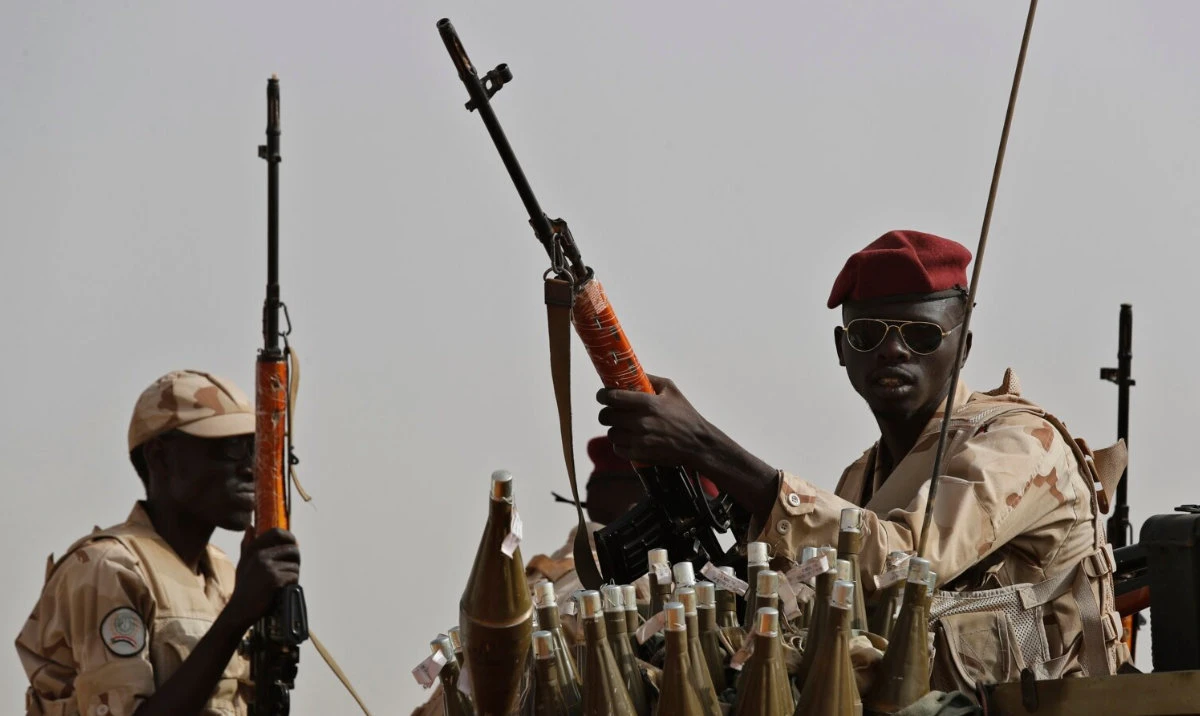

In April 2023, fighting erupted in Khartoum between the Sudanese Armed Forces and the paramilitary Rapid Support Forces. For more than two years, the conflict that followed behaved like most civil wars: brutal inside its borders, dangerous to its neighbors but fundamentally localized.
Those days are over. The conflict in Sudan has now breached the physical and political boundaries that once defined it, and it is doing so through three channels that reinforce one another with alarming efficiency: armed drones are violating the airspace of neighboring states at will; a transnational gold pipeline is converting looted minerals into weapons on a near-industrial scale; and more than 14 million displaced people are pouring into countries with no capacity for absorbing them.
Each of these channels connects to existing fault lines in the Horn of Africa, from the dispute over the Grand Ethiopian Renaissance Dam to the rivalries between foreign powers competing for Red Sea real estate.
Sudan’s civil war has, in other words, stopped being simply a Sudanese story.
Starting with the air war, Sudan’s battlefield shifted to the kind that respects no borders. In early 2025, SAF aircraft pursued an RSF convoy about 100 km inside Chadian territory, a depth of penetration that would constitute an act of war under almost any reading of international law.
A few weeks later, a drone struck a funeral gathering in the Chadian section of Tine, killing civilians and forcing Chad’s air force into a permanent state of alert. Meanwhile, Chad is hosting more than a million Sudanese refugees, making it a sanctuary, a target, and a combatant-adjacent party, all at once, in a war it never chose to enter.
Ethiopia represents an even more dangerous variant of the same pattern. Relations between Khartoum and Addis Ababa deteriorated sharply after Sudanese technical teams claimed to have identified serial numbers that proved drones hitting the capital were being operated from Ethiopia’s Bahir Dar Airport. The airport sits at the heart of the Amhara region, where Ethiopia’s own Fano insurgency has torn through the countryside, also beginning in April 2023.
Any direct military exchanges between Khartoum and Addis Ababa risk welding Sudan’s war to Ethiopia’s internal woes, creating a single continuous arc of instability stretching from the Red Sea to Lake Turkana.
Moreover, gold is greasing the machinery of this perpetual war, and the numbers behind it are striking. Sudan produced about 70 tonnes of gold in 2025, worth more than $7 billion at prevailing prices, and approximately two-thirds of it left the country via smuggling routes. The RSF controls the artisanal mines of Darfur and Kordofan, where digging often takes place at gunpoint. The SAF oversees extraction in the east.
About 60 percent of the gold from SAF-held territory moves first to Egypt, where it is laundered into formal circuits before arriving in Dubai. Gold from RSF territory follows parallel routes, much of it ending up in overseas refineries. Once melted, assayed and sold, the metal becomes cash for fuel, mercenaries, and drones. Every gram that crosses the border extends the war by another day.
Sudan’s battlefield shifted to the kind that respects no borders.
Hafed Ghwell
Western policymakers have noticed the gold pipeline and taken steps to address it — at least on paper. In July, the EU imposed sanctions banning the import of Sudanese gold, and the export of mercury and cyanide, the chemicals used in artisanal refining.
Though this measure appears decisive, when examined more closely it is clear that the EU imports virtually no Sudanese gold directly, and the chemicals that matter flow primarily from Asian suppliers, which Brussels does not control.
The UK, however, has managed to sanction smugglers and middlemen, rather than trade categories, demonstrating the feasibility of targeting the networks through which the money moves, rather than mere geography.
As for the war itself, nowhere are the stakes more high than in the Nile Basin. Egypt regards the SAF as a key partner in its long-running dispute with Ethiopia over the Grand Renaissance Dam, which Cairo fears will restrict the flow of water on which nearly 110 million Egyptians depend. Addis Ababa, for its part, tolerates RSF supply lines that run through its territory. Therefore, Sudan has effectively become the kinetic expression of a water dispute that diplomacy has failed to resolve for more than a decade. As a result, every drone launched from Ethiopian soil and every arms shipment arriving at Port Sudan raises the probability that a disagreement about cubic meters of water will become a war between standing armies.
Adding to these woes we have the fragmentation of the country itself. Sudan has become a de facto partitioned state, which renders the idea of containment almost meaningless; there is no single government whose consent neighbors can seek, no single chain of command whose violations can be protested, and no single peace process that could plausibly end the fighting.
Furthermore, the unprecedented human tide compounds the danger. Of the millions forced from their homes since April 2023, more than 4.2 million have crossed into neighboring states. Host countries maintain refugee camps that strain increasingly scarce resources and local labor markets, reviving old tensions between local host communities and the new arrivals along tribal and ethnic lines. Aid workers describe situations in which a dispute over a well or a market stall can reignite conflicts that predate the refugee arrivals by generations.
Against all of this stands a humanitarian response that is, by any reasonable measure, overstretched, underfunded, and under attack. The UN has appealed for about $2.8 billion to cover the response in Sudan this year, with 33.7 million people in need of assistance and 20.4 million targeted for aid.
As of this month, donors had funded just 41 percent of the plan, and some sectors fare much worse than others. Education, for example, which keeps children out of recruitment networks, sits below 20 percent funded. Last year’s appeal was less than 40 percent funded, and aid cuts have ripped hundreds of millions of dollars out of programs that once fed refugees in Chad and treated the wounded in Darfur.
Looking ahead, Sudan’s war has settled into an eerie equilibrium in which the global community knows almost everything about how the conflict is financed, who is arming whom, and where the next border violation will occur, and yet takes steps that are designed to look consequential rather than actually be consequential.
All the while, millions of people remain displaced, tonnes of gold continue to be smuggled, incursions into sovereign territory mount, and a deepening rivalry over the Nile is poised to turn into a proxy war.
All of the ingredients for a regional catastrophe are in place but what is missing is the will to treat Sudan’s war as a runaway catastrophe, because every month of delay allows the pipelines to harden, the fault lines to deepen, and the human cost to climb.
• Hafed Al-Ghwell is senior fellow and program director at the Stimson Center in Washington and senior fellow at the Center for Conflict and Humanitarian Studies.
X: @HafedAlGhwell


