
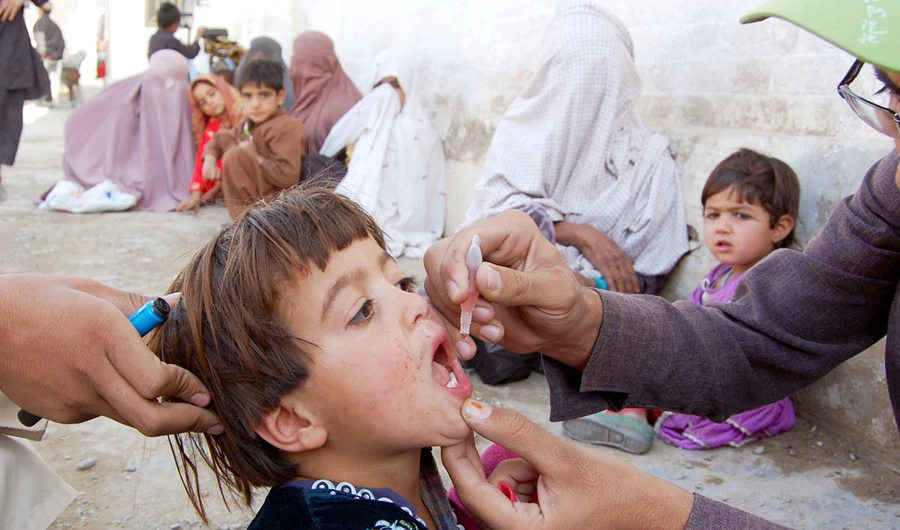


Most families who come to Mirwais Hospital in Afghanistan’s southern Kandahar province arrive because illness or injury has already struck. Abdul Rahman’s father made the difficult one-hour journey for a different reason: to protect his 4-year-old son from polio.
We met him at the hospital’s vaccination corner in July, when we were visiting Afghanistan and Pakistan as part of the Global Polio Eradication Initiative’s Polio Oversight Board delegation. Within weeks of our visit, multiple children in the same province were paralyzed by polio.
For many parents, traveling to vaccinate their child means taking time away from earning a living — time they cannot always afford. The priority is clear: Bring vaccines to the homes of children still being missed, reaching every child repeatedly and safely until polio is gone.
Afghanistan has reported 42 cases of wild polio so far in 2026, compared with 21 in the whole of last year. Pakistan, the only other country where wild poliovirus remains endemic, has reported seven cases so far, compared with 31 in 2025. Since the global polio eradication effort began in 1988, wild poliovirus cases have fallen by more than 99 percent. What remains is concentrated in places where the barriers to healthcare are greatest.
Trust is as important as the logistics
Dr. Ziad Memish and Dr. Jamal Ahmed
The remaining challenges are specific, and so are the solutions. In Afghanistan, some families can make the journey to a vaccination site, as Abdul Rahman’s father did, but others cannot. National authorities and partners are working to bring services closer to more of them, although coverage still remains below eradication levels. In southern Khyber Pakhtunkhwa in Pakistan, to overcome access challenges, teams are adapting and innovating their approaches to reach more children. Visiting every home remains the quickest and most effective way to ensure every child is vaccinated.
The challenge extends beyond the two remaining countries where wild poliovirus is endemic. In countries such as Somalia and Yemen, outbreaks of variant poliovirus exploit gaps in population immunity, particularly among children who have repeatedly missed vaccination. Insecurity, displacement and weak health services make closing these gaps especially difficult. Families on the move, within and across borders, must not fall through those gaps: A child’s protection should not depend on where their family happens to be during a campaign.
In June this year, the Technical Advisory Group on Polio Eradication reported that high-quality vaccination campaigns had helped suppress virus circulation in parts of Pakistan, including the Peshawar and Quetta areas. The task is to extend and sustain that quality wherever transmission persists.
Trust is as important as the logistics. Most parents want to protect their children, but repeated campaigns generate frustration where families lack reliable access to other basic services. Misinformation can deepen mistrust. In Pakistan, we heard from female front-line health workers who are trusted and central to the communities and are best placed to listen to families, answer questions and deliver vaccines. Building on existing efforts to support these workers, programs must sustain safe working conditions and give a meaningful voice in how campaigns are designed.
Regional leadership and international solidarity are essential to finishing the job. Saudi Arabia, through the King Salman Humanitarian Aid and Relief Center, is among the largest contributors in the program’s history. Beyond financial support, the Kingdom contributes to strategic and technical discussions through its representation on the Polio Oversight Board and Polio Research Committee. Its engagement also supports efforts to integrate polio eradication with broader essential health services, helping reach vulnerable communities and sustain the gains made.
No single donor can finish the job alone
Dr. Ziad Memish and Dr. Jamal Ahmed
That support is essential, but no single donor can finish the job alone. National authorities must lead, with WHO, UNICEF, Rotary International, and local and religious leaders alongside them. The laboratories, surveillance networks and workers trained to find poliovirus also strengthen the Eastern Mediterranean region’s ability to detect and respond to outbreaks.
These gains are now threatened by severe financial pressures. With the GPEI’s 2026 budget reduced by 30 percent, programs face difficult choices precisely when sustained intensity is essential. Reduced financing risks weakening vaccination campaigns, surveillance, laboratory capacity, and rapid outbreak response. The consequences are greatest in insecure and remote communities, where reaching a single child may require substantially more resources than in accessible settings.
Following World Polio Day on Oct. 24, we call on political leaders to turn their commitments into concrete action: securing access to every child; enabling vaccination at the doorstep wherever possible; protecting front-line health workers, including female vaccinators; and strengthening coordination across borders. These are not simply operational challenges; they require sustained political engagement at the highest levels. At the same time, donors must provide predictable financing through the end of eradication, allowing programs to plan campaigns, maintain surveillance, and respond quickly wherever the virus is detected.
Abdul Rahman’s father made a difficult journey to protect his son. Millions of other parents cannot make that journey, and their children must not be left behind. Failing to finish the job now would put decades of progress at risk. Ending polio is no longer primarily a question of whether we have the tools, it is whether we can secure access, sustain political commitment and finance the final effort. Every child missed is a reminder that eradication remains unfinished.
Dr. Ziad Memish is a senior adviser to the Supervisor General, King Salman Humanitarian Aid and Relief Center.
Dr. Jamal Ahmed is director for Polio Eradication and Vaccine-Preventable Diseases, World Health Organization, Eastern Mediterranean.


