

Heydar Aliyev, the late Azerbaijani president, famously coined the principle of “one nation, two states” to describe the relationship between Turkiye and Azerbaijan as “close allies with shared history.” That principle is now facing a tense moment.
Last week, Azerbaijan’s Education Ministry began enforcing new dress code rules preventing female students from wearing headscarves in school. Following the decision, protests began outside state schools in several districts across the country. The decision also raised eyebrows in Ankara, where it drew criticism from several MPs in Turkiye’s ruling party. It was not surprising that Turkish politicians reacted to this decision, as Turkiye has had a similar experience in its own history.
In 2008, the Turkish parliament passed a constitutional amendment allowing women to wear headscarves on university campuses, and the ban was lifted in 2010. This was followed, in 2013, by a decision to allow women to wear headscarves while working in state institutions. The same year, four female MPs entered parliament wearing headscarves. In response to the remarks of the Turkish MPs, Azerbaijan’s ruling New Azerbaijan Party said that close ally Turkiye should not interfere in its domestic affairs.
Although several commentaries have pointed out that the headscarf controversy was just the tip of the iceberg, the real tension between the two allies stems from Baku’s ties with Tel Aviv. Some voices in Turkiye have suggested that Azerbaijan’s headscarf ban serves the Israeli interests.
Both Turkiye and Israel provided vital support during Azerbaijan’s 2020 war with Armenia over Nagorno-Karabakh. Since then, Azerbaijan has developed close defense and strategic ties with both Israel and Turkiye, while trying to navigate a delicate balance in its relations with Ankara and Tel Aviv, whose relations have hit rock bottom over Gaza and, more recently, Syria.
Azerbaijan needs Turkish support for peace and stability in the South Caucasus
Dr. Sinem Cengiz
Azerbaijani President Ilham Aliyev played a critical role in helping establish a deconfliction mechanism between Turkiye and Israel, bringing the two sides together at a meeting in Baku in April 2025. However, after Israel struck the Abu Al-Duhur Air Base in northwestern Syria, relations reached an irreparable stage. Israeli leaders have even equated Turkiye with Iran in their speeches when discussing the threats both countries pose to Israel.
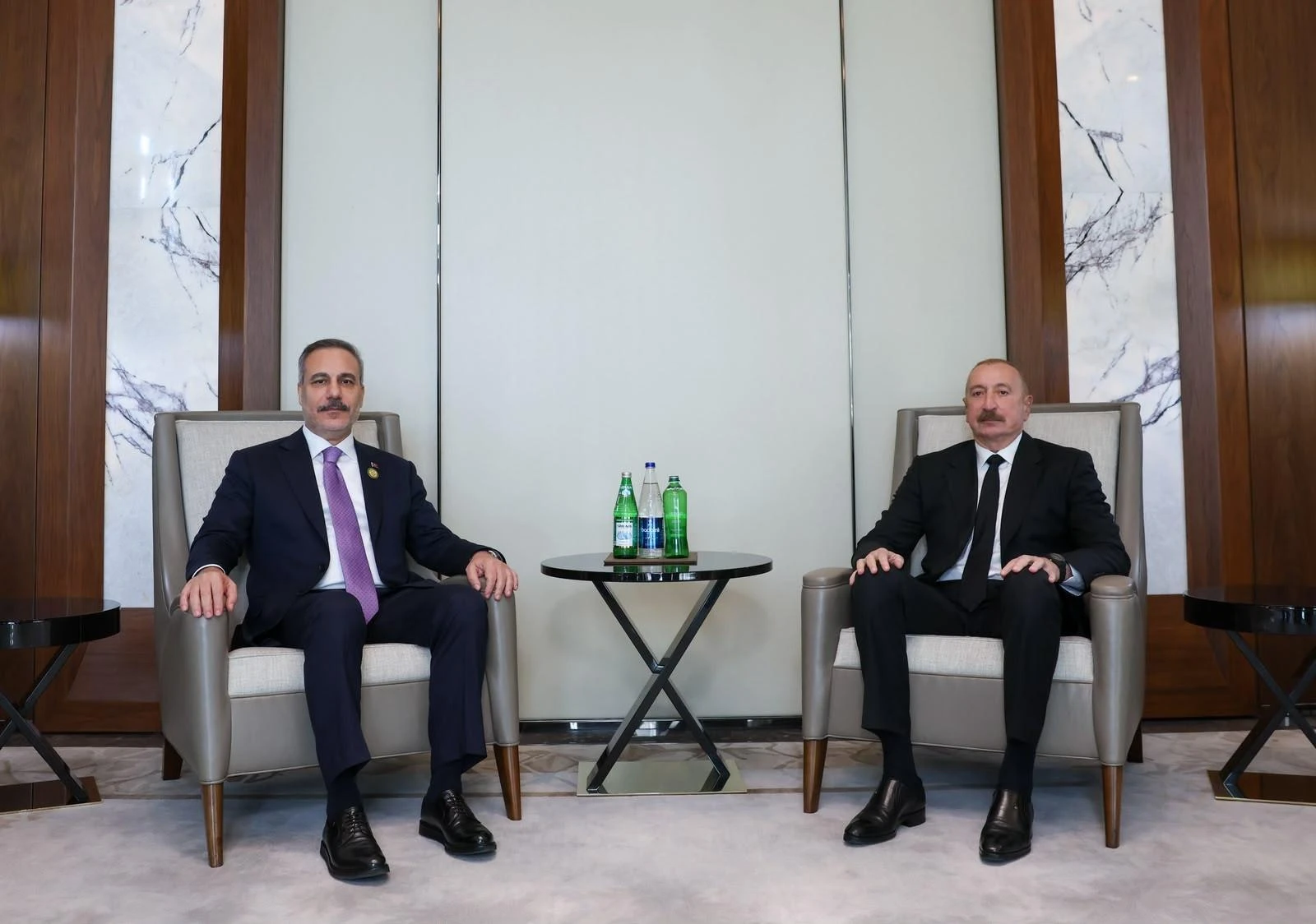
Amid these public statements, a significant regional gathering, the 7th Summit on the Interaction and Confidence Building Measures in Asia, took place in Baku. Turkish Foreign Minister Hakan Fidan attended the summit, representing Turkish President Recep Tayyip Erdogan. Israeli President Isaac Herzog was also present. When Herzog began his speech, Fidan and representatives from several countries left the hall. Another development that attracted media attention was Herzog’s reported journey to Azerbaijan on a commercial AZAL flight that crossed Turkish airspace. Ankara said it had been unaware that he was on board.
Despite these tensions, Fidan’s meeting with Aliyev and his remarks to the press afterwards were significant in showing that the two allies are unlikely to allow their relations to be harmed. Fidan said that the relationship between Turkiye and Azerbaijan rests on firm strategic foundations and should not be worn down by disagreements.
He also outlined priorities that require closer Turkish-Azerbaijani relations. The first is the Middle Corridor, which connects China and Southeast Asia to Europe by passing through Central Asia, the Caspian Sea, Azerbaijan, Georgia, and Turkiye. The second is greater synergy among Asia’s regional cooperation mechanisms.
Turkiye strongly supports Azerbaijan, particularly regarding its normalization process with Armenia and the security of the South Caucasus. Ankara also has its own normalization process with Armenia. Therefore, Azerbaijan needs Turkish support for peace and stability in the South Caucasus, while Turkiye needs Azerbaijan as a key partner in its Caucasus policy.
The US-Israeli war on Iran and its implications for the South Caucasus are also significant factors that pose challenges to regional stability. Azerbaijan and Turkiye are both neighbors of Iran and have sought to avoid being drawn into the wider consequences of the conflict. For both countries, regional instability could threaten their economic connectivity, energy cooperation, and broader geopolitical interests. This makes continued coordination between Ankara and Baku even more important.
Beyond the South Caucasus, Azerbaijan is also a key partner for Turkiye when it comes to Syria. Azerbaijan’s planned natural gas exports to Syria through Turkiye could become an important part of regional energy cooperation and Syria’s reconstruction.
So, are Turkiye and Azerbaijan going to ride out the storm? That is likely given the high stakes for both sides, not to mention their long-standing strategic, economic, and security ties. Turkiye and Azerbaijan are connected not only through a shared history but also through defense, energy, pipelines, and connectivity projects. Their political disagreements are unlikely to change the overall direction of their relationship.
They are likely to compartmentalize their relations in a way that ensures other issues do not affect their foreign policy goals. This will also help maintain their strategic alliance and demonstrate that the two governments do not necessarily have to agree on every issue.
Fidan’s visit and his statements suggest that domestic political disagreements are unlikely to undermine a strategic alliance when both countries need each other geopolitically and geoeconomically. The two countries may have different political views and relationships, but their shared geopolitical interests are far greater than their differences.
In international relations, strong alignment does not require identical domestic policies; it requires the maturity to manage differences through quiet diplomacy without sacrificing common interests. In a fragile region such as the South Caucasus, where interference by Russia, Iran, and other powers can undermine stability, Ankara and Baku will continue to need each other.
Dr. Sinem Cengiz is a Turkish political analyst who specializes in Turkiye’s relations with the Middle East.
X: @SinemCngz


