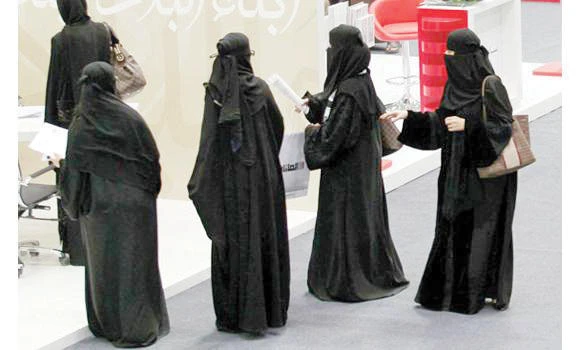
Among 51 percent of Saudi women who are well qualified to work, only 13 percent are employed in the public and private sectors, local media reported. Many of the qualified women hold bachelor degrees.
Women bachelor degree holders account for 64 percent of the total number of graduates from the Kingdom’s universities, and 51 percent of the total number of graduates of Saudi universities and overseas scholarship holders are pursuing diploma, BA, MA and PhD studies.
Experts attribute the poor participation of Saudi women in the labor markets to many factors, mainly the social factor and the reluctance of certain sectors to employ them because of inadequate work environments for them.
Nawaf Dhubaib, an expert and member of the Arabian Society for Human Resources Management, said the Saudi society is still hesitating to allow women to work.
“Therefore, it is not fair to compare male and female graduates and the proportion of their participation in the work force. Many women choose, by their own free will, not to go out and work,” he explained.
He added that this social trend is clearly reflected on the decision-making process of officials. “When the Saudi society demanded the feminization of shops, the decision-makers responded immediately. With the increasing demand for employing women, many sectors are willing to offer them job opportunities.”
Women today want more financial independence, especially as family expenses are on the rise and so they are coming forward to work, he said, adding that sectors that are more likely to provide job opportunities for women in the future include health and services.
“The private sector is faster than the public sector in creating job opportunities for women because its investment sector looks for higher employee productivity,” he said.
He explained that the studies conducted 10 years ago on the levels of productivity of employees showed the superiority of Saudi women, probably because they desperately want to maintain and hold on to their jobs in view of limited employment opportunities available for them.
Mohammad Al-Khunaizi, member of the Committee on Human Resources in Shoura Council, agrees with Dhubaib in that the social factor is the main reason for the poor participation of Saudi women in the labor market, in addition to other factors.
“The government sector did not provide many job opportunities for women either. Here in the council we issued many recommendations to encourage women’s employment,” he said.
He added that the inability to enact harassment laws has discouraged women to come forward and work in mixed environments. “Work environment is still raw, and the salaries in the private sector are low and are not encouraging enough for women to venture out and take up jobs, which has led mainly to the spread of ‘ghost’ employment,” he explained.
‘13% of 51% qualified women employed’