A total of 1.8 million Saudis have canceled their marriage plans after tests showed they were genetically incompatible with their prospective spouses, the Ministry of Health official has said.
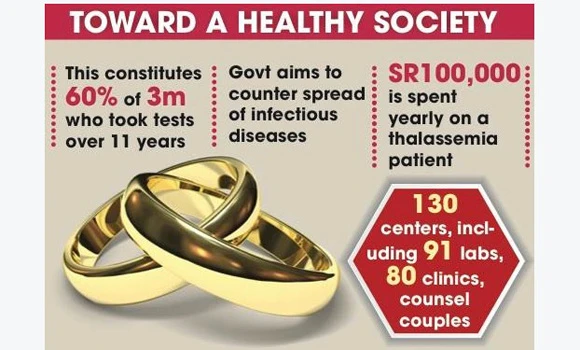
This constitutes 60 percent of the 3 million people who took the required premarital screening over the past 11 years, said Dr. Muhammad Saeidi, director general of genetic and chronic diseases at the ministry.
The ministry aims to counter the spread of infectious and genetic diseases, and in turn reduce the financial burden on the state’s health system, and on families with ill children.
The ministry introduced the tests in 2004. In 2008, the test was updated to include mandatory screening for hepatitis B and C viruses and Human Immunodeficiency Virus (HIV).
Genetic disorders and in particular hemoglobinopathies such as sickle cell anemia and thalassemia are common in Saudi Arabia, especially in the eastern and southern regions.
An estimated SR100,000 is spent annually on a patient suffering from sickle cell anemia or thalassemia, while HIV and bone marrow patients need SR100,000 and SR500,000, respectively.
He said 300,000 couples on average report for these tests every year and that their number is on the rise. There are 130 centers throughout the Kingdom, which include 91 laboratories and 80 clinics for the couples to get counseling. These facilities are manned by 1,120 workers.
“Our target is to reach 90 percent of the prospective couples but so far we have only 60 percent of them under the program,” Saeedi said.
He urged couples to do the test as early as possible, to avoid disappointment if the results turn out to be unsatisfactory.
In a statement on its website, the MOH explained that while premarital screening is compulsory, it is up to the couple to go ahead and marry regardless of the test result. It said the big number of couples who opted out only indicate that people are becoming more aware and concerned of the implications of pursuing marriage despite genetic incompatibilities.