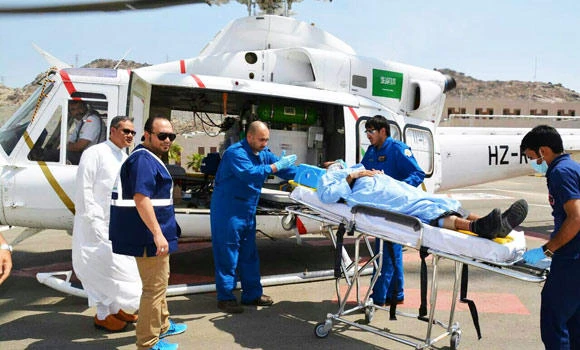
A total of 22,000 medics and paramedics have been assigned to look after the welfare of both local and foreign Haj pilgrims in the holy cities of Makkah and Madinah, according to the Acting Health Minister Adel Fakeih.
The officials will man the Ministry of Health (MoH) facilities located within the holy cities in Makkah and Madinah.
In addition to a fleet of 100 ambulances, the ministry has deployed some 50 mini-ambulances to navigate the crowded areas to ferry patients to the nearest hospital. There are 141 primary health care centers which include 100 primary health care centers and 17 emergency centers near the Jamaraat Bridge (stoning area). “In addition to these facilities a total of 16,000 units of blood have been stored for emergency situations,” said Dr. Hussein Ghannam, general supervisor of the general directorate of health affairs for Haj and Umrah.
Last week, the ministry also introduced its annual phone-in service, ‘Saha Ziyufur Ar Rahman’— Health for the guests of Allah — in the presence of senior health officials of the ministry at its call center in the capital.
The service is available on the toll free number 8002494444 which will greet the caller and subsequently divert him or her to the concerned medical officer. The service in Arabic, is open for the public from 9 a.m. to 3 p.m. Interested parties can also contact the call center via Twittersaudimoh or www.moh.gov.sa for clarifications on health matters pertaining to Haj.
There are 25 hospitals in the holy cities that include seven in Makkah, nine in Madinah, and four each in Mina and Arafat in addition to King Abdullah Medical City. There are a total of 5,250 beds in the holy cities including 500 beds for Intensive Care.
As part of its strategic health program for the Haj, the Ministry of Health has set up a central command center to monitor the health condition of the incoming Haj pilgrims from all parts of the world.
Ghannam said the MoH has deployed health officials at 15 ports of entry via land, sea and air, to monitor the entry of Haj pilgrims during this season. “They are expected to take preventive and curative measures to keep infection, if any, under control,” he said.
He said that the health officials deployed at the ports of entry would ensure the pilgrims had already taken the vaccination from their ports of origin as advised earlier. “If they have not done so, relevant doses will be given to them at the ports of entry so that they would be fortified with immunity against the respective diseases,” the official said. “They would be reporting any developments to the central command committee on a 24-hour basis,” he added.
This year, the center would focus on the Ebola and MERS corona virus during the pilgrimage. “We are monitoring the movement of all incoming pilgrims at all entry points to the Kingdom with the help of our trained health officials,” he said, adding that all health officials serving the pilgrims will wear face masks as a protective measure.
The hospitals and health care clinics in the holy cities of Makkah and Madinah are fully equipped with the required manpower, ambulances, equipment and medicines for preventive and curative treatments.
MoH, through its overseas Saudi missions has already instructed the incoming pilgrims to produce vaccination certificates against yellow fever, meningitis, polio and influenza depending on the countries of origin.
Most of the pilgrims from African and South American continents have been advised to take vaccination against yellow fever which is endemic to those countries and vaccinations against meningitis have been made compulsory for all pilgrims since it can spread due to crowds, coughing and droplets from infected people.
The official said the ministry had spelt out the quarantine regulations of the Kingdom. They include a valid certificate of vaccination against meningitis 10 days before the departure of the pilgrims to the holy cities of Makkah and Madinah, as well as to obtain a certificate of vaccination against polio from pilgrims hailing from the disease-affected countries.
The ministry has taken all preventive measures to combat the spread of the Ebola and MERS corona virus with the help of local and international medical experts including officials from the World Health Organization.
22,000 medics assigned to ensure ‘healthy’ Haj