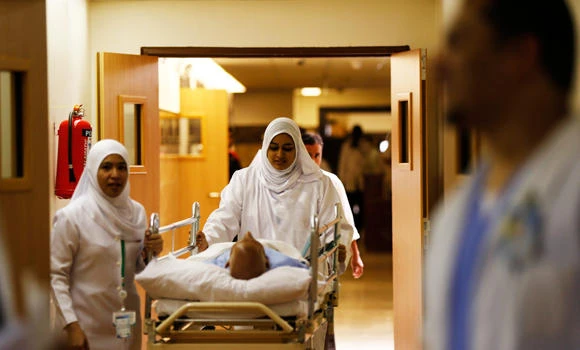
The Ministry of Health (MOH) has trained 40,000 health officials in infection control during the past four months with the cooperation of the World Health Organization (WHO) and the Atlanta-based Center for Disease Control and Prevention (CDC), said a senior official.
Speaking at a workshop on infection control at the MOH, Undersecretary for Preventive Health, Dr. Abdullah Al-Aseeri said the ministry is implementing a series of programs for infection control to adopt preventive measures to protect patients and staff in the medical sector from infection of Middle East Respiratory Syndrome MERS, corona virus and other communicable diseases.
Under this program, Al-Aseeri said his ministry has plans to appoint health inspectors to ensure that the hospitals and clinics have infection control programs within their facilities.
“However, the ministry still lacks qualified personnel to handle infection control. Therefore, we have intensified our program to train more and more people to bridge this gap,” he stressed.
With the cooperation of the Saudi Commission for Health Specialties (SCFHS), he said around 418 hospitals in the Kingdom have been accredited to treat MERS corona virus patients in the country.
“We also have plans to coordinate with the Saudi Aramco which has some cooperation with the John Hopkins University to train Saudis in the field of infection control," said the official.
Some 40 Saudi nationals pass out annually with a diploma in infection control he said, pointing out that the level of skills acquired by the graduates are of international standards and they are carried out at par with the standards maintained in reputed hospitals in the US.
He recalled that the ministry in collaboration with the US hospitals was able to bring the best trainers to educate the first batch of students in a fitting manner.
The graduates received their internship in hospitals such as the King Faisal Specialist Hospital in Riyadh and Jeddah, the King Fahd Hospital in Jeddah, the King Fahd Medical City in Riyadh and the King Fahad Specialist Hospital in Dammam, the undersecretary noted.
“The students were given theoretical and practical training in these health facilities,” he said.
The issue of anti-infection is a major concern in most of the world’s hospitals where patients sometimes develop fatal diseases as a result of bacterial infection.
The diploma graduates are expected to make a useful contribution toward reducing the percentage of wound contamination, transmission of bacteria from person to person and possible inflammation.
In an effort to control infection in the Kingdom, the MERS-CoV Advisory Council was formed by the acting Health Minister Adel Fakeih to develop a set of guidelines to meet the urgent need for up-to-date information and evidence-based recommendations for the safe care of patients with suspected, probable, or confirmed Middle East Respiratory Syndrome Coronavirus (MERS-CoV) infection.
Tariq A Madani is the chairman of the council.
The main bulk of these guidelines have been adapted from previous guidelines produced by the World Health Organization (WHO) and the Centers for Disease Control and Prevention (CDC).
The council members have revised these two documents and made important modifications based on the current epidemiological evidence and the members’ clinical experience in Infectious Diseases.
40,000-strong task force trained to battle infectious diseases