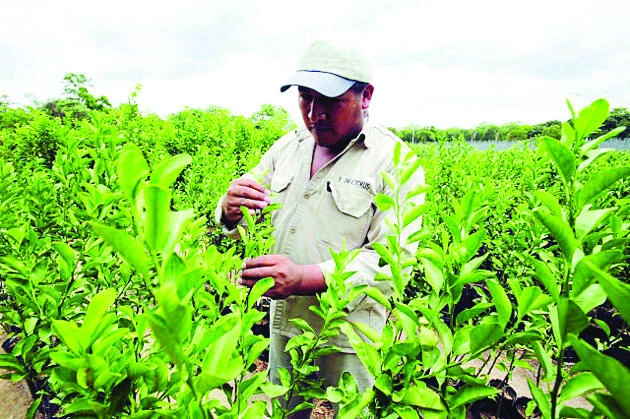
Five percent of all agricultural produce in the Kingdom is contaminated with high levels of insecticide harmful to people, animals and the environment.
This is according to a three-year study conducted by the Ministry of Municipal and Rural Affairs. The study was unveiled at a workshop on “Contaminators and residues in food” by Abdulhakim Al-Jubair, a ministry official.
Al-Jubair said the study included Jazan, Al-Qasim and the western, central and northern regions. The study concluded that 68 percent of 4,000 samples were free from any insecticide residue, 26 percent contained the allowed percentage, while 5.4 percent exceeding the allowed limit. Insecticide residue percentages varied in other studies conducted by the Saudi Food and Drug Authority (SFDA) and the ministry between 2001 and 2005. Rates ranged between 2 and 15 percent at the central vegetable market, which was relatively high in comparison with other countries. For instance, Greece had zero percent residues, and European countries had 4 percent.
Various speakers at the workshop said 99 percent of Saudi fruit and vegetables are sprayed with insecticides. They said there should be a greater focus on producing organic food, but conceded that this was an expensive enterprise.
The study found that Al-Qasim had the most insecticide contamination with 7.52 percent, followed by Jazan with 7.35 percent, the Southern Province with 3 percent, Western Province with 5.08 percent, Riyadh with 4.97 percent, the Northern Province with 4.97 percent, and Eastern Province with 3.91 percent.
Representatives from the Ministry of Agriculture said the country does not currently have laws allowing it to punish farmers for using too much insecticides. However, the ministry has a set of regulations dealing with these chemicals.
The officials said it was difficult to monitor farms because they could not access private properties. There were fewer officials to cover the large territory where farming takes places. The ministry’s work is now limited to educating farmers through workshops, they said.
Speakers also called on the government to pass laws limiting the use of antibiotics and hormones at poultry and animal farms. They said government should set up laboratories to conduct quick tests for antibiotics and hormone residues at all slaughter houses, and should criminalize the use of industrial hormones at poultry farms.
Abdullah Al-Oweimir, a specialist in animal production at the Food and Agricultural Sciences Department, said there are no controls over the use of antibiotics at present.
5% farm produce contaminated