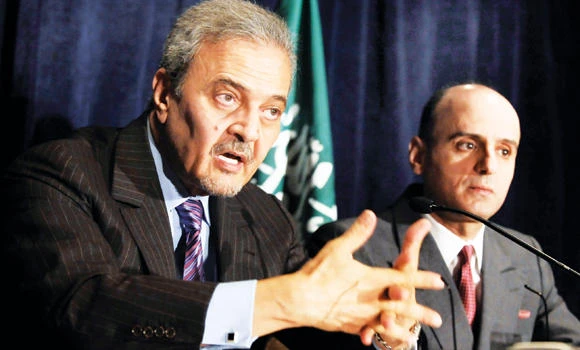
Prince Saud Al-Faisal’s service of almost 40 years as foreign minister is testimony to his incredible stamina and fortitude; a true son of the soil who was relentless in promoting the interests of this country across the globe.
Prince Saud was often described as the “Kissinger of Arab politics,” and the face of the Kingdom.
A political analyst based in the United Arab Emirates recently said: “One of my friends once asked me to describe Prince Saud in one word. I replied, ‘dynamic’ because I have never seen a foreign minister with his level of dynamism. Indeed, his unbridled energy and passion for work were some of his most important and attractive qualities as an individual.”
Those who know Prince Saud are aware of his extraordinary intelligence and uncanny astuteness, which regularly made those gathered at the negotiating table desperate for him to say more. However, he was content to say only what mattered, in a direct and unequivocal manner.
Others are equally glowing in their assessment. “Wherever my post happened to be, Prince Saud Al-Faisal had been my guardian angel,” said Abdulaziz Khoja, former Saudi Ambassador. Former Russian President Mikhail Gorbachev once said: “If I had a man like Saud Al-Faisal, the Soviet Union would never have collapsed.”
Born in 1940 in the mountain city of Taif, Prince Saud was imbued with an intense curiosity that led him to Princeton University in the United States, where he completed a degree in economics. He became a member of the exclusive Ivy Club, whose members included the late President Woodrow Wilson, former US Secretary of State James Baker and former White House Chief of Staff Joshua Bolton.
Initially, his expertise in economics was put to good use in 1964 when he became a consultant to the Ministry of Petroleum and Mineral Resources and a member of its High Coordination Committee. In 1970, he was appointed deputy governor of the General Organization for Petroleum and Mineral Resources (Petromin), and in 1971, named deputy minister of petroleum and mineral resources, a post he kept until King Khaled asked him to become minister of foreign affairs in October 1975.
“A hallmark of Saudi Arabia’s presence on the global stage has been a consistent foreign policy that has not only highlighted its strong alliances with friends but also served to assert the Kingdom’s unwavering commitment to economic development, justice and the tenets of Islam. For nearly four decades, the Kingdom’s primary ambassador has been Prince Saud Al-Faisal,” Arab News Senior Editor Siraj Wahab commented in an analysis piece published in 2008. “During that time, he has represented the views of the Kingdom and helped shape the course of world events, issuing and reissuing the Kingdom’s message of peace for all nations of the world and fair, even-handed treatment for all its peoples,” Wahab wrote.
Musaed Al-Zayani, a senior Saudi journalist based in Dubai described Prince Saud as an encyclopedia of Saudi foreign policy. “Prince Saud is a unique personality who cannot be compared with any others in the world. His contribution to the Kingdom and other friendly countries will be written in golden letters ... Prince Saud ensured Saudi Arabia’s voice was heard in all parts of the globe ... on political, social and economic matters.”
I met Prince Saud in Colombo in 1980 during his visit to Sri Lanka. It was during the late A.C.S. Hameed’s tenure as foreign minister. As the national president of a leading Muslim organization in Colombo, I joined my colleagues in asking for an embassy in the Kingdom and a Saudi mission in Colombo. Prince Saud listened patiently and approved our proposal without any delay.
A man of prompt action on all levels, Prince Saud remains a living legend in the history of Saudi Arabia. We pray that his expertise should be further harnessed for the greater good of this nation. May Allah grant him good health and a long life for us to benefit from his rich experience as a political leader.
A true son of the soil