RIYADH: The number of beggars in the Kingdom has increased, triggering fears that the issue may turn into a phenomenon and cause security, social, health and economic problems, a study has revealed.
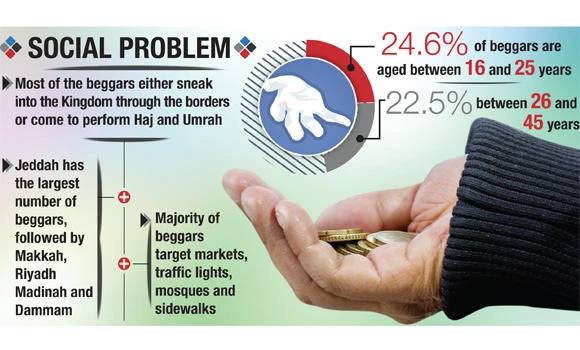
The number of beggars in the Kingdom is on the rise because they sneak through the borders or come to perform Haj and Umrah and stay in the country after their rituals, local media has reported, quoting the study.
Onlookers say that the issue is further compounded by the sympathy shown to them by people, reveals the study, carried out by a social science professor at King Saud University, Musaed Al-Hadeethi, under the title "The Begging Phenomenon and its Social, Economic and Security Impact in Saudi Arabia".
The study showed that Jeddah has the largest number of beggars and that 33 percent of them have been arrested, followed by Makkah with 25.3 percent, Riyadh at 19.4 percent, Madinah with 16.5 percent while Dammam has the least number of beggars with 4 percent.
The study was published by the Islamic Studies Journal and showed that the begging phenomenon isn’t limited to a particular nationality, but is found among Arab, Asian and African nationalities (85.4 percent).
It said that 24.6 percent of beggars are aged between 16 and 25 years while 22.5 percent between 26 and 45 years. "Begging was found to be widespread among males at 84.6 percent, with 52.8 illiterates, while the number of married men reached 56.3 percent of the total."
The majority of beggars target markets, traffic lights, mosques and sidewalks, while some resort to knocking on people's doors, says the study.
The researcher has stated that begging is a phenomenon that is found all around the world, but noted that there are differences in its spread according to the culture of the community.
He has stated that it is an illegal way of making money, and many people use it because it makes for an easy income. This phenomenon has negative impact on the community on all levels, he said.
Al-Hadeethi pointed out that begging has taken many forms in modern times, with some considering it to be criminal, while others viewing it as seasonal, simple, planned or emotional.
Saudi Arabia has witnessed this rising phenomenon and has taken many steps to fight begging all parts of the Kingdom. The study has recommended that all relevant authorities should coordinate their efforts to fight begging in Makkah, Jeddah and Riyadh. They should support these efforts with manpower and equipment, in addition to devising rules and regulations to focus on areas targeted by beggars.
The study recommended that violators of the laws on begging should be punished and said that job opportunities for them should be found in addition to educating the community about the negative effects of begging through visual, audio and written communications.
Begging may turn into a phenomenon