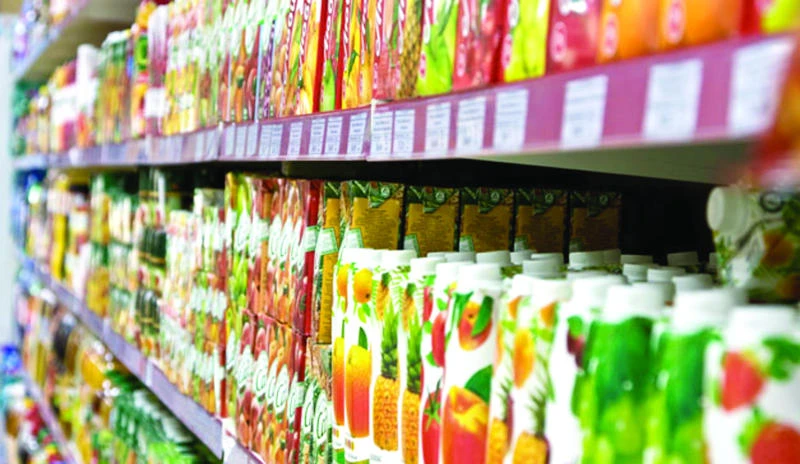
DAMMAM: Juice and dairy companies in Saudi Arabia have increased their production capacity during Ramadan to face rising demands. Munther Al-Harithi, chairman of the Arab Beverage Association, revealed that the increased consumption of juices during Ramadan sat at around 20 to 25 percent in comparison with the rest of the year.
Al-Harithi said this increase becomes apparent in the purchase of many family size containers, and pointed to the increased demand for dairy products because of the customs and traditions followed during the holy month.
He confirmed that the sector is stable in terms of prices regarding Ramadan offers. He pointed out that its difficult to define the volume of Saudi consumption during the holy month because statistics deal with the annual consumption.
A few days before the start of Ramadan, social media websites published a rumor saying there were holes in the internal cover of Tang products, but the rumor was refuted by the Food and Drug Authority saying these holes exist to stabilize the internal pressure of the container and pose no harm to the product’s safety.
Juice companies focus on berry flavor during the marketing campaign this year, calling it a Ramadan drink because Saudi families like to consume it during Ramadan.
Al-Harithi explained that berry flavored juices have a special meaning in Ramadan, and confirmed that demand has increased for all other flavors, too. However, many health experts argue that berry flavored juice, whether concentrated or not, contains artificial colors and flavors that are harmful to the human health.
Recent statistics show that mango juice is amongst the favorite juices during the year, with an annual consumption of 106 million liters, followed by mixed fruit at 91.5 million liters, orange juice with 83 million liters, apple juice at 53.5 million liters, guava juice at 35 million liters and strawberry juice with 30,8 million liters.
Saudi juice companies created new flavors that are expected to compete with traditional flavors at the top of which are peach, pomegranate, pink guava and lemon with mint.
Workers confirm that some flavors failed to penetrate the Saudi market and couldn’t attract consumers, flavors such as melon, pear, berry, red grapes and mandarin.
Prior economic statistics revealed that Saudi Arabia occupies the peak of consumption rates in the Middle East by consuming a quarter of the sector’s production with 24 percent of the total consumption of the Middle East.
Consumption of juices increases by 25 percent