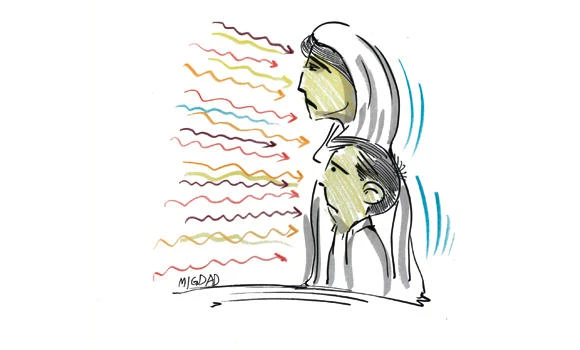
Several experts here say that children, women, the elderly and maids are the most likely victims of physical, verbal, psychological and sexual abuse in the country.
Quoting various studies, they said domestic violence is a behavioral disorder where abusers want to exert power over weaker members of society. This results in families breaking up, and destroying feelings of trust and security among family members. The entire community is threatened when divorces take place, they say.
Sultan Al-Thoban, a psychology expert and member of the domestic violence committee at Asir Central Hospital, said abuse is caused by several factors. “The reasons for domestic violence are related to ignorance, unemployment and drug addiction. Most cases registered in Asir involve violence against weaker family members such as women and children."
He said this abuse takes various forms including incest, denying women their inheritance, or preventing them from visiting their families. "People who abuse women are sadists because torturing others gives them pleasure,” he said.
A recent study on domestic violence prepared by Tawfiq Al-Sweilim, president of the Charitable Organization for the Welfare of Saudi Families Abroad (Awasser), recommended that preventive measures should include anger management therapy, and for husbands and wives to respect each other's rights.
The study said that domestic violence should be solved through dialogue, understanding and self-discipline. It also found that domestic violence was linked to drug abuse, and economic, psychological, social, cultural and religious factors.
It said that those most likely to be abused are women, children, the disabled and the elderly because they cannot defend themselves. The study suggested there was a rise in domestic violence, which might be linked to people having access to new cultures through various media outlets.
The study found that most abused children have poor mental skills and are antisocial. Some also used drugs and alcohol at an early age. Children subjected to sexual abuse have low self-esteem, a need to satisfy other people, suffer from feelings of guilt and have physical symptoms such as headaches and stress.
Al-Thoban said children suffering from behavioral problems, chronic diseases or disabilities are the most vulnerable to abuse.
Abdulhameed Al-Habeeb, head of the psychology and social health unit at the Health Ministry, said government plans to set up a mental health center to conduct research and compile statistics on domestic violence in the country.
He said the ministry took the decision after several victims of "family violence ended up in hospital." He said the ministry does have a mechanism to protect people from violence and abuse. He said 23 centers have been approved to protect children. The latest statistics show that 1,600 cases of violence against women, children and maids were registered, he said.
Maha Al-Mounif, head of the Family Security Program in the Kingdom, said that 41 teams nationwide had recorded cases of violence against children in a national register. She said there should be a way to protect weak members of families. Two programs to protect children are still under study, she said.
Al-Mounif said a free hotline staffed by experts had been established to help children. She said 6,000 calls were received in 2012 despite the fact that the line had not been officially announced.
Wajdi Shafiq, a professor of sociology and expert in family issues, said there should be more educational programs and workshops to help people prepare for married life, and to teach them how to be tolerant and kind toward each other. He said domestic violence is linked to social and economic problems.
Muneira bint Abdulrahman Al-Saud, in her study on the reasons for child abuse, said parents often lie about the injuries of their children when hospitals report cases to the police. She said children are abused by servants, relatives and even neighbors. The study showed that 91.5 percent of children were subjected to physical abuse and 87.3 percent to neglect, psychological and sexual abuse.
Nora Aal Sheikh, a social consultant, in her paper on family violence, said there are no clear statistics on domestic violence, but there is a general feeling that these problems are on the rise. However, she said that field surveys show that violence against women, children, maids and the elderly are increasing. Most of the cases were registered with the police. She said there was an urgent need for programs to counter family violence in Saudi society.
‘Domestic abuse threatens society’s fabric’