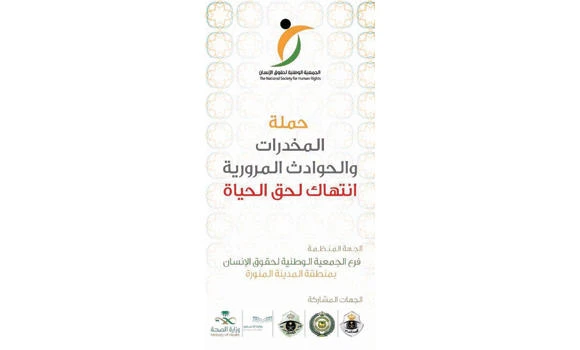
MADINAH: The right to life and physical safety are rights guaranteed by Islamic law, the Sunnah, local regulations, and international treaties, conventions and agreements, said Sharaf Al-Qarafi, general supervisor of the National Society for Human Rights (NSHR) in Madinah.
She said that drugs and road accidents violate the rights to life and physical safety the most, whereas the drug problem is a global problem, not local.
“Saudi Arabia is one of the world’s most targeted countries, as it is the ‘Qiblah’ of Muslims, and has a leading role in the global economy, and enjoys security and stability,” she said.
The effects of drug abuse on physical and mental health are likely to damage the individual to the point of physical and psychological disability, leading in many cases to early death, suicide, insanity, and heart diseases that result in sudden death.”
The other part of the campaign focuses on road accidents. A vehicle is considered a means of freedom of movement guaranteed to all people. However, road accidents can violate the rights to life if misused without following safety and security procedures. Road accidents taking place everyday are a form of infringement of human rights, in terms of deaths, injuries and material damage, Al-Qarafi said.
“Road accidents have serious effects that can be deemed a clear form of encroachment of human rights,” she said.
“The main objective of the campaign is to spread the culture of awareness of the importance of life and the damages caused by drugs and road accidents among the target group, namely young people (boys and girls), first through cognitive changes, then through behavioral changes.”
Al-Qarafi added that the campaign aims at warning and reminding motorists of dangers posed by road accidents and complications resulting from them; educating children, teenagers and youths as road users and drivers in the future, with a focus on sustainable awareness as a continuous education process; and encouraging drug users to apply for addiction treatment; taking confidentiality into account about the people being treated for drug addiction, or those who come on their own or at the request of loved ones; as well as encouraging and motivating civil society, she said.
Al-Qarafi confirmed that the campaign will be carried out somewhere between 30 and 40 days in the field every Sunday and Tuesday, at public schools, private universities and colleges.
There will be a 10-day evaluation of the effectiveness of the campaign through monitoring and measuring the impact/influence by the monitoring team of the NSHR branch in Madinah.
The NSHR has provided a hotline (8664544), and e-mail [email protected], to receive inquiries and questions. The campaign was launched on Tuesday morning at the School of Tourism and Hospitality.
Drugs, road accidents violate right to life: NSHR