The European Union (EU) has taken Saudi Arabia off its list of developing countries with customs preferences and grade it as a high-income economy that would have to pay normal EU duties on its exports starting in January.
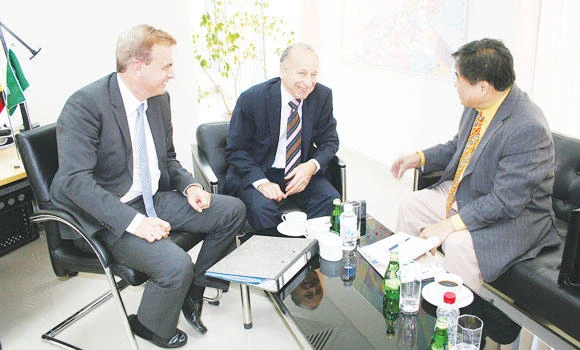
“From then on, only the poorest countries such as Yemen will receive aid from the EU in the form of reduced customs duties,” EU Ambassador Adam Kulach said during a meeting at the Delegation of German Industry and Commerce headquarters in the Saudi capital recently.
Kulach also said the upcoming changes of the EU's generalized scheme of preferences to leading Saudi industry representatives in Riyadh.
He also called for the conclusion of an EU-Gulf Cooperation Council (EU-GCC) free trade agreement as the best solution for Saudi exporters, which forms part of the EU-GCC Invest project.
The project was co-funded by the EU, Eurochambres, Delegation of German Industry and Commerce in Saudi Arabia and Yemen, the German Emirati Joint Council for Industry and Commerce, and the Federation of GCC Chambers.
“The decision to take Saudi Arabia off the list of developing countries is in effect an acknowledgement of the Kingdom's impressive economic progress,” the EU envoy said.
He said that 40 years ago, when the EU started its program of aid to poor nations using customs preferences, Saudi Arabia was a completely different country and its industry needed support.
“Today, it is a G20 member with per capita income of over $25,000, which is more than many EU countries. We have therefore been able now to take the Kingdom off our list, together with 19 other high- and upper-middle income countries around the world,” he said.
Since 1971, the EU has granted exceptionally low customs rates to various countries, including Saudi Arabia. Next year's update of this EU regime, known as the generalized scheme of preferences, is supposed to give the poorest nations better access to European markets by facilitating their exports.
Exporters from rich countries including the United States and Saudi Arabia, will have to pay the EU's usual customs rates.
“Most countries in the world, including the US, Canada and Japan, have already been applying their normal rates to Saudi exports for many years. After four decades the EU is now following suit,” Kulach said.
However, the EU envoy said “he was taking concerns of Saudi business seriously.”
“The best solution for Saudi exporters would be the conclusion of the EU-GCC free trade agreement. Through such an agreement, Saudi industry could benefit from even lower EU duties than those applied during the past 40 years. That would further facilitate Saudi exports, boost the economy and create many jobs for young Saudis,” he said.
The ambassador said the EU-Saudi trade and investment partnership would continue to develop and benefit the economies of both sides.
EU acknowledges progress of KSA