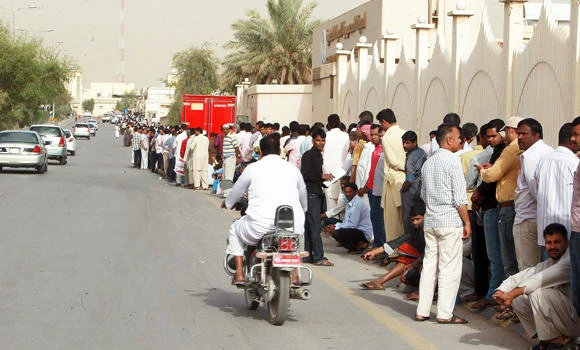
Saudi authorities have stipulated that only expatriates who were in violation of labor laws prior to April 6, the beginning of the grace period, are now eligible for deportation.
Thousands of Asian expatriates who became labor law violators during the seven-month grace period are being held at the Shumaisy deportation center and are unable to leave even though they have no criminal records.
The deportation criteria is creating confusion among the thousands who were unable to legalize their work status between April and November and who see no end in sight to their dilemma.
Thousands of foreign workers were declared as absconders by their sponsors following the announcement of the grace period to avoid incurring penalties and to maintain a clean track record.
Yet such a move has made matters worse for those who were unable to secure final-exit visas during the grace period owing to their inability to acquire paperwork because of their “absconding” status.
This segment of expatriates now finds itself in a quandary with no hope of deportation.
There are currently 10,148 expatriates being held at the Shumaisy deportation center. Of them, 7,165 are men and 2,983 women, according to Col. Badr Al-Saud, public relations director at the Makkah Police Department. It remains unknown how many of these expatriates are eligible for immediate deportation.
Majority of the expatriates languishing at the center come from Pakistan, Indonesia, Bangladeshi and the Philippines.
According to informed sources, local authorities are granting exit visas to Umrah and Haj pilgrim overstayers even after the expiration of the grace period.
For instance, some 350 Indonesians pilgrims were granted exit after Nov. 3. Scores of Pakistanis also managed to secure the exit permits.
Many expatriates who were unable to leave during the grace period have taken to the streets in the hope of being picked up by the police. Indonesian expatriates first staged a sit-in on the Palestine Street. Police and passport authorities arrived at the site and took the illegal expatriates to the deportation center.
Ethiopian youth staged a road blockade on Sitteen Street, also known as King Fahd Road, a few days later. And so hundreds of illegal Ethiopian and Pakistani expatriates rushed to the site in the hope of being arrested.
Around 600 Filipino expatriates were also shifted to the deportation center last November.
Since then, hundreds of Filipino expatriates have camped outside their consulate demanding deportation. However, they failed in view of the new rules.
Diplomatic missions are expressing their helplessness in the face of thousands of requests for deportation.
Fate of many illegal Asian expatriates hangs in balance