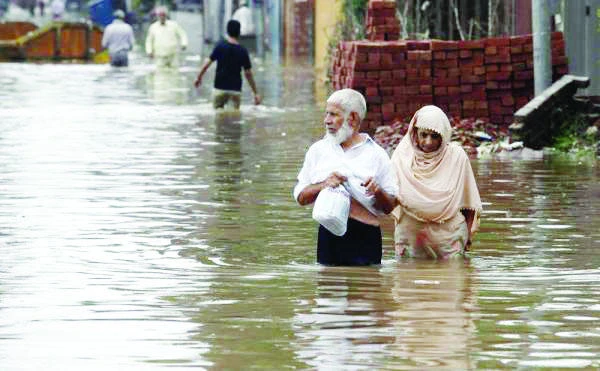
The Pakistani expatriates in Riyadh have expressed concern for their families back home, who have been stricken by devastating floods triggered by heavy monsoon rainfall.
More than 2 million people have been affected by the natural disaster and 300 have been killed.
Farzana Parveen, a Punjabi residing in Riyadh, learned that her sister’s house in Jhelum was completely flooded and her furniture and belongings damaged.
She said that her family lives in a village near the Jhelum River, which also overflowed due to the heavy rains, causing livestock to drown and destroying thousands of homes.
Parveen said that NGOs are providing aid and members from Islamic organizations, such as Jamaat-e-Islami and Jamiat Ahl-e-Hadith are helping flood victims and collecting donations.
Yasmeena Kangoo, a Kashmiri, said that three-fourth of Srinagar is submerged and unabated rainfall is making things worse for the city, inundating three-story houses and left 150,000 people stranded.
Kangoo is worried for her sister, whose house was completely deluged, as well as their family-owned Islamic bookshop, which had many valuable materials that were destroyed.
The government has set up camps for more than 700,000 homeless people, but has failed to provide basic resources or invest in water reservoirs. In fact, only unreliable irrigation systems exist in villages.
Makeshift hospitals have been erected for emergency victims that are facing a major shortage of antibiotics as water-borne diseases spread.
An online initiative was set up by Kashmiri expatriates on social media sites for collecting donations and raising awareness in the Kingdom toward the 4.5 million people devastated by the floods.
Mirza Asif, founder of the initiative, said: “I heard my mother’s voice only two weeks later since the telecommunication services have been destroyed.”
His household hosts six families, who are now homeless, while the Indian army has sent rescue aid for the stranded victims, which is not sufficient.
The response for the initiative has been limited in the Kingdom and internationally, as there are issues of fund transfer because the area is a conflict zone.
Asif said that three to five Kashmiri expats are traveling back home every week to provide aid.
Temperatures in Kashmir are dipping to -20C as winter approaches and people are in desperate need of blankets and warm clothes.
He said that inhabitants are concerned because there is no operational state government since offices remain submerged and world organizations have given a limited response, while Kashmir’s only road link to the outside world remains closed.
Floods in Pakistan concern expats