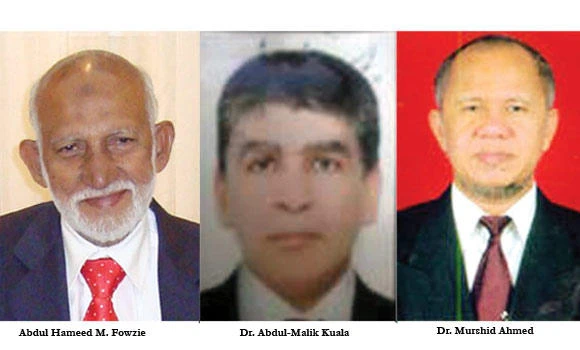
Haj groups leaders have hailed the exemplary health services rendered by the Saudi government during Haj this year.
“The efforts exerted by the Kingdom in the health sector are an honor for every Muslim. The hospitality shown to the guests of God is really unique,” said Abdul-Malik Kuala, head of the Moroccan Haj Medical Mission.
Kuala pointed out that the quality and equality in therapeutic and health services provided to pilgrims were highly commendable.
“The kindness shown by health officials in treating patients was really touching,” he noted, pointing out that patients were happy with the level of health care provided.
He also thanked Custodian of the Two Holy Mosques King Abdullah for the wonderful services offered to pilgrims from all parts of the world.
Ali Ahmed Baqqara, head of the Bahraini medical mission, echoed the sentiment, saying that health officials have done a marvelous job in treating the foreign pilgrims without discrimination.
Dr. Murshid Ahmed, head of the medical office for pilgrims from Indonesia, said that nearly 200,000 Jakarta pilgrims performed Haj this year and made use of the medical services, offered free-of-charge, whenever needed.
Abdul Hameed Mohamed Fowzie, Sri Lankan senior minister for Urban Affairs, described the Haj services as excellent.
“Pilgrims from all parts of the world felt very comfortable with the ways the Saudi officials treated them at the airport and at strategic points,” he said.
Anees Sendi, deputy chairman of the Ministry of Health Command and Control Center, said the overall health status of pilgrims is reassuring.
“So far, so good,” he said.
According to Sendi, no infectious or epidemic diseases have been detected to date.
Likewise, no confirmed Coronavirus or Ebola cases have been reported either.
“As such,” he said, “there is nothing to worry about when it comes to epidemic diseases.”
Sendi emphasized that the ministry kept a close eye on every single suspected epidemic case, be it inside health utilities or even at camps, and addressed such cases as if they had been confirmed until proven otherwise.
“There was a total of 134 suspected coronavirus cases among pilgrims, none of which proved positive upon testing,” he added.
Nearly half a million pilgrims made use of medical facilities that were available within Makkah and Madinah during the Haj season this year, which included 19 open heart surgeries.
Some 22,000 health officials were deployed in the holy cities this year, as well as at 14 land, sea and air entry points.
Some 472,000 pilgrims made use of medical facilities in the pilgrimage areas and at entry points to the Kingdom.
He said that 329,000 pilgrims had visited medical centers in the holy sites and 111,000 had sought outpatient treatment at these clinics.
“A total of 28,000 pilgrims have sought emergency treatment, while 3,700 were admitted to various hospitals in Makkah and Madinah,” he added.
The ministry said that 19,000 units of blood were used to treat patients in the holy areas so far.
Some 19,000 pilgrims were given on-the-spot medical treatment at various points throughout the holy city.
According to statistics provided by the Health Ministry, 988 pilgrims received dialysis treatment, while 330 underwent catheterization and 55 were given endoscopic treatment.
A comprehensive Haj health program was implemented under the leadership of the Acting Health Minister Adel Fakeih this year in cooperation with the World Health Organization (WHO).
The Health Ministry took preventive measures to combat the spread of the Ebola and the Middle East Respiratory Syndrome coronavirus (MERS-CoV) with the help of local and international medical experts, including officials from the WHO.
There are 25 hospitals in the holy cities, including seven in Makkah, nine in Madinah, four in Mina and four in Arafat, in addition to King Abdullah Medical City.
There are a total of 5,250 beds in the holy cities, including 500 beds for ICU patients.
Foreign Haj group leaders hail health services at holy sites