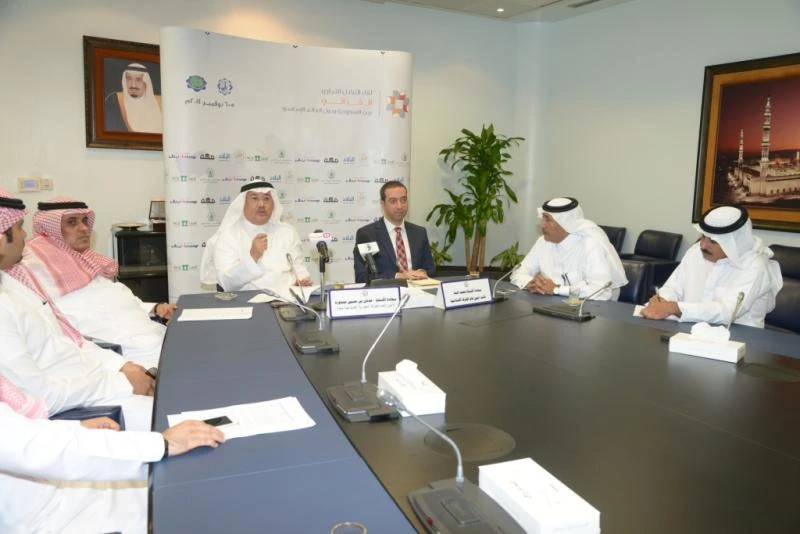
Representatives from the Islamic Chamber of Commerce and Industry and from the Jeddah Chamber of Commerce and Industry (JCCI) officially declared the opening of the First Inaugural Food Forum with the participation of Islamic countries on Nov. 5 and 6 in a press conference on Tuesday at JCCI.
The JCCI joined hands with the Islamic Chamber of Commerce and Industry and Agriculture Industry to gather leading exporters of food in Islamic countries worldwide besides Saudi importers in the forum.
Adnan bin Hussein Mandoura, the JCCI secretary general, said that everyone is well aware that the United Nations is warning of a major crisis looming on the horizon in all parts of the world, and that the Food and Agriculture Organization (FAO) similarly warns that global reserves of grain are dramatically low. “Extreme climate factors are one of the major factors for disappointing crop growth — a fear that will lead to rising food prices and increased risk to disaster events such as famines,” he said.
He noted that the aim of the forum is to bring together the major entities in the Islamic world on one platform, so as to help control rapidly increasing food prices. He said this forum will have positive impact on the food industry, with statistics showing that Saudi Arabia importing more than SR100 billion in food products every year, 10 percent of which comes from Islamic countries, and 90 percent coming from Brazil and the European Union.
“There is a need to diversify sources of food and to make sure that the import of food from Islamic countries will be more beneficial and stronger in the future”, he said.
Mohammed Al-Banna, deputy secretary general of the Islamic Chamber of Commerce, Industry and Agriculture, stressed that the forum will take place within a practical framework where 50 exporter companies representing 6 countries (Egypt, Sudan, Algeria, Kuwait, Uganda, and Niger) will showcase their products to Saudi importers, in order to obtain a reasonable trade between the Islamic countries and Saudi Arabia.
“The Islamic Chamber aims to increase bilateral trade between Islamic countries by up to 20 percent over the next five years, and it is hoped that through this forum value can be added to Islamic countries. This trade will focus on rice, tea, coffee, fruit, vegetables, medicinal plants, meat, poultry, fish, and other key products,” he said.
He said that the three elements that make this forum unique is, first, the presence of Muslim countries having great agricultural and food production potential, second, the sheer size of food imports to the Kingdom and, finally, the significance of halal certification cooperation between the Islamic countries.
Forum to tackle looming food crisis