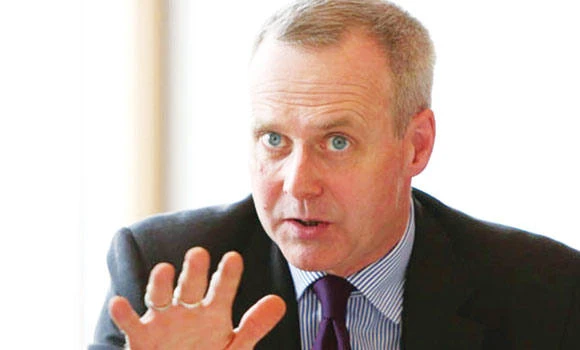
Boris Ruge, a veteran diplomat, took up his position as German ambassador to Saudi Arabia in June this year.
Having previously served as regional director for Middle East and North Africa at the German Foreign Office in Berlin, Ambassador Ruge is well-versed in the Middle East diplomacy and security issues.
The new envoy, who was earlier stationed in New York, Brussels and Sarajevo, shared his vision, plans and policies with Ghazanfar Ali Khan of Arab News in a special interview on the occasion of German national day.
How do you evaluate relations between Germany and Saudi Arabia? Please give detailed answer with special reference to the new developments on bilateral level.
Germany and Saudi Arabia enjoy a very strong and dynamic relationship with very positive developments in many sectors.
Both of us are members of the G20, which gathers the strongest economies and the leading emerging nations of the world.
This role gives us also special responsibilities.
On the political front, we are joining hands to promote peace, progress and stability in a rapidly changing world — including in this troubled region.
Like Saudi Arabia, Germany is fighting terrorism and is sharing the burden in the fight against Da’esh.
How do you evaluate the economic and cultural relations between Germany and Saudi Arabia? What is the total volume of two-way trade and investment?
Our bilateral ties and contacts in both fields are extremely strong and still growing and expanding.
As for the economic relations between Saudi Arabia and Germany, they are excellent and go back a long way.
It was German companies who built the Hejaz railways in the early 20th century, and who since then have been present at every step in the development of the modern economy of Saudi Arabia and the expansion of its infrastructure.
The official bilateral trade balance stood at an impressive number of 11 billion euros in 2013 and has been constantly growing in the last years.
But these numbers do not reflect the entirety of our bilateral economic activities.
The exchange of the traditional range of goods — mechanical engineering and chemical products against crude oil and petrochemical products — continues to play an important role.
But crude oil from the Kingdom and other Saudi exports reach Germany not only through the direct route but also to a much larger extent through other European ports, which means that the Saudi exports are much higher than those published in the trade balance.
While German enterprises have been less visible as general contractors, they are still very much engaged in consortia in the giant infrastructure projects of the Kingdom or act as suppliers for other enterprises.
Payments by foreign general contractors to German sub-contractors may not appear in the German trade balance with the Kingdom.
As for our cultural relations, they are very strong as well and growing. In 2014 Germany was the special invitee for the educational fair. We have had 13 German Universities and Academic Institutions participating in this year’s Exhibition on Higher Education — the largest number ever.
Especially in the cultural field, we see many more opportunities for enhanced exchange.
We were very pleased to see the Saudi Government organizing Cultural Days in Germany less than a month ago.
This has helped to cement a better mutual understanding. In 2015, my country will be guest of honor for the Janadriyya festival.
We are also very proud, that we could establish the German Language Center in Riyadh with more attractive language courses for Saudis for educational, commercial or private purposes.
The new Goethe Language Center in Riyadh offers German language courses for beginners and advanced learners (men and women).
The German International School in Jeddah also offers German language courses for beginners.
Which are the most important sectors of German economy or business opportunities that could attract interests of Saudi businessmen? What kind of concessions German government offers to Saudi and Gulf investors?
There are several good reasons for foreign direct investment in Germany.
Saudi Arabia’s public and private sectors could profit from these investment opportunities.
Located at the heart of Europe, Germany is Europe’s number one logistics market.
A sophisticated energy and communications infrastructure and first-class transportation networks, attractive incentives to all investors, highly developed economic and political frameworks and the good quality of life — Germany is a modern, tolerant, and cosmopolitan society with a high standard of living — as well as our world-class education system are only some of the reasons to invest in Germany.
As for the sectors, for an energy and petrochemicals driven economy like Saudi Arabia, the field of energy and environmental technologies (bioenergy, solar energy, wind energy) as well as chemical and materials sectors might be of special interest.
But fields like electronics and microtechnology, the Life Sciences (medical technology, medical biotechnology, pharmaceutical industry), the Emerging Industries as well as the classical consumer goods and the tourism and leisure sectors offer also excellent opportunities for investors.
How do you see the prospect of Saudi-German commercial relations in days to come, keeping In view the oil-drive economic boom of Saudi Arabia? Which are the new potential areas of bilateral cooperation to your mind?
Today German companies participate in the creation of a modern public transport system for Riyadh as well as in the diversification of the Saudi petrochemical industry.
German companies are among the pioneers of energy technology, and promote the use of renewable energy for electricity generation and water desalination in the Kingdom.
Saudi Arabia puts much emphasis on the creation of a manufacturing industry based on locally available raw materials such as crude oil, gas, or aluminum.
Germany figures among the top investors in the strict sense, as defined by Saudi Arabian General Investment Authority SAGIA.
More and more German companies decide to establish a manufacturing base in the Kingdom (Foreign Direct Investment).
Alone or together with a Saudi partner, they transfer technical know-how to the country, create high-quality jobs, and qualify a new local workforce.
A good part of German companies in Saudi Arabia consists of small and medium-sized enterprises (SMEs).
Such companies form the backbone of German Industry. Often, they are market leaders in their special field.
They are considered as competent, punctual in keeping deadlines, and fair. They are long-standing and highly valued partners of Saudi entrepreneurs.
What is the German position on Syria? Do you share similar views and approach adopted by the six-nation Gulf Cooperation Council (GCC), which still advocate the need to use force to solve continuing civil war in Syria?
The civil war in Syria has destroyed so many lives, has caused so much pain and has destroyed whole families.
Millions were forced to leave their homes and have become refugees. We should never forget that Assad has the biggest part of responsibility for this situation.
German enterprises building on strong commercial ties with KSA