JEDDAH: Studying abroad has many perks — new people, new books, new food, new cultures. It all seems like a fresh start, right until the moment you receive an e-mail reminding you to renew your residency permit (iqama), the expiration of your exit/re-entry visa and, worst of all, your family enjoying their vacation with you stuck in lectures. It is not as problem-free as it sounds after all.
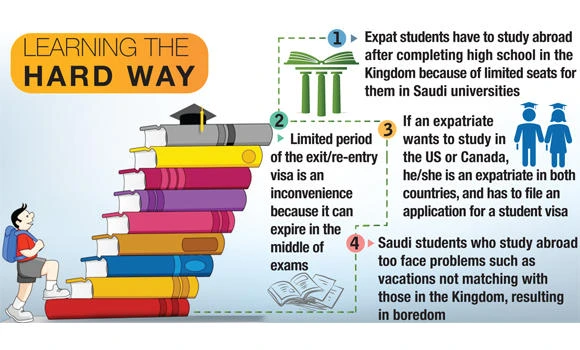
Saudi Arabia has never held back in its provision of excellent education to society. Some of the best schools in the Gulf region are located in the Kingdom, providing globally recognized programs to both Saudis and expatriates. The problem, however, begins once the students have graduated from high school; the usual practice is for non-Saudis to study abroad because there are a limited number of seats for them in Saudi universities.
Destinations, such as the US, Canada and the UK, are very popular in attracting students from the Kingdom, but even if you do manage to get accepted at a prestigious university, you can’t just book a seat on the next flight and leave. As an expatriate in both countries, you must file an application for a student visa before applying for an exit/re-entry visa which only lasts up to six months.
Khaled El-Shareef, an Egyptian studying in Canada, claims that the limited period of the exit/re-entry visa is an inconvenience he could not afford as the typical university year lasts nine months, three more than the visa’s validity. “It expired in the middle of my exams and I had no choice but to let it go or I would have failed,” he said.
He now visits his family in the Kingdom on a limited-validity visit visa, the price he had to pay for his extended stay outside the Kingdom.
It is not just expatriates who suffer. Saudi students who study abroad return home to a different atmosphere due to holidays being at different times.
Noura Al-Aswad studies in Australia, a country where the summer vacation is typically from November to February while Saudi summer holidays are in the months of May to August. Al-Aswad can only afford to come home once a year due to the extremely long journey from Sydney to Jeddah.
Back at home, however, everyone is engrossed in their work. “My sisters had school for a month after I came back, so all I could do was surf the Web and watch TV. Even my parents were at work, so I was at home alone with nothing to do. Holidays literally became a nightmare after a while,” she said.
Al-Aswad had to spend both the Eids without her family, a first for her, which she says brought into perspective the sacrifices one has to make in the pursuit of education.
All is not bad either. One particularly striking story was of Zaffer Shahid, a Pakistani national studying in England. Shahid had completed his A levels in Jeddah and wanted to study Computer Science in California, but sadly, his preferred university turned him down. His secondary qualifications, however, were internationally recognized and so he applied to a British university at the last minute and was accepted.
“I’m so grateful for taking A levels; any other program would have made it difficult for me to apply in various countries. Jeddah has a program for everyone,” he said, adding: “I just wish we had the opportunity of studying at branches of foreign universities in Saudi Arabia.”
Hurdles expats face for higher education