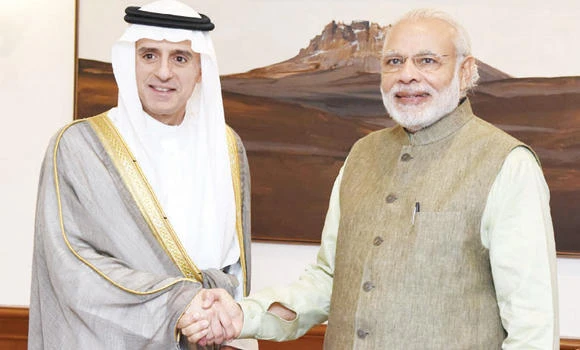
JEDDAH: One of the leading Indian authorities on Saudi Arabia and the Middle East, Talmiz Ahmad, has said Prime Minister Narendra Modi’s visit is the perfect opportunity for India to play a role in encouraging dialogue among countries in the region.
“The region faces two serious issues. The first has to do with terrorism while the second is the scourge of sectarianism. Both are matters of deep concern for India and the people of this region,” he said in an interview with Arab News on Wednesday.
Widely known in diplomatic circles as a walking encyclopedia of the Middle East, Ahmad served as Indian ambassador to Riyadh twice (2000-03 and 2010-11) and it was during his second posting in Saudi Arabia in 2010 that former Prime Minister Dr. Manmohan Singh visited Riyadh.
He is the only Indian diplomat to have been awarded the King Abdul Aziz Medal First Class for his outstanding contribution to Saudi-Indian relations. He entered the Indian Foreign Service (IFS) in 1974 and, after his retirement, joined the corporate sector for three years. He is now an independent consultant based in Dubai and advises Indian and local companies on business expansion and diversification.
Following are excerpts from the interview:
Q: What are your thoughts regarding Prime Minister Narendra Modi’s visit to Saudi Arabia?
A: I welcome the visit of the Indian prime minister. It is taking place just six years after the visit of Dr. Manmohan Singh. I am confident that this visit will carry forward the initiatives that had been finalized during the last prime ministerial interaction with the Saudi leadership and will take into account the interests of both countries in promoting peace and security in the region.
Q: You know the Saudis very well, having been the ambassador in Riyadh twice. What do you think the Saudis expect from this visit?
A: Both India and Saudi Arabia attach the highest importance to the bilateral relationship that has been shaped over the last 15 years. The relationship has a very substantial political and economic content. I believe that the Kingdom will be interested in strengthening these ties, particularly in regard to the area of security cooperation. I think that is going to be the most important item because both countries are concerned about the proliferation of extremism and violence in our region and agree on the need to pool our resources to combat the scourge that has affected the entire region.
Q: We keep hearing that the Saudi-Indian relationship was taken to a “strategic” level in 2010 when Dr. Manmohan Singh visited Riyadh. From a layman’s point of view, what is the difference between an ordinary relationship and a strategic one?
A: The most important aspect of a strategic partnership is the greater political and security content in the relationship. A normal relationship is founded on economic ties and a certain degree of diplomatic interaction but when the relationship moves to the next stage, it acquires a greater security and political content. This includes cooperation in regard to intelligence sharing and also greater defense cooperation. Thus, it denotes a much higher degree of mutual confidence and shared perceptions with regard to the strategic scenario in the region as a whole.
Q: In 2010, when Manmohan Singh visited Riyadh, the region was not in such flux. There was no Daesh then. What impact, if any, do you foresee on the relationship?
A: We have been concerned about extremism and violence for several years. Al-Qaeda emerged as a scourge in our region in the 1990s. India has been under attack by extremists in our neighborhood from 1989, when numerous organizations in Pakistan were mobilized by state and non-state elements to assault India. Daesh is the third generation of terrorists. The first generation of terrorists was from 1980 to Sept. 11, 2001. The second generation of terrorists was from Sept. 11, 2001 up to 2010. Daesh represents the third stage from 2011 onward. It has younger leaders as well as followers. It makes robust use of modern technology. It has now established a proto-state across parts of Iraq and Syria and also stretched its tentacles to targets in the West. These developments obviously pose very important challenges to the security of the region all the way from Pakistan to the Mediterranean in addition to Saharan and sub-Saharan Africa. To complicate the picture we cannot rule out the possibility of terrorists in Pakistan and in other parts of the region coming together and operating under a broad leadership. I think that would constitute a very serious threat to the security of the entire region.
Q: Saudi Arabia has recently formed the Islamic Military Alliance in which 39 mostly Muslim nations have joined. Some Indian commentators have expressed reservations about such an alliance…
A: I don’t think this is a matter of concern for India. Any regional grouping that comes together to combat extremism and violence is welcome. Whether the countries concerned are brought together by their Islamic identity or not is a matter which each country has to consider on its own. I personally see this initiative as an attempt to pool resources in order to combat a shared threat to our region. Also, it is important that Muslim countries take a united stand against the wanton violence perpetrated in the name of their shared faith.
Q: When the late King Abdullah visited India in January 2006, that visit came after a long, long hiatus, spanning decades.
A: Yes, our political relationship is a complex narrative. In the 1940s, 1950s and, even in the 1960s, India and Saudi Arabia had a very strong political relationship. After that, we became divided primarily due to the different options we adopted with regard to our affiliation during the Cold War — while Saudi Arabia was linked to the US-led camp, many observers felt that India was more inclined toward the Soviet one; we obviously saw ourselves as a non-aligned grouping. In any case, the political relationship deteriorated. At the same time, Saudi Arabia built, on the basis of its Cold War alliance, a very strong relationship with Pakistan. After the end of the Cold War, many countries in the region began to take a fresh look at the foreign policy options available to them in the face of new scenarios and new challenges.
Q: What really broke the ice?
A: Saudi Arabia and India reached out to each other to prepare the ground for a good political relationship with the visit of our External Affairs Minister Jaswant Singh to Saudi Arabia in 2001. With this visit, many of the old cobwebs and misunderstandings were swept away. The two countries agreed that their relations would be pursued on the basis of the importance each country directly attached to the other. This understanding enabled us to move forward. This is why, within a few years of this opening, King Abdullah came to India in 2006. Since then, the political content in the relationship has continued to strengthen.
Q: So the breaking of ice essentially came in 2001 when Atal Behari Vajpayee was the prime minister?
A: Yes, that is correct. After External Affairs Minister Jaswant Singh’s visit in 2001, there was a period of great turbulence in the region. The Kingdom was preoccupied with the implications of the Sept. 11 attacks, the subsequent conflict in Afghanistan and the war in Iraq. Once the Kingdom had effectively handled these challenges, King Abdullah’s visit was organized in 2006, when he came to us as the chief guest at our Republic Day.
Q: The Riyadh Declaration was signed in 2010. How do you see the progress on agreements that were signed during that very important visit?
A: I think the promises of the Riyadh Declaration have been achieved to a considerable extent. Firstly, there is very strong security cooperation between our two countries which has benefitted both of us. Saudi Arabia has recognized the danger that the region faces from extremist elements in Pakistan which have been a source of threats to most of the Middle East. Those elements are the ones who launched the Mumbai attacks in 2008. Those attacks fundamentally transformed the understanding of the Gulf Cooperation Council (GCC) states with regard to the threat of terrorism emanating from Pakistan. On this basis, we were able to build a strong security relationship with each other. The second aspect is that both our countries attach great significance to our economic ties. A large number of business delegations have been exchanged and the Kingdom’s businessmen and women have also announced that they are looking at investment opportunities in India. That too, I think, is a significant change. Obviously, the energy-based relationship continues to be the most important aspect of our ties. Saudi Arabia is the No. 1 supplier of petroleum and petroleum products to India. The Kingdom supplies 18 percent of our petroleum requirements. The size of the Indian community in Saudi Arabia continues to expand — we are a little under 3 million and are the largest expatriate community in the Kingdom. The traditional sources of connectivity remain and I think the new areas that are being more vigorously pursued are in regard to the political and security partnership.
Q: You were the ambassador when Dr. Manmohan Singh visited Riyadh. Can you share some anecdotes from that 2010 visit?
A: The most important aspect was that the entire city of Riyadh was organized to celebrate the visit. There was an air of anticipation. Saudi and Indian flags flew from each lamppost. All the senior royals of the Kingdom went to the airport to receive our prime minister. Dr. Singh also had an excellent meeting with the Shoura Council. When he entered the Shoura Council chamber, he was welcomed with loud cheers. His remarks were received with great enthusiasm. At the end, he was given a standing ovation. I was told that this was quite exceptional. He addressed students at King Saud University where he received an honorary degree. He also addressed the Indian community at the Indian Embassy. He spoke at the Council of Saudi Chambers, where a large number of Saudi business leaders were present. Every aspect of a bilateral relationship, political, economic, intellectual, was covered in that visit. It was in every sense comprehensive.
Q: Saudi Foreign Minister Adel Al-Jubeir was in India recently and in an interview to The Times of India he described Pakistan as a historic ally and India as a strategic ally. That is an interesting comment, isn’t it?
A: India does not compete with any other country. The relationship that we have with Saudi Arabia is valuable in itself. This was the decision taken by the two countries as far back as 2001, that is 15 years ago. And we stand by that. There is no zero sum game involved in this scenario. There is of course the strong traditional relationship that the Kingdom has with Pakistan. We welcome that relationship. Indeed, we see it as one that can ultimately strengthen that country’s institutions and ensure that extremist elements that are so dominant in that nation’s fabric are controlled and finally eliminated. So that is something that stands on its own merit. When the foreign minister referred to the strategic partnership with India, he was only referring to the factual scenario.
Q: In 2010, there was controversy surrounding comments by Shashi Tharoor, the minister of state for external affairs, in which he seemed to suggest that Saudi Arabia play the role of a facilitator between India and Pakistan. Is India amenable to Saudi Arabia playing such a role?
A: At that time, there was some misunderstanding in some sections of the media about what the minister had said. He simply stated that we had explained our position relating to Pakistan-sponsored terror to the king and we were hopeful that the king would use his good offices to encourage Pakistan to desist from using extremists against India. I see no problem with the remark, and it is something that I would uphold even today. The Kingdom has considerable influence on Islamabad and it is in a position to actually convey to the Pakistani leadership, both political and military, that the game they have been playing for a long time is a very dangerous one. It has harmed the interests of Pakistan and has disturbed regional security. Also, there are elements in Pakistan which have built a strong relationship with Daesh as well. Therefore, they are a danger not only to India but to the Middle East as well. I would very strongly urge the Kingdom’s leadership to pursue this line as they have done for the last few years.
Q: Despite this strong multifaceted relationship, Saudi Arabia often gets a bad press in India. Some individual cases of abuse are blown out of proportion and sweeping generalizations are made. Saudi diplomats have publicly expressed concern about this attitude. Why do you think this is the case?
A: I feel very strongly that we should not highlight anecdotal events and arrive on that basis at certain conclusions regarding the welfare of the Indian community in Saudi Arabia. The Indian community is 3 million strong; its size has increased rapidly over the last 20 years. In 1982, we were the fourth largest expat community and we are now the largest. Yes, there is a tendency in some sections of our media to highlight individual cases of mistreatment of our workers. I have, however, repeatedly stated — and I continue to do so — that the number of such events is very, very small. The most important aspect of this matter is that both governments are totally committed to addressing these problems, both to prevent them and, whenever they occur, to address them effectively. We have excellent mechanisms for interaction and dialogue in this regard and I think that is the way forward. I personally found no difficulty in dealing with the Saudi officials in the Labor Ministry or in other departments. We have been able to come up with an excellent mechanism for cooperation. Things have improved considerably over the years. You should look at the number of complaints that the two missions in Riyadh and Jeddah receive. They represent a very tiny fraction of the overall size of the Indian community. Indeed, I would say that many of the difficulties with regard to individual cases perhaps have their origin in certain aspects of maladministration at home. We need to improve the situation in India in order to prevent illegal recruitment and the proliferation of illegals; they are the ones who face severe difficulties.
Q: Final comments?
A: The Modi government has recognized the importance of the relationship with the GCC countries. It has already established a very solid partnership with the UAE and it has now reached out to Saudi Arabia. This visit is based on the concerns that we have with regard to security. Security is the most important factor because without security, there can be no development, no prosperity. Now we face two serious areas of concern which are terrorism and sectarianism. There is now a deep divide between certain major countries of this region and this is a matter of concern for India and for many other Asian countries. I think that, given the importance of regional stability for our long-term interests, India should play a lead role in encouraging dialogue among the various countries of the region so that ultimately we can achieve the mutual confidence required for a cooperative security arrangement to be put in place. This would be a diplomatic initiative. It would bring together all the powers, regional and extra-regional, that have a stake in regional security. The vision that I have for the prime minister’s visit is the promotion of dialogue and a cooperative security framework which will embrace the region and put an end to the serious threat of confrontation and violence that South Asia and the Middle East face today.
‘India should play a lead role in encouraging dialogue’