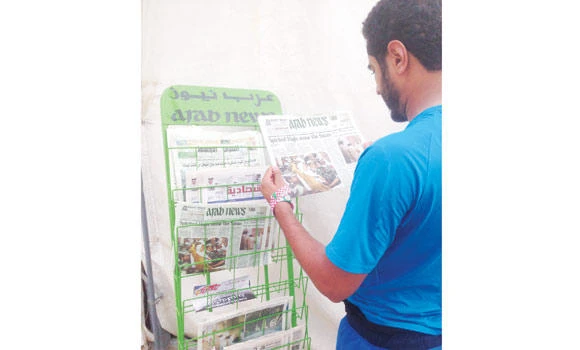
As the revolutionary progress in the various Internet tools continue to overwhelm the world, it is the media personnel who are still mastering the scene every time there is a big event taking place in any part of the world, such as the Haj.
People call them the unknown or ghost soldiers, for the fact that do their job from behind the scenes and work hard to ensure that the message is delivered to the readers wherever they are.
However, not only covering Haj season for many reporters, photographers and cameramen falls within their job as journalists. Rather, it is perceived by many of them as a remarkable religious mission aimed at delivering the message of Islam to the rest of the world.
This Haj season, as was the setup in the previous years, the media delegations are residing in camps hosted by the Saudi Civil Defense Center in Mina and the Saudi Telecommunications Company in Muzdalifah and Arafat.
Although the camps are equipped with A\Cs, beds, refrigerators and furnished with carpets, this doesn’t sound as fancy as it sounds.
The high temperature and the many computers and refrigerators posed an overload to the electric power supply. This caused some AC’s to fail to operate for hours during the day and at night, making it almost impossible to sleep despite the state of weariness and exhaustion journalist would be suffering from running around hunting news down.
Without a doubt, being involved in the Haj season is not an easy job to do whether you are in the services, or the media sector. However, journalists feel the huge burden that falls on their shoulders particularly during Haj.
“It is in the heart of our job to report news to the readers who are eager to learn more about Haj. Having that in mind, we are also doing our best to deliver an important message not only to the Muslim world, but also to non-Muslim communities so they would learn more about Islam,” Majed Al-Mofadhali, a managing editor at Makkah Daily and head of its media delegation to Haj, told Arab News on Sunday.
Al-Mofadhali, like several other journalists, had decided to take the opportunity perform Haj while covering the various rituals of Islam’s fifth pillar.
“This makes it a double burden on me and on other colleagues who are also performing Haj,” he said. “It is not an easy mission on both counts and I only hope that I do my job as good as possible,” he said.
Asharq Al-Awsat’s Fahd Al-Bugami said that as soon as he came back from Muzdalifah he had to visit a clinic after he had skin rashes in certain parts of his body from friction, in addition to blisters on his feet.
Nevertheless, this was not good reason enough to stop him from doing his job as a reporter. “It is a tough mission covering this important Islamic ritual but without the media the larger world would be ignorant of what is happening in this part of the world,” Al-Bugami said.
He elaborated that journalists are professionals working under a code of ethics which includes the need to be fair to all parties involved in any news story. However, journalists, most of the time, work under pressures such as meeting deadlines, checking facts, verifying quotes and most of all pleasing their editors.
“Of course, you will sometimes fail. This is an imperfect world, and journalists are also imperfect. But as far as I am concerned, I will continue to do my job relentlessly,” he said.
The media has a noble message that reaches its peak while covering Haj, Ibrahim Al-Qurashi, from Asharq Al-Awsat, said.
“The Kingdom has done enormous and impressive job in service of the pilgrims. It is fair to say that the world should know what the Saudi government has been doing to facilitate this religious journey of the millions of pilgrims coming from around the world,” Al-Qurashi said.
“We also report any mishaps that we see while covering the various rituals of Haj. We are the people’s window to the authorities and we are the country’s window to the outer world so we try to be balanced in our reporting as much as possible,” he concluded.
Journalists beat all odds in the line of duty