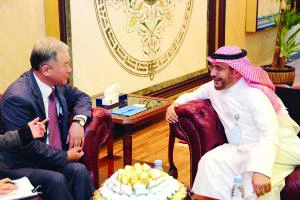
South Korean Ambassador in Riyadh Kim Jin-soo held a meeting with Waleed Hussein Abulfaraj, vice president of King Abdullah City for Atomic and Renewable Energy (K.A.CARE), at its headquarters in Riyadh, and discussed bilateral cooperation in atomic and renewable energy.
Notably, K.A.CARE President Dr. Hashim Abdullah Yamani had visited Seoul with the Saudi-Korea business forum delegation from Oct. 29 to 31, which was aimed at exploring cooperation.
Speaking to Arab News, B. K. Chun, the commercial attache at the Korean Embassy, who accompanied the envoy during the meeting, said: “The envoy met K.A.CARE vice-president in his office and the two sides discussed a range of issues concerning atomic and renewable energy cooperation.
“They reviewed K.A. CARE projects in atomic and renewable energy and discussed areas of mutual cooperation to be explored.”
Chun said: “A comprehensive cooperation in atomic and renewable energy between the two countries is the final objective of this bilateral cooperation.”
Earlier, the two countries reached an agreement in this field and within the context of the agreement on peaceful uses of atomic energy
K.A.CARE signed a cooperative agreement with the Korea Advanced Institute of Science and Technology Research (KAIST) on Nov. 15, 2011.
The work at the human resource level is already in progress as Saudi researchers are being provided with the proper training in this field in South Korea, the official said.
“A number of training programs have been carried out where Saudi engineers have received training at the hands of Korean experts through an atomic energy advanced course arranged for the purpose in Riyadh,” a statement issued by K.A. CARE after the joint meeting underlined.
It added: “Twenty-three Saudi students have also received further training during summer in South Korea, which is one of the leading states in the field of atomic energy.”
According to the Korean Embassy, the Polysilicon Technology Company (PTC) is already working on a poly-silicon plant in Jubail Industrial City, which aims to have an initial production capacity of 3,350 metric tons of solar grade Polysilicon, the main raw material used in the solar industry which is then converted into ingot, wafers and then into solar cells that are put into panels in order to generate electricity from the sun.
Furthermore, Han Hwa, another Korean giant in solar energy, has also taken initiatives to explore options for the alternative energy sector in the Kingdom. As the Kingdom looks forward to promote an ambitious energy program, the establishment of K.A.CARE aims to reduce its dependence on petroleum products to produce electrical energy and expedite the process for atomic and renewable energy to decrease carbon emissions.
Korean envoy seeks atomic energy cooperation