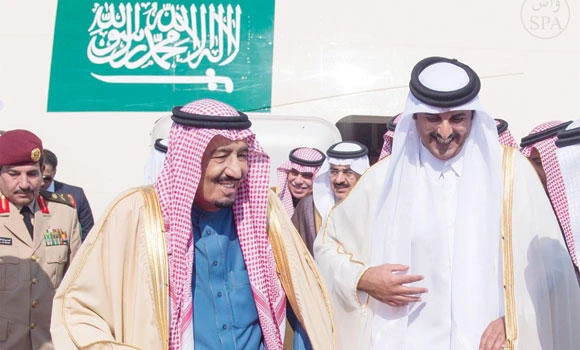
The Kingdom’s leadership has prioritized its efforts and interests in Gulf affairs, and has worked with complete transparency and dedication toward achieving security and stability for the people of the region.
Since the founding of the Gulf Cooperation Council (GCC) in Abu Dhabi on Oct. 21, 2000, Saudi leadership positions have emerged in support of the council and its advancement both internally and internationally.
At the 19th summit in Abu Dhabi, King Abdullah continued to call for increased military cooperation, stressing the need to transform the Peninsula Shield from a symbolic power to an active force for the protection of allies from enemies. He suggested a number of mechanisms for the development of cooperation among leaders of the GCC member states during the 26th session in December 2005 in Abu Dhabi, most notably his recommendation for the Joint Defense Council to study the development of the Peninsula Shield Forces.
Despite increasing calls for military cooperation, Arab and Islamic issues have not been dismissed by King Abdullah, as he has addressed the leaders of the GCC member states continuously about related issues. “If we look around us at the Arab and Islamic world, we see what is happening to our brothers in Palestine, and the bloody massacres,” he said during the 22nd summit in Muscat.
Regarding unity and progress in the Gulf, King Abdullah spoke during the Kuwait Summit in 2009 about the Gulf’s role in supporting greater achievements that satisfy the ambitions of citizens of the Gulf. During the 33rd summit in Bahrain in 2012, King Abdullah reiterated once again his commitment to the alliance of member states and the need to transition from a stage of cooperation toward a stronger and more cohesive entity that works together to meet the aspirations of GCC citizens.
As King Khaled bin Abdulaziz — may his soul rest in peace— confirmed, the council works for the good of the region and does not attempt to harm any actor, as it is not a military alliance against any specific target, nor a political axis against any particular power.
King Fahd bin Abdulaziz — may his soul rest in peace — played an important role in supporting the council since its inception, and took on the responsibility since the third session, which was held in Manama in 1980 to support the council in facing and overcoming difficulties.
The emphasis on strengthening the military alliance among member states continued to dominate the agenda during later sessions. During the 21st session that was held in Bahrain on Dec. 31, 2000, King Abdullah — then crown prince at the time, emphasized the need to develop military cooperation between member states and boost effective self-defense capability of the GCC states. He called for speeding up the pace to establish such an alliance, and called on member states to cooperate more than ever to overcome weaknesses, imbalances, and serve the citizens as best as possible.
KSA committed to Gulf stability