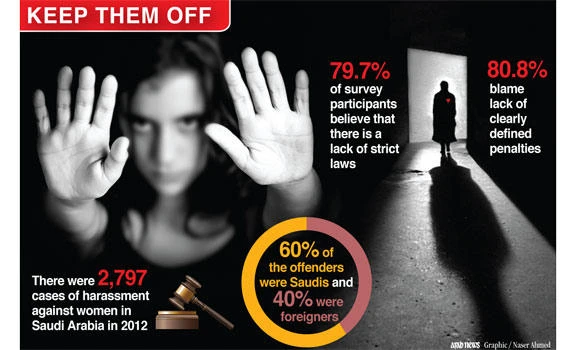
Most Saudis in a poll conducted recently by the King Abdul Aziz Center for National Dialogue believe that a lack of heavy penalties has contributed to an increase in cases of men sexually harassing women in the country.
The survey included 992 Saudi respondents, representing all levels of society over the age of 18 from all 13 provinces. The margin of error was 2.3 percent. It was conducted over the telephone between Dec. 10 and 15.
The researchers found that 79.7 percent of respondents believe that there is a lack of strict laws and heavy penalties that have contributed to an increase in sexual harassment cases in the country. A total of 14.3 percent do not support this view.
A total of 80.8 percent of the participants believe that the lack of clearly defined penalties is one of the main causes of increasing sexual harassment cases in the country.
A total of 76.6 percent also believe that lengthy and complicated court procedures have resulted in women not getting justice, and that the courts do not adequately protect the reputation of victims, especially since their guardians and fathers have to be present during proceedings.
In addition, 73.3 percent believe that lack of awareness of penalties on the part of offenders have contributed to an increase in cases. However, 16.2 percent of respondents do not agree with this view.
A total of 85.5 percent of the sample believe that sick people tend to harass women who use heavy makeup, laugh loudly in public, and go out alone late at night. Only 8 percent do not support this view.
The results also showed that 75.2 percent of Saudis think that the lack of signs at malls, parks and other public places warning people not to commit such crimes, and listing penalties, have increased sexual harassment offenses. A total of 14.3 percent do not support this view while 10.5 percent are neutral.
Many Saudis and expatriates have called on the Kingdom to introduce laws similar to those in the United Arab Emirates where the punishment for any reported harassment is a fine of 500 dirhams, with the offender’s picture published in the media the following day.
A woman lecturer at King Abdul Aziz University said that more awareness programs should be launched to create awareness of sexual harassment.
“We badly need to reeducate our society on what is acceptable behavior in the workplace. Some men in our society regard women as helpless. I think a very important step for women is to be assertive and communicate their needs professionally and directly,” she said. They should not tolerate any behavior they feel uncomfortable with, she said.
Sawsan Hennawi, a social activist, said sexual harassment in the workplace is a sensitive topic rarely discussed even among close friends. “From clinical experience we know that there are scores of people suffering from harassment. I think this is a universal problem for women around the world.”
The survey comes in the wake of a high profile case involving six men harassing women at a mall in Dhahran on Oct. 22 last year, which was captured on video. A Dammam District Court sentenced the men to prison terms of between one and 15 months and lashes.
In 2005, four men were arrested, lashed and jailed for harassing women in Riyadh. There were 2,797 cases of harassment against women in Saudi Arabia in 2012, involving 60 percent Saudi offenders and 40 percent foreigners, according to a news report published last August. Riyadh ranked first with 650 cases, followed by Jeddah with 250, the Eastern Province with 210, Makkah with 180, and Madinah with 170.
Lack of heavy penalties seen in rising cases of harassment